Sunday, July 28, 2013

Different Strokes


Different Strokes

By Tom Wachunas
 

    “Time is but the stream I go a-fishing in.” –Henry David Thoreau


    “The only reason for time is so that everything doesn’t happen at once.” –Albert Einstein
 

EXHIBIT: Adjunct Faculty at Malone University, McFadden Gallery, located in the Johnson Center for Worship and the Fine Arts, 2600 Cleveland Avenue NW, Canton. Open for viewing during regular business hours Monday through Friday. Works by Liz DeBellis, Todd Biss, Heather Bryson, Laura Donnelly, Li Hertzi, Richard Hugget, Susan McClelland, Michele Waalkes, Sarah Winther Shumaker, THROUGH AUGUST 9
 

    Some of you faithful readers may have noticed that of late I’ve not been my usual prolific ARTWACH self. Never before has so much time passed (nearly three weeks!) between posts. The previous one doesn’t really count as it’s not my own writing. No, I’ve not been “on vacation” –  I’ve forgotten what that means anymore. That’s certainly not a complaint, mind you.

    I’m remembering that sobering scene in Dances With Wolves when a trail guide, peering down at a human skeleton that Kevin Costner discovered in the sun-drenched prairie grass, smirks and comments, “Somebody back East is sayin’, ‘Why don’t he write?’” I’ve simply been very committed to other projects which, as life would have it, tend to occasionally collide and greedily feast on my time.

    One casualty of my critiquing hiatus was the most recent group show at Translations Gallery, Those Who Can. While I greatly enjoyed the viewing experience – a thoroughly engaging range of work – I was unable to record here any thoughts. I think that’s been the only show I’ve missed writing about from that important gallery since its inception, and I really do apologize. Tempus fugit.

    Speaking of thoroughly eclectic content, though, there’s still a little time (Monday to Friday during business hours) to take in the excellent Adjunct Faculty Exhibit at Malone University’s McFadden Gallery. I saw the show shortly after it was installed in May, and I mention here just a few of the fine works that have persistently clamored for comment before the show ends on August 9.

    In the past, I found some of Sarah Winther Shumaker’s earlier mixed media explorations, in varying degrees, to be somewhat formally awkward and unresolved. But here, in her sleek stoneware and encaustic wall piece Amalgamation, there’s no such shortcoming. All the variations in texture, pattern motifs, and color work together toward an elegant geometric harmony. It’s a beautifully designed, tactile gem of gleaming symmetry that is at once pristine and earthy.

    Growth, by Liz DeBellis, is a gently crinkled, printed “curtain” of sheer fabric that is more a conjuring of fleeting sensations than it is a solid object. Both veiled and revelatory, its gossamer texture evokes a duality - the cycles of life in bloom and decay.

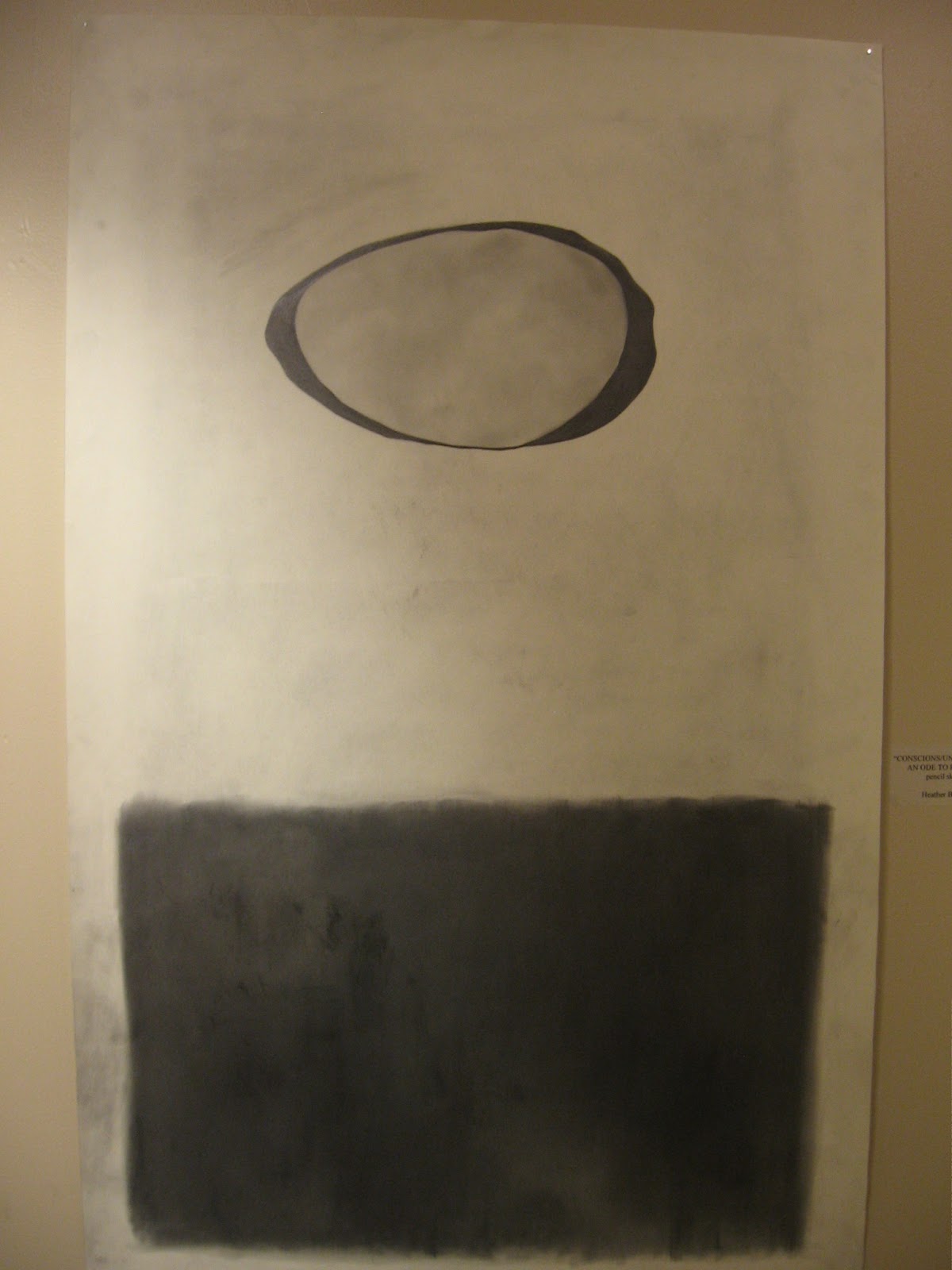
   Most intriguing about Heather Bryson’s Conscious/Unconscious- An Ode to Mark Rothko is how it manages to embody the serene, often somber ethereality of Rothko’s large oil canvases in such an unlikely, counterintuitive fashion. While Rothko immersed us in visual mysticism via fields of subtly undulating color, this intimately scaled homage by Bryson is in pencil – a studied meditation in moody dark grays and soft, misty mid-tones. Mysticism indeed, it’s a haunting picture of the unpicturable.

    On a lighter (though not insignificant) note are the three acrylic ink on canvas entries by Richard Hugget - the refined freneticism of a highly playful imagination. You’ll be reading more about his work in my next entry, I assure you. And I won’t be letting three weeks pass before posting it.


PHOTOS, from top: Amalgamation by Sarah Winther Shumaker; Growth by Liz DeBellis; Dish Rags by Laura Donnelly; Conscious/Unconscious- An Ode to Mark Rothko, by Heather Bryson    

Friday, July 26, 2013

Something New


    I just received this from Craig Joseph, curator of Translations Art Gallery and co-founder of The Parallax Ensemble. I’m passing it on as received. Thanks to all for your attention.
Hello, Friends

    As you may know, this past year was Year One for a theatre group I'm a part of called The Parallax Ensemble.

    We introduced ourselves to the public with the Ohio premiere of a new play by LA-based writer, Anna Carini, called SWEET CONFINEMENT.

    We entertained audiences and raised lots of money for anti-bullying initiatives with a production of the Broadway hit, GOD OF CARNAGE.

    For the past few months, we've been producing live performances of original radio dramas - complete with sound effects and music - for First Friday crowds; this initiative is called THE SOCIAL ANXIETY HOUR.

    We're tackling our most ambitious project yet. A totally new piece, developed by our ensemble, modeled on Thornton Wilder's OUR TOWN and based on interviews we've collected with people around Canton, Ohio

    We'd love if you could help us out in two ways.  Check out all the details at the link below and if you feel so moved, please contribute.  ANY amount helps.  Then, if you'd be so kind, tweet and post on Facebook and share the link wherever you can to let the community know that we're developing a piece all about them.


   And THANKS so much!  Feel free to contact me with questions


   caj

   Craig Joseph, Curator

   Translations Art Gallery

   331 Cleveland Ave NW

   Canton, OH, 44702

Wednesday, July 10, 2013

Natura Reformati


Natura Reformati

By Tom Wachunas


    “The artist and the photographer seek the mysteries and adventure of experience in nature.” –Ansel Adams

  “Art not only imitates nature, but also completes its deficiencies.” –Aristotle

   “I am at two with nature.” –Woody Allen

   EXHIBIT: Lux Botanica: The Photography of Doug McLarty, at the Canton Museum of Art, THROUGH JULY 21, 1001 Market Avenue North, Canton

   www.cantonart.org  330.453.7666             www.signaturefocus.com


    Part whimsy, part high drama, the botanical imagery of photographer Doug McLarty is wholly enthralling. The wondrous theatricality of his configurations brings to mind this observation from Guillarme Apollinaire: “Without poets, without artists, men would soon weary of nature’s monotony.”

    There’s certainly nothing monotonous about McLarty’s delightfully unique take on plants, flowers, seeds and the like. His compositions, set against solid black grounds, often appear to be intricately sculpted entities, exuding an otherworldly aura.

    The heightened dimensionality and focus of detail, astonishingly crisp and vibrant hues, and sharp illumination of the forms are all the result of a working technique which the artist calls Scanography. His explanation of the technique is posted with the exhibit, described in part as a process “…of capturing digitized images of objects for the purpose of creating printable art using a flatbed “photo” scanner with a CCD (charge-coupled device) array-catching device.” Sheesh. Such technospeak is so far beyond my understanding that it might as well be alchemy.

    And indeed, the net effect of McLarty’s wizardly method is nothing short of magical. Several of his images are mesmerizing in a way somewhat reminiscent of the playfully surreal works by Giuseppe Arcimboldo, the 16th century Italian painter who made portrait heads comprised of fruits, flowers and vegetables.  

    One resonant function of art derived from nature has been not so much to merely imitate it as much as shape and sharpen our attentions to its power of evocation, its power to make us sense things beyond the obvious, or monotonous. It’s not about improving on nature per se (a fool’s errand if ever there was one), but improving our ability to see in the fullest sense of the word. In McLarty’s photographs, marvelously presented forms seem to vibrate as if to music, or recite wordless poetry.

    After seeing them, I’ve acquired a renewed, celebratory appreciation for the wild gathering of textures and myriad shapes that are currently dancing together in my vegetable garden.


    PHOTOS (from top): Toucan Island; Scheherazade; Supremes  

Monday, July 1, 2013

A Persistent Theatre of Self


A Persistent Theatre of Self

By Tom Wachunas 

    EXHIBIT: Snap! In the Photobooth with Warhol and Friends, at Massillon Museum, THROUGH OCTOBER 13, 121 Lincoln Way E., downtown Massillon

(330) 830-4061  www.massillonmuseum.org


    “My work has no future at all. I know that. A few years. Of course my things will mean nothing.”  -Andy Warhol

    “I have nothing to say and I am saying it…”  -John Cage

    Among the many ironies about Andy Warhol’s work is that while it was originally a deliberate undermining of traditionally lofty Western art standards and practices, it remains nonetheless present in many art museums worldwide. Of course he wasn’t the first to throw down such a daunting cultural gauntlet and garner a place not only in our most revered art institutions, but in the history books as well. For that we can look to the mischievous French artist, Marcel Duchamp, who during the early decades of the 20th century, farted in our general direction with his “readymades.”

    Prior to the time Warhol made his entry on to the art world stage, the term “pop” had already emerged in the contemporary art lexicon, thanks to critic Lawrence Alloway’s championing artists such as Eduardo Paolozzi and Richard Hamilton, who were among the founding members of the early 1950’s British Independent Group. Just a few years after, in New York City, Jasper Johns and Robert Rauschenberg were also seminal influences on what would become “officially” called Pop Art by 1962.

    Speaking of seminal influences, this Massillon Museum exhibit is a finely organized record of how Warhol melded the technology of “instant” photography with advertising design and methods which became so central to his oeuvre. Keep in mind, though, that the photo booth and Polaroid portraits gathered here aren’t uniquely or formally “beautiful” photographs in the “high art” sense of the word. And for that matter, the nature of Warhol’s portraiture in general was far more formulaic and mechanical than emotionally powerful. Additionally, his legacy is as much about his attitude as it is his manufactured objets d’art.

    Some Warholisms are posted throughout the exhibit, such as “I want to be a machine..,” and, “Isn’t life a series of images that change as they repeat themselves?” Those words are revealing enough as to his motivations and methods.

     Warholisms, by the way, are his pronouncements about life and art that have surely taken on a life of their own, and arguably more significant than many of his works. But like his works, on the surface his words still possess a breezy, even theatrical simplicity. Underneath, though, there’s a calculated gravitas, glibly disguised as banality and naïveté. Warhol was, among other things, a Dadaist provocateur who could be maddeningly changeable and ambiguous. In 1979 he amended his iconic 1968 utterance about fame to, “I’m bored with that line. I never use it anymore. My new line is, ‘In 15 minutes everybody will be famous.’” (italics added)

    Whichever version of 15 minutes of fame you prefer, to the extent that Warhol’s work was a celebration of celebrity itself – our consumerist society’s insanely elevated narcissism – his words were hauntingly prophetic. Today, we have all manner of social media stages on which to play out our lives and sing the praises of us, making our selves instantly known to countless “friends” and strangers.  

    In this context, think of photo booth image strips as a Facebook prototype of sorts. As objects, they’re generated by a machine one might call a mini-factory, bringing to mind Warhol’s legendary Factory that churned out his silkscreen “paintings” and lithographs (among many other enterprises) between 1962 and 1984. The analogy isn’t so far- fetched if you consider those who step into a photo booth as similar to Warhol’s Factory workers (dubbed in their day “Warhol’s Superstars”), collaborating in assembly line fashion to make his serial images.

     Better yet, think of the photo booth (there’s one in the Massillon Museum lobby) as a miniature theatre – an intimate, curtained stage allowing you to indulge the notion of self- image. Here you are at once director and actor. It’s a space that seems to have the intrinsic capacity for encouraging role-playing, acting out, or posing in an adopted persona, as is evident in Warhol’s self-portraits. The photo booth is a place where you can inpersonate yourself, so to speak - where you can be a legend in your own mind.

    Keep in mind another Warholism: “I’m afraid that if you look at a thing long enough, it loses all of its meaning.” Warhol the prophet speaking?  Still, your personal photo strip could be a document of your own celebrity, however fleeting it might be.

    Say… for 15 minutes?

Friday, June 21, 2013

Ravishing Retro


Ravishing Retro
By Tom Wachunas

    EXHIBIT: Flemish Pearls: 35 Paintings in the Flemish Technique, at The Little Art Gallery, located in the North Canton Public Library, 185 North Main Street, North Canton, THROUGH JULY 13  http://www.ncantonlibrary.com/?q=little_art_gallery

    “These are pictures with a pulse, drawing us deep below their mirror-smooth surfaces. We become delightfully lost in their ethereal subtleties…”

    That quote is from a review of painter Frank Dale’s work posted here back in 2009. Here’s a link, and I respectfully ask you to click and read before proceeding any further:  http://artwach.blogspot.com/2009/08/palpitations.html  And as long as I’m playing the role of taskmaster, just for good measure, go ahead and read this one from 2011:  http://artwach.blogspot.com/2011/04/giving-past-future-in-present.html

    One adage that I have come to understand over many years is this: You’ve got to give it away to keep it. It’s a philosophical gem that can apply to everything from contentment and spiritual healing to practical wisdom and knowledge. And it’s in the realm of knowledge, passed on from a teacher to his students, where this show resonates in a most edifying way.

    Frank Dale’s aesthetic spirit is passionately immersed in the Flemish painting methodology and the demands that come with it. Among those are impeccable drawing skills along with the application of transparent oil paint glazes to produce  luminosity so heightened that colors don’t so much rest atop the painting surface (usually glass-smooth wood panels) as they seem to breathe underneath it.

    This compelling exhibit includes several of Dale’s works. They offer us stunning evidence of his utterly empyreal handling of the Flemish technique. He presents the method quite concisely in the guide book he authored, A Search For Beauty, which is available for purchase directly from him at dulcipix@ameritech.net or through gallery curator Elizabeth Blakemore at gallery@northcantonlibrary.org . The lion’s share of this exhibit, however, belongs to 30 of his students (he’s been giving private lessons since 2002).

    Within that group there is a considerable range of ages and artistic experience. The same can be said of pure skill levels. Which is to say that yes, some painters are more successful than others in the discipline of drawing (what the exhibit juror, Dino Massaroni, prefers to call “shape control”) and nuanced paint application. But overall, there’s plenty of evidence here that Dale is an effective teacher. And what is most wondrously apparent in his students’ portraits, still lifes, florals and landscapes is the achievement of an ineffable candescence – surely a magical lustre – so characteristic of the technique.

    One of the more accomplished still lifes is Reflection by Murli Narayanan (Best In Show). The lavishly detailed textures of wood, stone, galss and metal are a masterful demonstration of trompe l’oeil illusionism. Similarly spectacular is Josette Meade’s charming Memories of a Special Night (Third Place).

    Amid the many traditional subjects addressed in this show are some images that have a relatively more modernist theme. There’s at once a Baroque and Surrealist theatricality about Erin Mulligan’s fanciful creatures (part bird, part cat) in Poetry of Deception (First Place). The Eye of God, by Mary Lange, is startlingly like a glossy photograph of a feathery stellar cloud or cosmic explosion, with diaphanous colors that are nothing short of…heavenly.

    Though The Bridge, by Gregory Giavasis, is one of the smallest entries in this collection, the artist manages the picture plane in an expansive way, with a remarkable sense of variation in textures and mark-making in his brush work. In some ways the piece is an elegant suggestion of Monet’s garden paintings, and even more remarkable when considering that Giavasis is all of nine years old. Talk about precocious youth… 
  
    While it was the 15th century Northern Renaissance masters who perfected and left us an unearthly gift of their vision and methods, it’s gratifying to know that Frank Dale is more than a solitary inheritor of an important legacy. Call him a torch bearer, generously lighting the way for those gifted artists such as we see here. Hopefully they will continue Dale’s practice of giving that legacy away so we can keep and cherish it.

    PHOTOS, courtesy Elizabeth Blakemore (from top): Girl with a Pearl Earing (after Vermeer), by Frank Dale; The Bridge, by Gregory Giavasis; Memories of a Special Night, by Josette Meade; Reflection, by Murli Narayanan; The Eye of God, by Mary Lange  

Saturday, June 15, 2013

Suspended Animations


Suspended Animations
By Tom Wachunas

    Exhibit: Eco – New Work by Steve Ehret, at Translations Art Gallery THROUGH JUNE 29, 331 Cleveland Avenue NW, downtown Canton. Gallery hours are Wednesday Noon to 9 p.m. / Thursday-Saturday Noon to 5 p.m.

    In the past, the scenic content of Steve Ehret’s paintings was that of a fantastical, surreal world typified by bizarre landscapes wherein bonhomie and malevolence seem to coexist. It is a world where bug-eyed biomorphs reign supreme as they mingle (and occasionally collide) with other beings both goofy and goulish. While these characters could elicit our laughter at their theatrics, they could just as often conjure nightmares.

    In this new crop of 12 very imaginative oil landscapes on wood panels, however, there’s not a monster to be found. Nor, for that matter, are there any beings, benevolent or otherwise, who might be identified as residents of the otherworldly panoramas Ehret depicts here.

    But as the title of the show implies, there’s plenty of evidence that some sort of population lives in and interacts with these environs. Beyond their occasional evocations of Tolkien’s Middle-earth, these locales have a history of their own. Titles of the paintings, such as Franklin’s Cave During Autumn, or Stew’s Landing, or Blue Ridge, Years After the Landslide, give us the sense that we are traveling in an ongoing narrative.

    Greatly enhancing this sensibility is the inventive presentation of the work. The paintings are suspended from the ceiling. We don’t simply look at them in the traditionally linear way so much as visit, walking through and among them. The experience is somewhat cinematic. It’s all a wholly engaged unfolding, a magical tour of changing seasons, variable light and atmospheres, shifting geographies and whimsical architectures.

    Ehret’s technical style of fantasy naturalism isn’t overly fussy or obsessively detailed. Unburdened by picayune concerns of hyper realism or trompe l’oeil illusionism, the paintings are nonetheless convincing images of enchanting realities. These are, after all, paintings, and Ehret lets us know as much with facile, fluid brushwork that infuses his surfaces with a remarkable lyricism. 

    Exciting travel plans and vacation getaways have always been a commonly encountered subject in my summertime conversations. But personal “vacation” and “travel” in that context have been absent from my vocabulary for… years. Still, this year I’m quite content to savor an adventuresome visit to the mind of Steve Ehret.

    PHOTOS (from top): Franklin’s Cave During Autumn; Islands Of Del Mar; Snowed In At Blue Hen; installation detail  

Tuesday, June 11, 2013

Personal Capitulations


Personal Capitulations
By Tom Wachunas

    “The creative process is a process of surrender, not control.” –Julia Cameron

    Exhibit: Surrenderings at Lynda Tuttle’s Art Center, THROUGH JULY 25, 209 6th Street NW, downtown Canton. Gallery hours: Wednesday and Thursday Noon to 5 p.m. / Friday Noon to 7 p.m. / Saturday 10 a.m to 3 p.m.  Participating artists: Bill Bogdan, Karen Bogdan, Margene May, Sandy Paradis, Clare Sikora, Amy Tuttle, Lynda Tuttle, David Whiteman, Nicole Wong, Charlene Snyder, Lynda Rimke.   www.lyndatuttle.com

    Lynda Tuttle, owner and curator of Lynda Tuttle’s Art Center in downtown Canton, offers this definition of surrender for her latest group show of 11 local artists, titled Surrenderings: “The act of laying down an inner desire or will for the greater choice before us. Gut wrenching and painful, glorious and freeing…” 

    The operative theme here (and for that matter the look of the art) isn’t about illustrating disastrous outcomes or the frenzied waving of white flags amid abject defeat. The art, in a wide array of media, addresses something more subtle and deeply personal – maybe even noble. Call it a submission to, or acceptance of phenomena or circumstances beyond the artists’ personal control. These works, each accompanied by a statement from the artist, are essentially confessional in nature.

    Among the more resonant works here are three self- portraits in pencil by Lynda Rimke. They’re simple yet disarmingly candid explorations of her medical condition called stereo-blindness. I get the sense that she’s not looking out at the viewer so much as carefully navigating the act of seeing. The mirror becomes her lens on an inward journey. 

    Clearly more outward-focused are the two sumptuous quilt works (collectively called Inception) by Karen Bogdan. Their surfaces shimmer with iridescent colors and metallic thread. Interlocking and overlapping organic shapes suggest waves of cosmic energy and clouds of light emanating from a central source – God in the act of creation. You might call them contemporary devotional icons, or close encounters of the divine kind.

     The large, surreal black and white woodcut print called Shadows by Bill Bogdan (Karen’s husband) is at once earthbound and ethereal. The composition is an intriguing mix of symbols which seem to embrace the notion of existential impermanence – things, ideas, and people appearing and fading away with the passage of time. The persistence of change. 

    One fascinating twist here is Bogdan’s presentation of three smaller prints below the large main image. These smaller images are actually sections pulled from the original block. Two of those sections are upside down, so that what were images of “buried” forms in the large landscape above now appear to rise upward in perhaps a reference (taking a cue from the cross on the horizon in the large print) to the cycle of death and resurrection.

    A consistent trait of Bogdan’s prints is their simplicity and rawness of drawing (cutting) along with the integration of visible grain patterns in the wood block. Another characteristic is the variability of saturation in his blacks. He hand-rubs his prints, which can result in a blotchiness that tends to give the imagery a diluted look - something I’ve regarded as mildly problematic in past pieces. Interestingly enough, though, these specific aspects work well together in Shadows, further imbuing the work with its strong sense of eerie transience.

   When you visit this gallery, you’ll no doubt notice that Lynda Tuttle has assigned a significant portion of her wall space to ongoing exhibition of Margene May’s stunning, 2-D fiber portraits. But May offers another particularly compelling work in the Surrenderings show with her first venture into 3-D portraiture.

    Her Surrender is a sculpture comprised of two pre-formed mannequin heads collaged with beautifully patterned pieces of black and white fabric. Prompted by the challenges faced, so to speak, by a single parent raising a child, the work depicts a mother and daughter. As in her wall pieces, May achieves a remarkable degree of subtle facial expressivity with her materials.

    Notice, then, the faces. Mother is quietly somber, yet neither disconsolate nor hopeless. Her eyes are fixed in a gently contemplative, downward gaze, as if measuring her forward progress into uncertain territory. Daughter looks ahead with the slightest hint of a smile crossing her lips, secure and serene for the time being.

   Sweet surrender indeed. It is a moment most exquisite. 

    PHOTOS (from top): Surrender by Margene May; Inception, quilt by Karen Bogdan; Shadows, three woodcut prints by Bill Bogdan