Monday, June 24, 2019

At the Crossroads of Built and Breaking


At the Crossroads of Built and Breaking

"The Life You Save Might Be Your Own"

"The Habit of Being"

"Everything That Rises Must Converge"

"The Violent Bear It Away"

"The Enduring Chill"


By Tom Wachunas

   “No structure, even an artificial one, enjoys the process of entropy. It is the ultimate fate of everything, and everything resists it.”
― Philip K. Dick, from Galactic Pot-Healer

   “Just as the constant increase of entropy is the basic law of the universe, so it is the basic law of life to be ever more highly structured and to struggle against entropy.”    - Václav Havel

      EXHIBIT: DRAFTING Dimensions – Contemporary Midwest Ceramics / On view through July 21, 2019 at The Canton Museum of Art (CMA), 1001 Market Avenue North, Canton, Ohio / 330.453.7666 / Viewing hours: Monday – Closed; Tuesday - Thursday - 10am-8pm; Friday - Saturday - 10am-5pm; Sunday - 1pm-5pm /


   In his eloquent website statement (click on the link above), Peter Christian Johnson has written that his sculptures are “…a meditation on entropy that uses architecture as a foil to examine the dichotomy of beauty and loss. I am interested in transformation, which is expressed in both destruction and growth…”

   In its broadest meaning and applications, ‘entropy’ is a measure of randomness or disorder. It’s generally recognized as a “law” or a given condition of any closed system, including the universe. In layman’s terms, things put together fall apart.

   You can get a good idea of Johnson’s working procedures by looking at the  two large wallboard panels covered with with his initial rough sketches, with some of them further refined through computer designs, and photos of various structures and sites that inspire his clay forms. His finalized ceramic objects can suggest any number of architectural forms - from elaborate urban towers, trellises, or bridges, to cathedral apses and naves. Made with delicate sticks of white porcelain, they appear to be bent by a confluence of heat and gravity. Are these intricately regulated configurations in the process of being covered by those irregular globs of colored glaze that look like a skin forming? Or are these meticulously constructed, pristine frameworks breaking free from such constraints?

   A particularly interesting aspect here is the way in which the objects are presented.  They’re not sitting on solid vertical pedestals. Each of the free-standing titled works is actually a tripartite entity occupying different planes in space via open-sided poplar stands supporting separate surfaces. It’s an elegant decision, imparting the sense that the object on the topmost “shelf” is the final step in a process – the result of evolving, associated thoughts or stages implied by the forms located below.

   If you think of the inherent tensions between our consciously organized physical and ideological systems and their gradual trending toward  morphing or collapse, then it’s possible to consider Johnson’s forms as metaphors for, or inquiries about, the very nature of our existence. The parameters of being alive place us always somewhere between our purposeful, intentional designs and the potential anarchy of uncertainty and decline.

    Between control and chaos, between building and brokenness, Johnson’s art is an intriguing crossroads where determinate solids meet unpredictable liquids. It’s a place where fragile permanence and inevitable mutability converge. Much like life.

Tuesday, June 18, 2019

Insides Out


Insides Out

"Listening to the Rain" by Corbett Lee Teter

"Red Colonial" by Diane Pribojan

"No Us #14" by Mark Keffer

"Nightly Commute" by Emily Schmidt

"The Art of Aging" by Charles Felzen Johnson MD

"Sunset Gathering" by Tina Meyers

"Street Fair" by Tina Grondin


By Tom Wachunas

“The title, “A View from Within”, suggests not only a personal viewpoint but also a perceptual or conceptual framework for seeing. This point of view, or attitude, incorporates how an artist establishes relationships between elements. Ideas and processes converge in order to communicate something vital, essential, or provocative in an artful manner…”
 - from the exhibition juror statement by Christopher Hoot, art and design teacher at the Myers School of Art at The University of Akron and  Coordinator of Foundations 2D Design and B.A. Studio Program.

   EXHIBIT: A VIEW FROM WITHIN / juried group show at Summit Art Space / 140 East Market St., Akron, Ohio /  THROUGH JULY 6, 2019 / Gallery hours are Thursdays and Fridays, 12 – 7 pm / Saturdays 12 – 5 pm.

   NOTE: The artists and exhibition juror Christopher Hoot will discuss the exhibit and art at a panel discussion on THURSDAY June 20, 7 p.m. Interested persons are invited to see the exhibit before the panel. Reserve your seat here


   As a total viewing experience, while impressed by the  eclectic range of media and stylistic content, I found this show of 42 works by 38 local artists to be curiously underwhelming. I’ve already reported to you the inclusion of my own work in the show (see my post from May 29 at


 Ultimately only you, the viewer, can decide how whelmed you may or may not be by it or for that matter any of the other works chosen for exhibition here.  Personal subjectivity will usually get the upper hand in making such determinations.  The initial Summit Artspace call for entries to this particular show invited a wide-open spectrum of iconographic interpretation:  All individuals bring their own perspective to what they see and how they interpret it.  The artists’ view reflects their view of the world around them. Artists can isolate the view or expand the view, direct our vision or simply allow us to set our own boundaries…”

   So imagine for a moment that the exhibit is a gathering of essays and poems titled, say, “Responses to Being Alive.”  It’s an uneven collection. Some of the authors are indeed provocative wordsmiths and thinkers while others are less than compelling.

   Of the former, here are a few I thought especially engaging.

   “Listening to the Rain” might seem like an unlikely title for the oil painting by Corbett Lee Teter. The imagery suggests an aerial view of forested or rocky terrain, or perhaps an urban coastline seen from outer space. There’s something hypnotic if not relentless about all that thick paint that saturates the surface in repetitive cross-hatched patterns. Like the percussive drone of drenching raindrops?

   The arresting perspective in Diane Probojan’s acrylic painting, “Red Colonial,” effectively captures the sensation of looking up at a house while standing in the shadow of a nearby overhang. It’s an exquisitely simple composition, bathed in a gentle light that brings to mind the haunting quiet of an Edward Hopper painting.

   At first blush, the very strange “No Us #14” by Mark Keffer (First Place award) looks like a slick, printed poster. But it’s a meticulously executed acrylic painting on paper. Here’s a dazzling precision of pure enigma, the eerie poetry of constructed ambiguity.

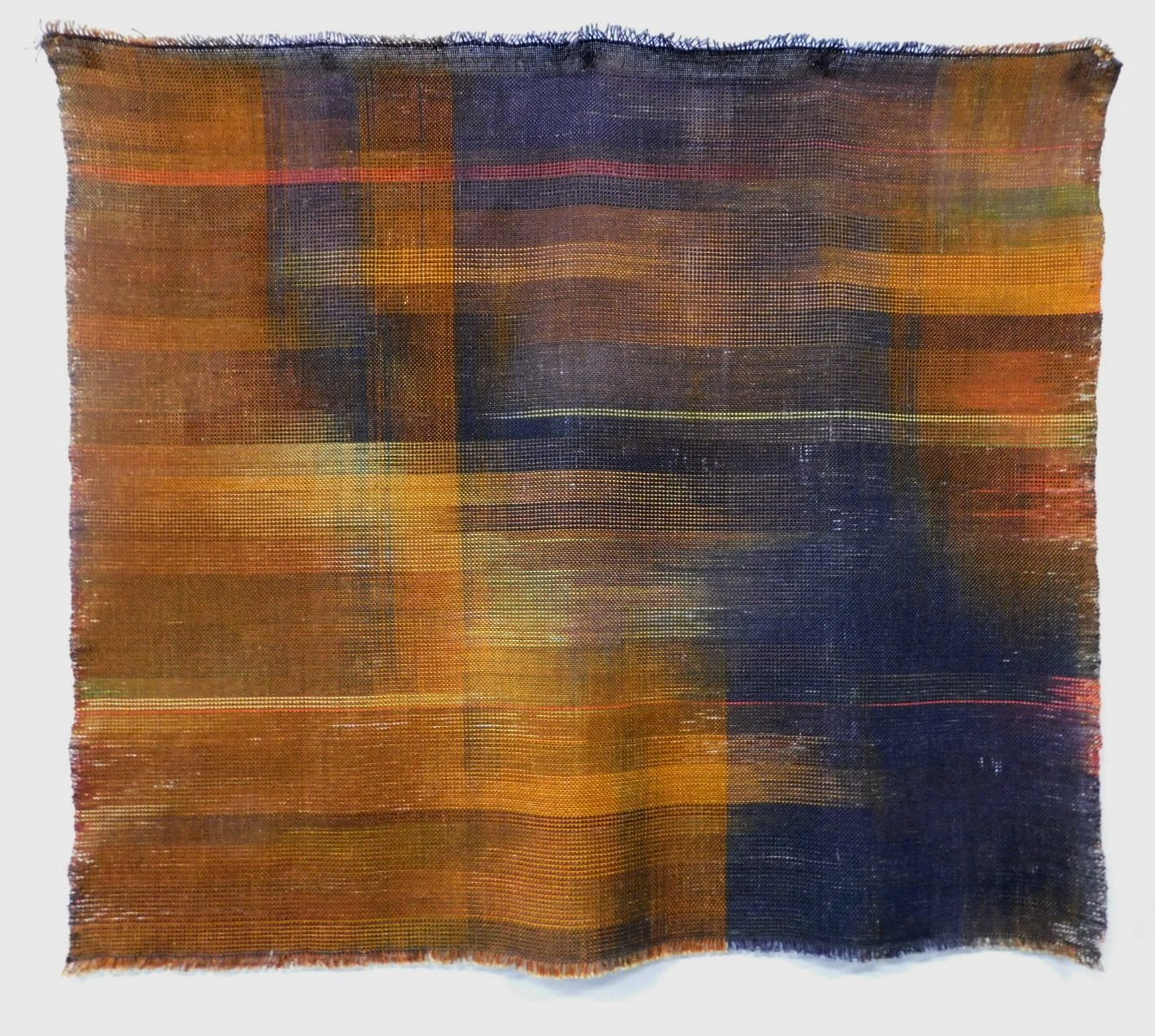
   The partially painted cotton weaving by Emily Schmidt, “Nightly Commute” (Honorable Mention) is a mesmerizing moment. Amorphous glows of warm light are seemingly refracted through patches of darkness.

   What comes to mind when looking at “The Art of Aging” (Third Place award), a vertical assemblage by Charles Felzen Johnson MD? An upended pinball machine, perhaps. Life as an arcade game? There’s infancy at the top, signified by a dangling pacifier. Follow the zigzag line from youth – a circuit board securely wired into vibrantly colored panels; through middle age and the advent of medication (white pill bottles) to alleviate damage from the now disconnected circuit board; and finally down to the bottom - muted colors of encroaching demise, with three black pill bottles like ominous sentinels keeping watch in the left corner. But all is not lost yet. Maybe you could recapture happier days with a dose of the medicine from those bottles in the opposite corner – an energizing snack of candy and Cheerios.

   At which point you might consider visiting the raucous celebration suggested in the mixed media collage by Tina Meyers called “Sunset Gathering” (Second Place award). It’s a delightfully frantic but festive work. And the oil painting by Tina Grondin, “Street Fair,” is invested with a similar spirit of crackling jocularity. Both works are episodes of joy made tactile.    

Thursday, June 13, 2019

A Dynamic Balancing of Freedoms and Constraints


A Dynamic Balancing of Freedoms and Constraints  

Untitled (2010), ink, acrylic, paint stick

Untitled, 2019, acrylic on panel

"Tower Queen" 2018

Untitled, 2018, from the Tower Series

"Tower King" 2018, from the Recursion Collision series


By Tom Wachunas

   “…The physical limits of building with clay and the utter freedom of manipulating paint can each be maddening at times – but can also be revelatory…”  - John Balistreri

   EXHIBIT: DRAFTING Dimensions – Contemporary Midwest Ceramics / On view through July 21, 2019 at The Canton Museum of Art (CMA), 1001 Market Avenue North, Canton, Ohio / 330.453.7666 / Viewing hours: Monday – Closed; Tuesday - Thursday - 10am-8pm; Friday - Saturday - 10am-5pm; Sunday - 1pm-5pm /


   Here’s a wonderfully engaging CMA exhibition that warrants separate commentaries on the participating ceramic artists – Malcolm Mobuto Smith, Future Retrieval (studio collaboration of Guy Michael Davis and Kate Parker), John Balistreri, Peter Christian Johnson, and Lesley Baker. So I’m beginning with the works by John Balistreri.

  In the statement posted with his exhibit, Balistreri is careful to point out that the connection between his paintings and ceramic sculptures is symbiotic rather than mimetic, which is to say that the paintings and sculptures are not to be taken as strictly copying each other. The processes involved in manipulating one medium can inspire formal resolutions or new compositional outcomes in the other. Call it a synergistic interaction of ideations. This give-and-take relationship between methods and materials is a studio practice which allows Balistreri to, in his words, “…reach a broader understanding of structural abstraction.” 

   That said, an untitled diptych painting from 2010 (the first image shown above) does look as if it may have been an embryonic exploration which inspired clay sculptures from several years later that we see exhibited here. All those loosely painted, dripping shapes, floating in a liquid plane of indeterminate depth, seem to be in the process of congealing into something anthropomorphic, architectonic, or both.  

  Another recent (2019) untitled acrylic painting is a much more aggressive and complex hybrid of regular and irregular shapes and marks, painted with a visceral, at times frenetic energy. These abstract configurations coexist in a sort of matrix that in some ways suggests clusters of synapses or neurons spread across a membranous field. There’s evidence of underpainting covered up by changed procedures and content. Some elements are discrete presences, placed atop or adjacent to each other in variable degrees of emphasis across the picture plane. Other elements are less defined, like remnants of structural systems fading away into ambiguous spatial relationships. 

   Yet there is a sense of unity in this vortex of painterly gestures, hovering as they do somewhere between intrusion and integration – a sustained equilibrium between compression and expansion, between arrivals and departures. Balistreri’s paintings aren’t pictures or diagrams of a  static reality. They’re codified histories of multiple decisions that can constantly alter the look of the painting as it’s being made. It’s in the very nature of abstract painting, then, to not only tolerate but also encourage such freedoms.

   That’s not the case with building big clay pieces such as those shown here. There are physical constraints to be considered.  Balistreri’s freestanding sculptures are vertical, totemic structures that could be called figurative architecture. The aesthetic character of these forms is an uncanny conflation of the modern and ancient. They’re built from the ground up, requiring a base stable enough to support the elements placed above it. As he tells us in his statement, “…Generally the lower part of a large sculpture cannot be completely reworked and become something else after hundreds of pounds of material have been added…”  

   Walking around the sculptures activates the space around them enough to better perceive the kindred dynamic at work in both the sculptures and the paintings. It’s that aforementioned balance between compression and expansion. The sheer diversity of visual vocabulary in the paintings is sometimes echoed in the fascinating organic protrusions and recesses that comprise the sculptures, and vice versa.

   Viewing the exhibit is to enter a complementary relationship. Or think of it as joining an intriguing conversation between mediums that inform, rather than merely imitate, each other. 

Monday, June 3, 2019

Of Poetry and Place

Of Poetry and Place

Afoot and Lighthearted

I Have a Desire to Go

A Brighter Dawn

Block by Block

Sanctuary

Bay Side

My Sun Is at Noon


By Tom Wachunas

…The earth never tires,
The earth is rude, silent, incomprehensible at first, Nature is rude and incomprehensible at first,
Be not discouraged, keep on, there are divine things well envelop’d,
I swear to you there are divine things more beautiful than words can tell….
- from Song of the Open Road, by Walt Whitman

EXHIBIT:  Earth Sky Sea - paintings and assemblages by Robyn Martins / at Lynda Tuttle’s Art Center, 209 Sixth St. NW, downtown Canton, Ohio, through June 29, 2019 / GALLERY HOURS:  Wed. and Thurs. 4 to 8 p.m., Saturday 10 a.m. to noon /  5 to 10 p.m. on First Fridays / Visits also by appointment, call 330-452-8211 to schedule /  artist website at:


   An interesting article in The Canton Repository by Dan Kane (May 23) piqued my curiosity about North Canton artist Robyn Martins. I think it would be good for you to read it and get some background before reading my take on her paintings.  Here’s a link:


   The conceptual thrust of Martins’ particular style of abstraction springs from her being inspired by poetry. She tells us in Kane’s article, “I’m informed by the nature of the poem…Sometimes I scratch text right into the painting. It’s not always legible, but I know it’s there.”

  When ‘scratched’ texts are visible, such as in Afoot and Lighthearted (poem from Walt Whitman), or I Have a Desire to Go (poem from Gerald Manley Hopkins), they’re integrated in an unobtrusive manner. Think of them as singularly quiet thoughts, afloat in places still being formed from the mists of memory, or yearning.

   Those amorphous mists are rendered in thin layers of oil paint blended with cold wax, giving the paintings a matte finish and a subtly earthen texture. Martins’ palette is subtle, too. Not mute, though. There are voices here, near and distant, often murmuring or whispering in hushed tones, and sometimes rising in volume to relatively more saturated hues.  

   With or without the cueing function of words, Martins’ iconography doesn’t come off as meticulously detailed representations of specific locales. Her images aren’t literal illustrations so much as they’re distillations, conjurings, evocations. Essences of places in the process of being retrieved, or newly discovered. Poems in themselves, really.

  These captivating meditations merit considerably more actual wall space for viewing than what they’ve been given. Paintings, and our eyes, need room to breathe, free from too many surrounding objects competing for attention. As it is here, the life in Martins’ paintings feels just a bit stifled. Her pieces have been crowded together like so many stacked greeting cards on a retail rack. They deserve a much more formal and elegant gallery setting – the kind which presently doesn’t exist in the downtown Canton arts district.

   Still, I offer my gratitude to Lynda Tuttle for a compelling enough introduction to an artist very worth watching in the future.

Wednesday, May 29, 2019

Deus ex Machina, Part 2


Deus ex Machina, Part 2


Deus ex Machina #2


   “What the Net seems to be doing is chipping away my capacity for concentration and contemplation. Whether I’m online or not, my mind now expects to take in information the way the Net distributes it: in a swiftly moving stream of particles. Once I was a scuba diver in the sea of words. Now I zip along the surface like a guy on a Jet Ski.”
― Nicholas G. Carr, The Shallows: What the Internet is Doing to Our Brains

“We refuse to turn off our computers, turn off our phone, log off Facebook, and just sit in silence, because in those moments we might actually have to face up to who we really are.”
― Jefferson Bethke, Jesus>Religion: Why He Is So Much Better Than Trying Harder, Doing More, and Being Good Enough

“Spirituality is committing suicide. Consciousness is attempting to will itself out of existence.” ― Jaron Lanier, You Are Not a Gadget

   Shameless self-promotion. Hey, it’s a tough job, but somebody’s gotta do it. Let’s review.
   You may recall my post from April, wherein I wrote about my sculpture/ 3D drawing called Deus ex Machina (accepted into the annual juried May Show at The Little Art Gallery in North Canton). Here’s the link in case you want to refresh your memory (ain’t the Internet grand?).


   So now, here’s my invitation for you to see my latest work, a variation on the same theme, cleverly titled Deus ex Machina #2. What I said about the May Show entry still holds for the latest version: … The imposed scribbles, smudges, symbols, and scripts constitute a calligraphy of sense and nonsense, truth and fiction. A 3D essay on confounding dualities. My intent is not to posit answers so much as to raise questions. So what indeed have we wrought? A treasure chest of incalculable riches, or a Pandora’s box of unspeakable ills? Digital Deity. The god of our age. 

 I’m pleased to report that #2 was accepted into the upcoming juried exhibit, A View from Within, at Summit Artspace in Akron. Please join me at the opening reception this Friday evening, May 31. The exhibit will be on view THROUGH JULY 6. Gallery hours are Thursdays and Fridays, 12 – 7 pm / Saturdays 12 – 5 pm.

JURIED EXHIBITION: A VIEW FROM WITHIN

Summit Artspace welcomes summer with a juried show that throws open the doors on May 31 to artistic interpretation as an evolving relationship between the viewer and the creator.

The show opens with a free reception with the artists and juror on Friday, May 31, 5-8 p.m., in the main gallery at Summit Artspace on East Market, 140 East Market St., Akron. Winners will be announced at 7 p.m. by juror Christopher Hoot Professor of Art, Univeristy of Akron Myers School of Art.


Tuesday, May 21, 2019

Treading Water, Valiantly


  Treading Water, Valiantly


(l. to r.) Daryl Robinson, Michael Jeffrey Lucas, Todd Cooper, Jim Graysmith

Heidi Swinford, Allen Cruz

Andrew Bolden, Sarah Marie Young

(l. to r.) Alexis Wilson, Kaelin Curran, Morgan Brown

Michael Jeffrey Lewis, Sean Fleming


By Tom Wachunas

“…And the night was alive/ With a thousand voices /Fighting to be heard /And each and every one of them /Connected to me...”

- lyrics by Maury Yeston from “The Night Was Alive” for Titanic – The Musical

   A confession: At this writing, I am overcome with mixed feelings in a sea of sad ironies. Not the least of those is that opening night of the Players Guild production of Titanic – The Musical came so soon (May 17) after the sudden passing on May 9 of 55 year-old Scott Sutton.

   Through decades, his work as lighting designer and sound engineer brought  magical dimensionality to hundreds of Players Guild productions, including the spectacular artistry of his final project in April, Jesus Christ Superstar. It’s not unreasonable to think that processing the loss of such a vital and beloved member of the Guild family might profoundly affect how the cast members - directed by Jonathan Tisevich – would rise to the challenge of insightfully focusing their hearts and minds on navigating the Titanic narrative (story and book by Peter Stone, music and lyrics by Maury Yeston). And that’s another irony. For here is a story - an operatic voyage, really – about unexpected tragedy, the promise and fragility of human dreams, and mortality itself.

   So in one sense, perhaps the emotive core of this show is to be found in the genuinely valiant efforts of the performers to somehow bind the weighty pall of their personal bereavement to the hopes, aspirations, and worldviews of the people they’re portraying. Still, the energy pouring from the stage is a wandering one, feeling oddly sporadic and numbing at times. It’s as if all these characters can do is to dutifully tread the cold water of circumstance.

   To be fair, the undermining flaws in this production are, for the most part, not the fault of the clearly gifted cast (though there are some distinctly off-pitch singing passages), but rather in the decidedly flaccid songwriting. While the live orchestra conducted by Steve Parsons plays superbly enough (as it always does), the music as a whole is not particularly remarkable.  The melodies themselves are largely impotent, doing little to evoke palpable urgency or suspense, despite some impassioned delivery from accomplished singers. Though too few and far between, the moments when the music is at its most powerful are those featuring choral singing from the full company, magnificent in its sheer aural opulence of thunderous, soaring harmonies.
    
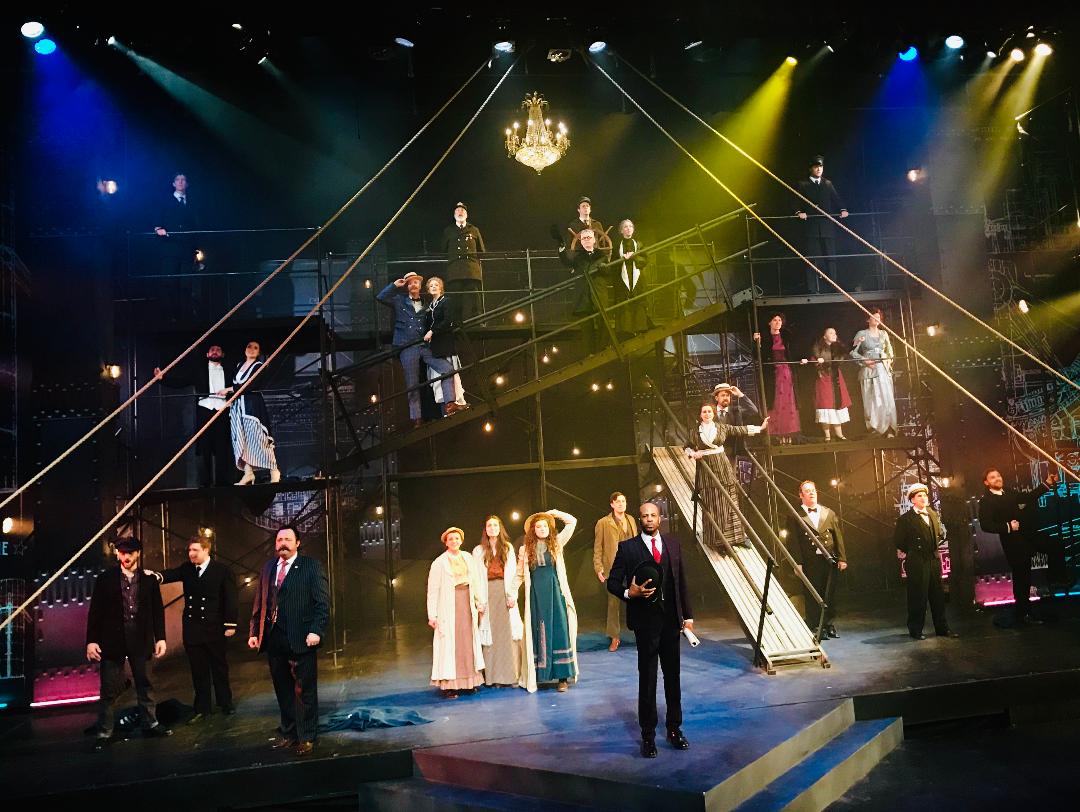
    There are some compelling dramatic scenes here that keep this “ship of dreams” afloat long enough for us to savor intervals of authentic anger, pathos, tenderness, and exhilaration. Daryl Robinson is a quietly riveting  picture of brooding obsession as he plays Andrews, the designer of the Titanic who never stops looking at his blueprints. As Captain Smith, Jim Graysmith is a cold figure, stern and aloof in the night atop his bridge, seemingly uncaring about the safety of his passengers. Similarly uncaring, Todd Cooper is sinister hubris and unbridled pride personified in his role of Ismay, Titanic’s owner, insisting that his property set a new trans-Atlantic speed record. In a startling song titled The Blame, the three of them engage in a chaotic flurry of insults and vicious finger-pointing as the ill-fated vessel begins to sink.

   On a gentler note, Heidi Swinford is all impish charm in her role of Alice Beane, a second-class passenger humorously swooning over and idolizing the wealthy first-class celebrities on board, all bedecked in flamboyant period costumes designed by Stephen Ostertag (oh! those ridiculous ladies’ hats!). Kaelin Curran, Alexis Wilson, and Morgan Brown are deliciously animated as a giddy trio of young, third-class Irish women, each named Kate, each dreaming of the good life in America. Meanwhile, Sarah Marie Young as Caroline, along with Andrew Bolden as Charles, are thoroughly captivating as they look forward to married life. Their duet, I Give You My Hand, is especially commanding.  Another most tender and endearing duet, The Proposal / The Night Was Alive, features Sean Fleming playing a stoker named Barrett, and Michael Jeffrey Lucas as Bride, who works in the ship’s teletype room. As Bride taps out Barrett’s dictated marriage proposal to his distant girlfriend, the two men are joined in a mesmerizing moment of contrapuntal harmony. 
   
   The set designed by Joshua Erichsen is a transfixing apparition of steel ramps, scaffolds, railings, and columns superimposed with projected mechanical drawings. It effectively captures the metaphorical spirit and epic scale of the historic vessel, described in the song In Every Age as, “…a  human metropolis... A complete civilization! Sleek! And fast! At once a poem and the perfection of physical engineering...”

   A complete civilization indeed. Sleek, fast, destined for disaster. Perfection? To a point, yes, as in…perfectly ironic.

Titanic: The Musical /  Through June 2, 2019, on the Players Guild Mainstage, Cultural Center for the Arts, 1001 Market Ave. N, Canton, Ohio  / shows at 8 p.m. on May 24, 25, 30, 31 and June 1 / shows at 2 p.m. on May  26 and June 2  / TICKETS: $32 adult, $29 seniors 65 and older, $25 for 17 and younger / at www.PlayersGuildTheatre.com   and 330-453-7617.

Monday, May 13, 2019

Retinal Poetry


Retinal Poetry

"Fourier" (detail - courtesy Canton Museum)


"Archimedes" (detail - courtesy Canton Museum)

"Gauss"

"Boole" (top), and "Cachy"

"Riemann"

"De Laplace"

By Tom Wachunas

   “The eye can travel over the surface in a way parallel to the way it moves over nature. It should feel caressed and soothed, experience frictions and ruptures, glide and drift. One moment, there will be nothing to look at and the next second the canvas seems to refill, to be crowded with visual events.”   - Bridget Riley

   EXHIBIT: Organized Ambiguity – Gridworks of David Kuntzman / On view through July 21, 2019 at The Canton Museum of Art, 1001 Market Avenue North, Canton, Ohio / 330.453.7666 / Viewing hours: Monday – Closed; Tuesday - Thursday - 10am-8pm; Friday - Saturday - 10am-5pm; Sunday - 1pm-5pm /


   In the mid-1960s. the emergence of Optical, or Retinal painting (named “Op Art” after the first major New York show  by Cleveland-based Julian Stanczak in 1964) signaled a dramatic shift in thinking about the presence of the painter’s hand – the unique, expressively charged mark – on a two-dimensional plane. This new genre of abstraction essentially eschewed the visceral, individualized painted gesture in favor of smooth surfaces and tight compositional rigidity that often suggested associations with science or technology. More importantly, Op Art embraced the physicality and psychology of the very act of seeing. Op paintings are often quite hypnotic in their playfulness, their sheer illusionism, their delightful tendency to tease and disorient our perceptions.

   In that capacity, David Kuntzman is an inveterate trickster, a gamesman of the highest order. His acrylic canvases, named after mathematicians, are  multifocal gems of pictorial ambiguity rendered with alluring exactitude. These are elaborate, complex fields – at once dense and airy - of variably scaled grids that intersect, collide, or otherwise overlap in contrasting angles. Vibrant patterns that dance, tilting and teetering in elegant pirouettes.

  Kuntzman is a remarkable colorist. His fully saturated hues can produce a sensation of electrified oscillation. And for all their architectonic precision and geometric solidity, the repeated motifs have an uncanny life about them, a pulse. They breathe. All those intricate planes are joined into retinal matrices of fascinating rhythms. They seem to float in and out of focus in an implied infinity, as if carried on a cosmic wind. Even his monochromatic paintings are imbued with subtle vacillations in illusory light, reflected and refracted amidst indeterminate spatial depth.

   Despite appearances, I don’t think the ultimate goal of Kuntzman’s paintings was limited to something so prosaic as meticulously painted grids.  Beautiful as they are, the grids are simple portals to a more transcendent aesthetic experience. In the end, it’s an experience rising from an unfettered desire to be enthralled by the act, the event, of seeing. Kuntzman has articulated that experience with exquisite finesse.