Tuesday, May 31, 2022

From Canton Symphony Orchestra, New Music of the Spheres


  From Canton Symphony Orchestra, New Music of the Spheres 


(l. to r.) Daniel Perttu, Gerhardt Zimmermann,  Jeffrey Biegel

By Tom Wachunas 

    A particularly gratifying take-away from the May 22 Canton Symphony Orchestra (CSO) MasterWorks program at Umstattd Hall was that one need not be in an actual rocket ship to experience the beauties and mysteries of the cosmos.

   As this concert so wondrously demonstrated, an orchestra as sublime as the CSO is itself a carefully constructed mode of transport. Call it a well-travelled vessel, amply fueled by a composer’s art, with performance flight plans navigated by the always sure hand of the conductor at the helm, Maestro Gerhardt Zimmermann.

   For all its surprising brevity, the evening’s opening selection, Starburst, lived up to its name in captivating fashion. Written for string orchestra in 2012 by American composer Jessie Montgomery, this single-movement work is a scintillating burst of her imagination, envisioning the explosive arrival of new stars in a galaxy. The music is a fast and complex progression of changing aural colors, blending sweet, fleeting melodies with brisk, emphatic rhythm variations. Montgomery has called it “…a multidimensional soundscape.” Through all their adroit gliding and sliding, and their crisp stacatto plucking, the CSO strings soared with remarkable alacrity.

    The next work on the program was Joseph Haydn’s light-hearted 1777  Overture to the opera buffa, Il Mondo della Luna (The World on the Moon). The raucous comedy tells the tale of a rich, gullible old man who loves astronomy, and who refuses to let his two daughters marry the penniless boyfriends they love. So the couples devise a devilish theatrical scheme to convince the old man that he’s been transported to the moon, where he meets the emperor and consents to his daughters’ marriage to members of the lunar court. The orchestra was an exuberant embodiment of the music’s symphonic thrust, imbuing it with a spirit of frolicsome majesty.

    Following that winsome fantasy, the evening’s long-awaited centerpiece was the world premiere of A Planets Odyssey, a piano concerto composed by Daniel Perttu in 2021, and here featuring the consummate artistry of pianist Jeffrey Biegel. Beginning with the ear-splitting, brassy blasting of the “Big Bang,” Perttu’s score is, literally and figuratively, a sensational nonstop trek across millions of miles, lasting approximately 22 minutes.

    Perttu’s theme and labyrinthine variations were inspired by his research into the physical properties and conditions unique to seven planets (Earth not included) as described by current science. His music possesses an uncanny acuity for translating visual and tactile phenomena into palpable realities in themselves, endowing the work with a phantasmagorical dimensionality. Through it all, the orchestra is much more than an echo or passive background presence. Every section is called upon to be in constant, active and loud dialogue with the soloist, and the ensemble here rose to the conversation with dramatic, even startling power.

    What magic this union was! If the orchestra could be considered as so many celestial bodies, Jeffrey Biegel’s playing was their collective heartbeat. And ours. His technique was a dazzling defiance of gravity, a life-affirming pulse that brought a sense of intrepid dancing, or relentless marching through this journey. While one hand constantly articulated a spirit of prowling and searching through rapid scales and arpeggios with crackling precision, the other, often simultaneously, pounded out bright exclamatory chords, as if declaring or celebrating the discovery of an immense new spectacle.

   Biegel was equally brilliant in his return to earth, as it were, when performing Chopin’s Andante Spianato and Grande Polonaise Brillante. While the orchestra’s role in this work is a relatively quiet one, the ensemble was nonetheless exquisite in its poetic filling-out of harmonies and colors against the mesmerizing sparkle of Biegel’s bravura.

   The evening concluded with yet another ascent to breathtaking musical heights in Mozart’s Symphony No. 41, “Jupiter.”  In this return to what Kenneth C. Viant rightly called in his program notes “an Olympian nobility and grandeur,” the CSO once again proved itself to be an ebullient tour de force of symphonic excellence.  

Tuesday, May 24, 2022

Some Enlivening Locutions


Some Enlivening Locutions 


detail - "May I Share A Word With You" by Judi Krew

"May I Share A Word With You" by Judi Krew

(left) "Murders in the Rue Morgue" by William Bogdan
(right) "Our Weapon is Truth" by Sally Lytle

"Lavish Lilies I" by Diane Belfiglio

"Small Reflections" by Christopher Triner

"DeDeKind" by David Kuntzman

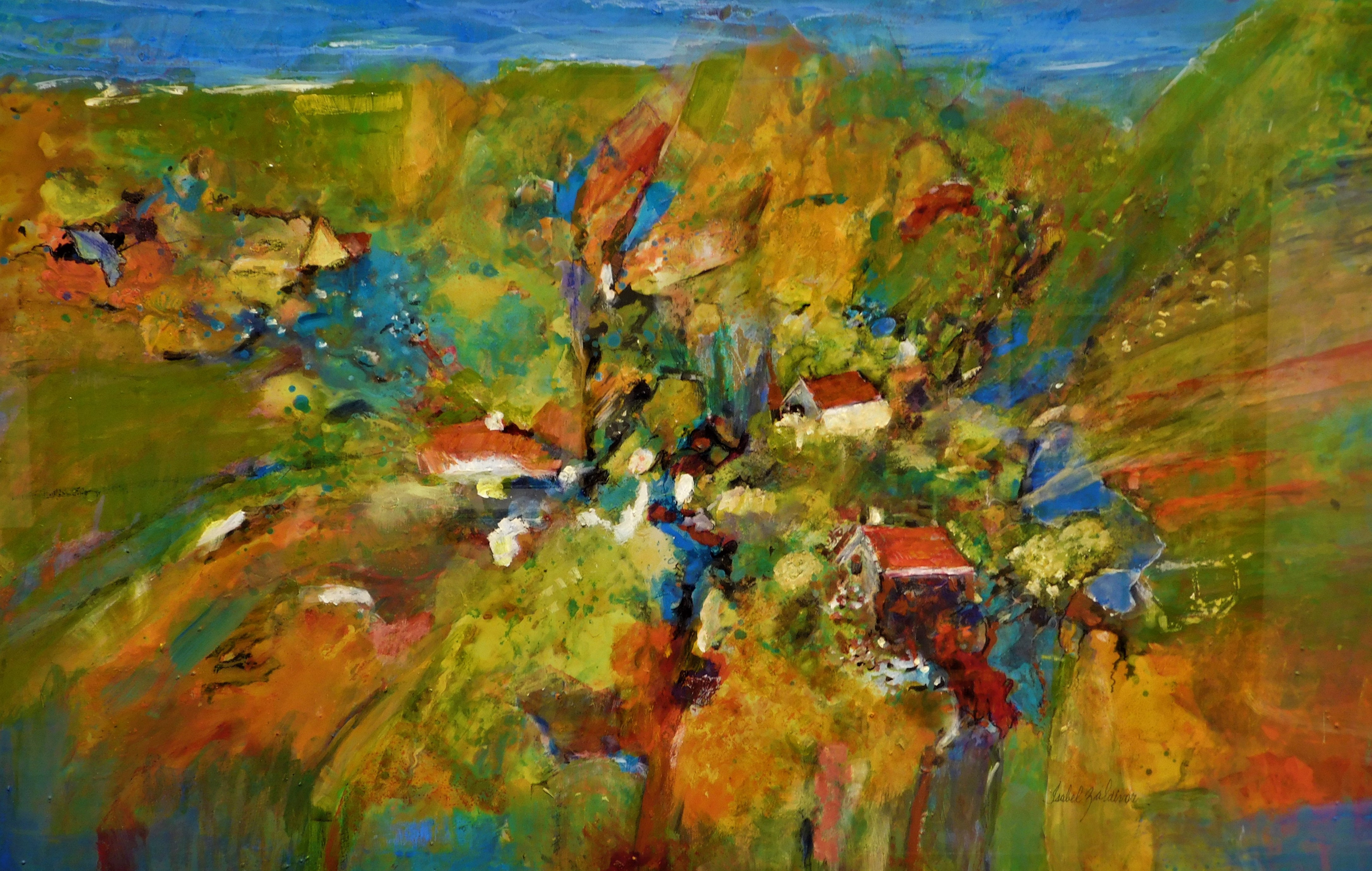
"A Place in the Mountains" by Isabel Zaldivar

By Tom Wachunas 

   “The aim of art is to represent not the outward appearance of things, but their inward significance.” – Aristotle 

   EXHIBIT: 79th ANNUAL MAY SHOW/ at LITTLE ART GALLERY, located in  The North Canton Public Library, 185 North Main Street, North Canton, Ohio/ Viewing hours: Mon.-Thurs. 10 a.m. to 8 p.m., Fri. 10 a.m. to 6 p.m., Sat. 10 a.m. to 4 p.m. /  THROUGH JUNE 4, 2022

From Merriam-Webster, definition of locution:

lo·cu·tion | \ lō-ˈkyü-shən (noun)

1: a particular form of expression or a peculiarity of phrasing

especially : a word or expression characteristic of a region, group, or cultural level

2: style of discourse : PHRASEOLOGY

     Jurors  Allyssa Hixenbaugh and Elizabeth Taylor have written that they  had “not an easy task” in selecting a scant 28 artworks from more than 130 submissions to this hallowed annual ritual. While I was consequently disappointed by the absence of 3D sculptural works on view (with one notable exception – more on that later), I’m happy and grateful to report that one of my monochrome 2D mixed media collages, Politics and Religion, did make the harvest, so to speak. I wrote about that piece in late 2020, and here’s a link to the post if you care to revisit:

http://artwach.blogspot.com/2020/11/description-and-de-scription.html

   This year’s May Show crop once again heavily favors art of the representational sort, with very little in the way of nonobjective abstraction. In that genre, David Kuntzman’s acrylic painting, DeDeKind, is a stunning mathematical mind-bender. Its complex layers of interlocking angled grids seemingly move forward and recede all at once in a suggestion of infinite spatial depth.

     As a whole, the show feels somewhat safe, as in quietly academic and traditional. This is certainly not to say it lacks technical or conceptual excellence. Several of the most compelling pictures depict the natural world, including landscapes. You might call them diverse narratives, or locutions of locations. Among those, Isabel Zaldivar’s wild, loosely painted acrylic, A Place in the Mountains, exudes a raucous joy with its harmonized planes of electrifying complementary hues. A much tighter method of layered mark-making imbues Christopher J. Triner’s acrylic painting, Small Reflections, with an enchanting sense of sparkling luminosity – a woods enlivened with magical, lambent light. And the remarkable precision of lines, organic shapes, and saturated color all unite to make Diane Belfiglio’s watercolor, Lavish Lilies I, an altogether breathtaking ode to delicate, sunlit textures.
    Elsewhere in the mix, two small portraits mounted side-by-side make for a sobering contrast in considering the darker if not more solemn side of existence in modern times. One is downright morose, the other poignant and  contemplative. In William Bogdan’s raw, bluntly rendered etching, Murders in the Rue Morgue – The Moment Before, a monstrous, wrinkled hand rests on the neck and shoulder of a woman in profile. Her eyes look to the edge of death. The moment before indeed. To the right, the girl in Sally Lytle’s gently fluid oil painting, Our Weapon is Truth, looks directly at us, her dark-eyed gaze at once mournful and expectant. Cutting across her neck and shoulders is an edge, where the blue and yellow fields of the Ukrainian flag meet, and here mix into a wispy swipe of green. Green, the color of growth, of hope? The promise of a life, like this painting, not yet finished?  

   And finally, on another Ukrainian / global note, there’s the exhibit’s sole sculptural – and most arresting - entry: Judi Krew’s interactive, life-sized  robed figure called  May I share a word with you? The piece has a lot to say.  In 73 languages. Here are Krew’s words about her work :

    One World * One People * One Voice. This coat contains 94 words in 73 different languages. The words are: Peace – Care – Kindness – Hope - Faith – Hello. Viewers are encouraged to gently lift any necktie piece and discover the word rendered and its language of origin. The more we learn, the more we will become a world of understanding and peace. The headpiece is based on the traditional ceremonial dress of the Ukrainian people. It contains three words to be shared: Peace - Freedom - Assistance. Materials for both: black out curtains, necktie skeletons, spray paint, shirt scraps, thread, embroidery floss, buttons, labels and crochet remnants on the headpiece.

   Krew’s materials and methods are themselves a grand and eloquent locution, literally and symbolically, of the ties that bind our longings for connectivity and unity in times of unspeakable turmoil.

Tuesday, May 10, 2022

A Magnificent Feast from Canton Symphony Orchestra


 A Magnificent Feast from the Canton Symphony Orchestra


Gerhardt Zimmermann

Matthew Jenkins Jaroszewick

(clockwise from top left) - Rachel Hall, John Pickle, David Small, Diane Fox


By Tom Wachunas 

      Talk about perfect timeliness. In this abysmal era so saturated with our blood and tears, along comes the Canton Symphony Orchestra (CSO) with its inspiring April 30th concert, called Music For Humanity, presenting a lavish feast to feed yearning souls.

   The first half of the evening featured two works conducted by the vivacious Matthew Jenkins Jaroszewicz, CSO Associate Conductor, beginning with Fanfare for the Uncommon Woman No.1. Composed in 1986 by Joan Tower, the work was inspired by Aaron Copland’s iconic fanfare and employed the same instrumentation of brass and percussion. Tower dedicated this surprisingly brief work to “women who take risks and are adventurous.” Adventurous to be sure, while the opening theme is a subtle echo of Copland’s, the CSO brass was remarkably bright, crisp and and crackling in its relentless morphing of the motif into quick, layered variations, both delicate and discordant, robustly spiced with startling bursts of timpani.

   The banquet continued with an especially delectable hors d’oevre in the form of Ralph Vaughan Williams’ Serenade to Music. Williams composed the work in 1938 for orchestra and 16 singers as a grand ode to the life-affirming potentiality of music. The sung text was adapted from a lovely scene in Shakespeare’s The Merchant of Venice, wherein two lovers pause on their walk through a verdant estate, glimmering in the moonlight, mesmerized as they listen to a group of musicians playing nearby. Mesmerizing indeed, the orchestra and choir here were a remarkable personification of that entranced couple, investing this wondrously atmospheric meditation with a rhapsodic reverence.    

    After the intermission, CSO Music Director Gerhardt Zimmermann joined his orchestra along with the Canton Symphony Chorus, directed by Britt Cooper, and University of Mount Union Choir, directed by Grant Cook. Here then was the Maestro, the intrepid master-chef, if you will, at his most technically astute, emotionally alert, even brave. Astride the pinnacle of his interpretive prowess, Zimmermann and his brilliant co-conspirators served up the evening’s main course - the most enlivening recipe for pure symphonic magnificence ever composed: Beethoven’s groundbreaking Symphony No. 9, Op. 125 “Choral.”

   Like misty storm clouds, tremulo strings in the first movement whispered, then swelled into fragmented themes suggesting the cruel vicissitudes that haunted Beethoven’s life. The unmitigated, largely upbeat intensity of the Scherzo movement – briskly stated, but never too rushed – was a decidedly more jovial probing of hope, giving way to the contemplative, majestic melancholy of the third movement. Throughout these movements, the orchestra consistently navigated the complexities of intertwined colors, textures and moods with a riveting clarity and precision.

   Then came the colossal, episodic final movement, a sumptuous regale in itself. The jarring, momentary uproar of the opening settled into short-lived snippets of themes from the previous movements, all quickly dismissed with the emergence of a new theme in the low strings that steadily grew into a full-fledged hymn.

   And just as the music seemed poised for yet another dark storm, a very loud halt was called by a lone, stern and rumbling voice from, of all places, the audience. Striding down a side aisle and stepping up on to the stage like a general joining his troops, baritone soloist David Small sang out the first stanza of Friedrich Schiller’s anthemic poem, Ode to Joy: “O Friends! Not these sad tones! Let us raise our voices together in more pleasant and joyful tones!”

   Thenceforth, it felt like all of heaven breaking loose. The combined choruses repeated the baritone’s words with utterly breathgiving power, and joining the exultant proceedings were the other members of the superb vocal quartet: Rachel Hall, soprano; Diane Fox, mezzo-soprano; and John Pickle, tenor. Their singing - crystalline and radiant - was enough to make angels jealous.

   The symphony’s thunderous final note brought the enthralled audience immediately to their feet in an equally thunderous roar of approval. And gratitude, I’m sure, for a great service rendered. After all, in these increasingly sad and troubled times, the CSO had just fed us a generous helping of unfettered joy.  

Wednesday, April 20, 2022

Scintillating Scraps


Scintillating Scraps


Goku vs. Superman

detail - Goku vs. Superman

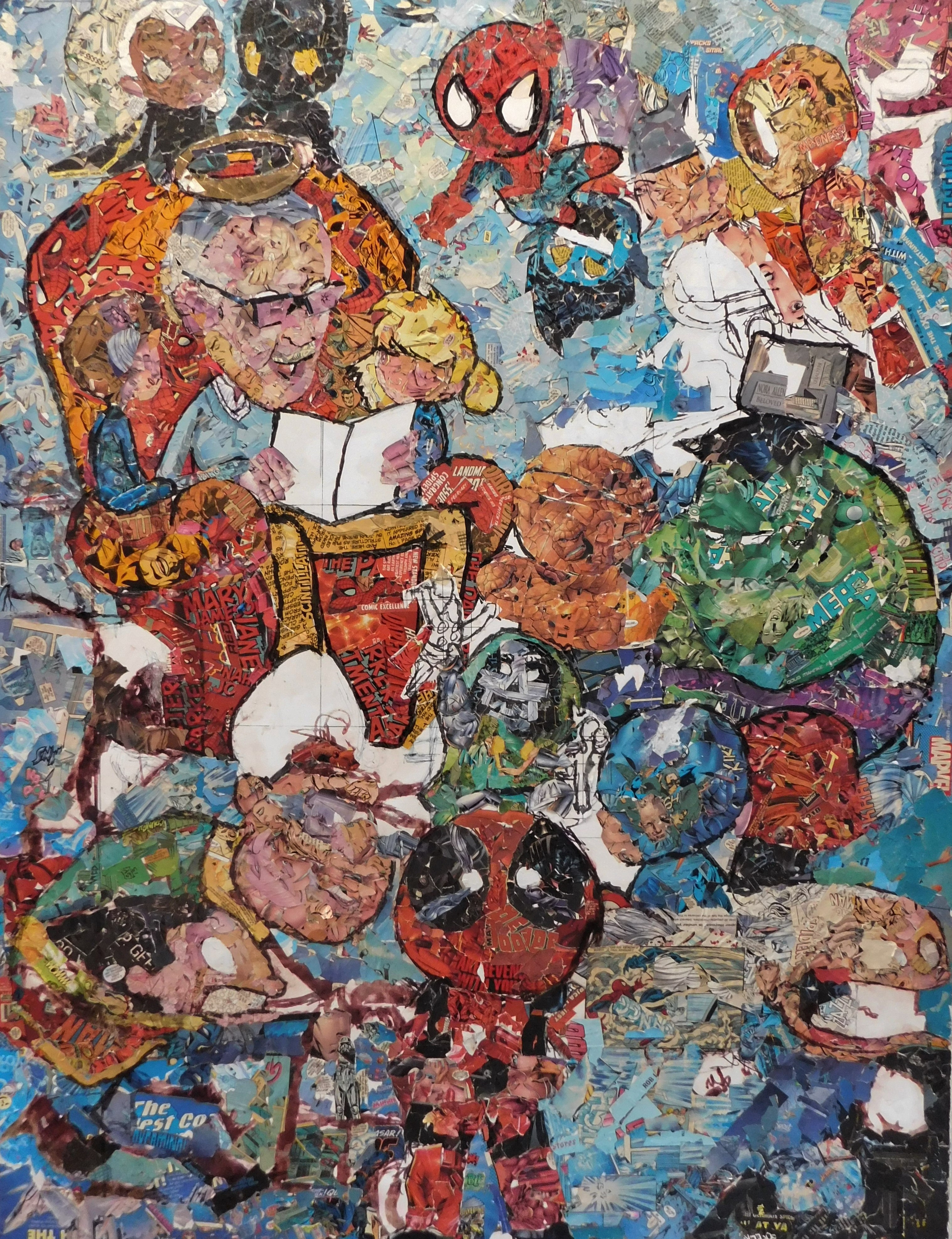
Skottie Young/ Stan Lee Tribute

Snakes On An Astral Plane

Jazzy Sessions

Open Your Eyes

By Tom Wachunas

   Marvel is a cornucopia of fantasy, a wild idea, a swashbuckling attitude, an escape from the humdrum and the prosaic. It's a serendipitous feast for the mind, the eye, the imagination, a literate celebration of unbridled creativity, coupled with a touch of rebellion and an insolent desire to spit in the eye of the dragon.”   - Stan Lee


   EXHIBIT: The Pieces That Fit – collages by Perris Mackey (p _ ThaNerd)   at  Patina Arts Centre, 324 Cleveland Ave NW, downtown Canton, OH / ending on APRIL 23 / Gallery Hours: Thursday 12-8pm, Friday 8-10pm, Saturday 12-10pm

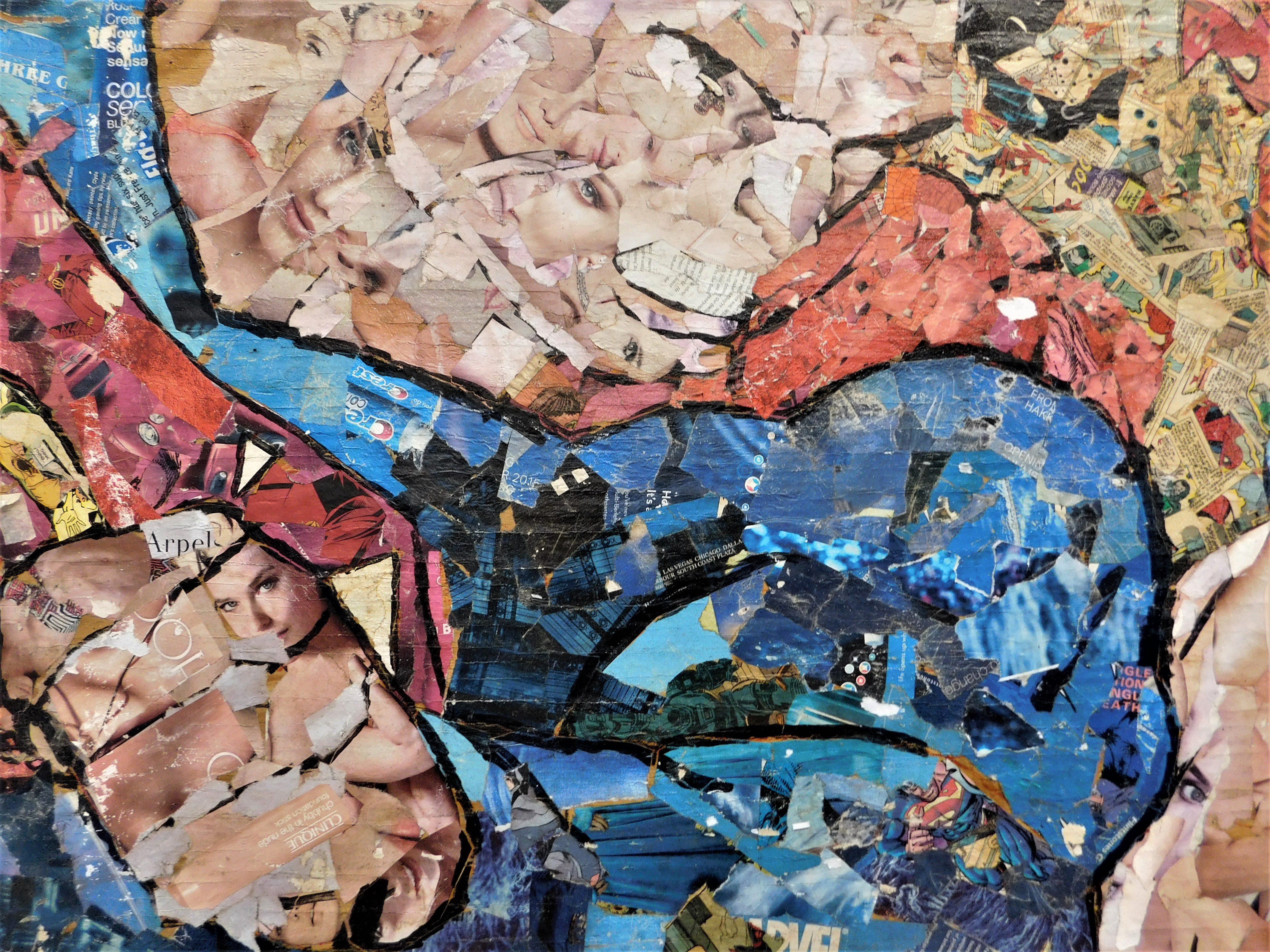
     Perris Mackey - a.k.a. p_ThaNerd – constructs spectacular collages that are dense, intricate agglomerations of fragments salvaged from damaged comic books and recycled magazines. Collectively, his pictures are a celebratory smorgasbord - a confluence of facts and fantasies incorporating iconic celebrities and characters – all seasoned with street-smart theatricality.

    At some points in your looking at this tantalizing mélange – and there are only a few days left to do so - you might even envision the artist as a savvy master rapper. Or maybe a virtuosic jazz horn player, belting out crazy fast improvisations with inexhaustible alacrity.

   These facile fusions join together myriad irregularly-shaped scraps of images, texts and textures to form labyrinthine backgrounds that exude a rococo kind of complexity. Here, “edgy art” acquires new meaning. In turn, the particulated forms of bodies and faces emerge from their surrounding clamour, like fractions becoming whole numbers, and take on a nearly sculptural solidity.

     So welcome to a parade of paper with a pulse. Have a rollicking romp through repurposed pulp festooned with the confetti of Pop culture. Nerds, unite!

Wednesday, April 13, 2022

Reconnections


Reconnections


"Muses" by Beth Lindenberger

"Deathbed" by Sherry Bradshaw

Antimony Bottle" by Donna Webb

"Spill Over" by Donna Webb

"Glyph Cairn" (left) and "Spiked Cairn" by Beth Lindenberger

By Tom Wachunas and others

“My surfaces are based on microscopic organisms and natural objects. I am interested in responding to nature, not copying it. Whether seen as individuals or in a group or system, I see these pieces as part of a larger environment.” – Beth Lindenberger

“I collect artifacts that wash up on the Lake Erie shoreline or end up at the side of the road… turning original identities into something magical yet absurd.  I am interested in the paradox between beauty and death.  And, I also love bird watching.”  – Sherry Bradshaw

“…Repetition provides a key to scientific understanding of species and of all other forms of knowledge. Variation also pops up everywhere. These exceptions keep us from becoming complacent and provide fresh reason for staying engaged in research. The meaning of the exception to the rule allows for interpretation, and therefore art and poetry.”  – Donna Webb


   EXHIBIT (ended on April 9, 2022): At The Lemmon Visiting Artist Gallery, in the Fine Arts Building at Kent State University at Stark: Natural Order: Accumulating Meaning - ceramic sculpture by Beth Lindenberger (curator), Sherry Bradshaw, and Donna Webb, exploring themes connecting art, science, and collaboration. / 6000 FRANK AVENUE NW, NORTH CANTON, OH

   Unexpected and daunting personal circumstances have recently wrecked my time and concentration. One regrettable casualty has been my blog activity, including offering a more timely review of this enthralling exhibit. Ironically enough, this situation has transpired while I’ve been teaching a course at Kent Stark called “Arts Engagement,” which focuses on practices and techniques of writing about contemporary art.

   So consider this post my soft reentry into the land of the writing, but with a twist. Here’s a review composed by multiple authors, including my ten Arts Engagement students. I’m proud of their mindful attentions to the marvelous works presented by three truly remarkable artists. Each student wrote a review essay, and so I present here, with much gratitude, edited excerpts. They collectively capture the overarching spirit of the show while resonating solidly with my own appreciation of the exhibiting artists’ works.

   Of Beth Lindenberger’s porcelain Protista: Dispersed, Caden Haines wrote, “…  as a material, porcelain is often seen as fragile and delicate. But to me, this work harnesses those fragile and delicate qualities in order to shift that impression. The spikes look as if you tried to pull on them they would easily snap, and yet they give off this air of defense and protection.”

   Observing Donna Webb’s Spill Over, Paige Johnson noted, “… Each tile creates a mood. For example, while the bottom left tile works quite wonderfully with the whole piece, looking at it by itself is very calming… It reminds me of rain on glass, hitting the surface and trickling down slowly.”

   Sherry Bradshaw’s Pegasus (an altered invisible horse kit with bird feathers) prompted this response from Ashley Winn: “Inside each creature is the better, bigger version. When a cat looks in the mirror does it see itself as a tiger, lion, perhaps a cheetah? Does a horse see its reflection in water and see a Pegasus? I feel with this piece, every horse, deep down, is a Pegasus.” 

    About Donna Webb’s Quest with Redwing Blackbirds, Alex Snyder offered, “Overall, the piece holds a certain energy for viewers, a fascination with the journey these blackbirds are taking, almost as if we are witnessing a brand new world outside our own cage…”  

    Here’s Samuel Gentile, on Beth Lindenberger’s Glyph Cairn: “… something as simple as stacked stones implies importance. These human-made constructions could have multiple meanings, such as remembering an achievement on a mountain plain; a warning to be wary of creatures in a dense forest terrain; or a ceremony for loved ones who have passed. The use of the crackle glaze gives the stones an appearance of rust, generating a feeling, as if discovering an artifact hidden away for years.”

   In his comments on Donna Webb’s Antimony Bottle with Strange Particles, Thomas Pedrotty wrote, “…The small particles floating around the work help elevate it from something relatively simple to a more complex analogy of a galaxy of possibility in the jar…I now have a greater appreciation for the infinite possibilities of ceramics…” 

   Sarah Vega wrote of her viewing experience, “…I was met with, if not overwhelmed by, wordless stories about the beautiful fragility of life… This show is a story written by the dwarves who could not bear to hide Snow White’s beauty even in death. I felt the memory of the fairy tale, ghostly yet comforting, surround me as I wandered through the poetry.”

   Similarly, from Christine Rogers, “… this exhibition is a raw experience of nature’s Oroboros of life and death, or the beautifully tragic tale of the circle of life… You can walk yourself through the gallery full of whimsy, but it will keep your feet grounded in the reality of the world we live in.” And Nicholas Hoover concurred: “… Both in process and form, themes of life and all of its cycles are present, from the smallest cell, to the local wildlife, even to the fungus found, all treated with immense respect. All of the works complement each other and build on one another.”

   And finally, this gem from Jessica Morton: “The exhibition is a liminal space where science meets spirituality. Sculptural artists Donna Webb, Beth Lindeberger, and Sherry Bradshaw, along with two-dimensional works by Jack McWhorter, create a space where the repetition and variation of life and nature are captured. The accumulation of works suggests a life cycle throughout time, from single cell to multicellular, from birth to death, transforming the gallery into a transcendent biorepository.”

Friday, March 11, 2022

Mettle Beyond the Metal


Mettle Beyond the Metal


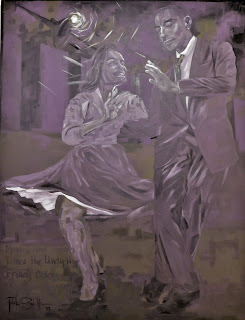
Morris and Judith

Bombraid

Feather

Black Squirrel

Futile

Biff


By Tom Wachunas

    EXHIBIT: Works by Patrick Buckohr / at Strauss Studios, Upstairs Gallery, 236 Walnut Ave. NE, in downtown Canton / 330.456.0300/ THROUGH MARCH 25, 2022 / Viewing Hours: Monday – Friday 10a.m. – 5p.m.

   As of this writing, Patrick Buckohr has installed 63 works of public art – murals and large-scale iron works - at various locations in Northeast Ohio over the past 15 years. Here in Canton, he’s gained considerable notoriety for his big outdoor metal sculptures, including several playful animal forms from his “Critters” series.

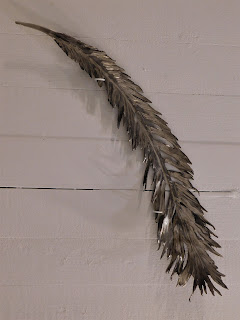
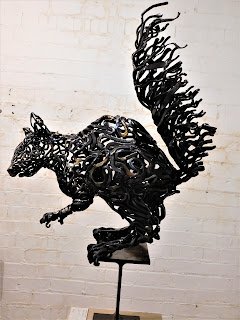
   So yes, there are some smaller 3D works in metal here. Among those are his steel Feather pieces, crafted with mind-blowing precision, and his exquisitely intricate (steel) Black Squirrel.

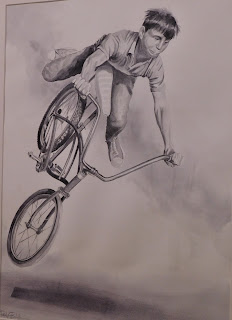
   But the most surprising components of this exhibit - which is Buckohr’s first solo show since 2011 – aren’t about sculpture or metal. I didn’t realize that the artist was such a deft wielder of the brush. Here is Patrick Buckohr, the painter.

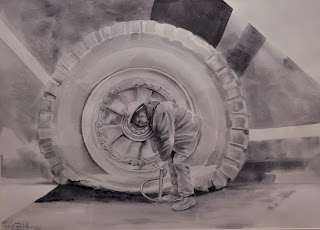
   His three black-and-white watercolors, along with three larger mixed-media paintings, are impressive demonstrations of facile draftsmanship and expressive tonality. One of the watercolors depicts a road construction worker stooped over a tiny manual air pump, trying to inflate a monster-sized flat tire. The piece is called, appropriately enough, Futile. More than an entertaining sight gag, the image feels like a timely commentary on societal ineptitudes during troubled times.

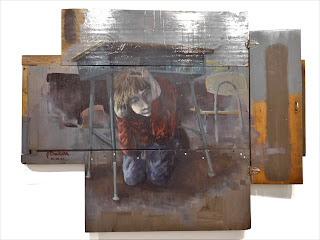
    Futile is an arresting emblem of world-weariness. A kindred spirit resonates in Buckohr’s mixed-media Bombraid  (4’ x 6’), painted on planks  of salvaged plywood. With his hands pressed against his ears, a boy on his knees cowers under a desk. Again, a timely aura, a haunting relevance. While the painting is a brooding remembrance of those schoolroom duck-and-cover air raid drills from the 1950s, is it not also a woeful reflection of here-and-now Ukraine?   

   In another big painting, Morris and Judith (6’ x 5’), the figurative brushwork is raw and loose, rendered with a palette of muted purples, smoky grays, and motley earth tones. These are hardly party-time colors. Still, the couple twirls and quick-steps their Lindy Hop, seeming not to care they’re dancing in the dark. Judith wears a fierce, determined grin, as if to say, “Morris, honey, it’s us against the world!”  

   When the going gets tough, the tough get dancing. Or painting.

Friday, March 4, 2022

In the thick of it


In the thick of it 


Harmony

Isolation

Signs of Life

Protect the Rose

The Wastelands

Trust

Epiphany

By Tom Wachunas 

“History doesn’t repeat itself, but it often rhymes” – Mark Twain

   im·pas·to / imˈpastō/ noun: the process or technique of laying on paint or pigment thickly so that it stands out from a surface. 

   EXHIBIT: Impasto Syndrome – paintings by Melissa Goff, at Patina Arts Centre, 324 Cleveland Ave NW, downtown Canton, OH / through March 19, 2022 / After the First Friday (March 4) showing from 5:00 pm to 9:00 pm, gallery viewing hours are:  Mondays, Wednesdays and Thursdays 12:00 noon to 4:00 pm, Saturdays 5:00pm to 9:00pm, and Sundays 12:00 noon to 4:00pm

   What do you think of when you hear or read the word syndrome? Usually, it refers to groupings of symptoms that together characterize a particular disease or disorder.

   It certainly is an arresting enough word to associate with an art exhibit, seeming to imply there might be something wrong with the art. In a recent interview with Ed Balint published in Canton’s Repository newspaper (Feb. 24 issue), self-taught painter Melissa Goff expressed a nervous sense of inadequacy about her work when she said, “The show title is a reference to New York and that imposter syndrome feeling I have when you can call yourself an artist.”

   After seeing this exciting exhibit – her first solo show in Canton – I think she should put her anxiety aside. Wordnerd that I am, I appreciate a rarer definition of syndrome: any set of concurrent things (such as emotions or actions) that can form an identifiable pattern. So if Goff can be said to manifest a syndrome, it’s not at all a troubling abnormality. In her case, it’s a benevolent affliction of affection for abundant application of oil paint. (Yikes - wordnerd strikes again.)  

   This show of some 60 paintings is in large part a wildly eclectic array of recognizable subjects. They’re often rendered in a very broad, loose manner, eschewing illusionistic detail, favoring instead the gestural actions of the artist’s intuitive hand. As if to say a picture is worth a thousand brushstrokes.

    The most remarkable and engaging pieces here are sumptuous, assertive surfaces that inch closer to nonobjective abstraction. To a notable extent they feel grounded in and inspired by the historical legacy of Impressionism and Post-Impressionism. Sometimes they recall the elegant, layered brushwork of Monet, or echo the visceral, expressionistic tactility of van Gogh.

   That said, Goff’s pictures aren’t just verbatim quotations of painting history. They’re not merely repetitions. Whether whispered or shouted, they are compelling - indeed beautiful - rhymes.