Wednesday, January 18, 2023

Combobulated Abstractitudes and Bruised Fruit


Combobulated Abstractitudes and Bruised Fruit 


Moonlight Mile, by Joe Ostrowske

Calm Like a Bomb, by Joe Ostrowske

Through the Eyes of Ruby, by Joe Ostrowske

Can't You Hear Me Knocking, by Joe Ostrowske

by Jo Westfall

by Jo Westfall

Blow In It, by Jo Westfall
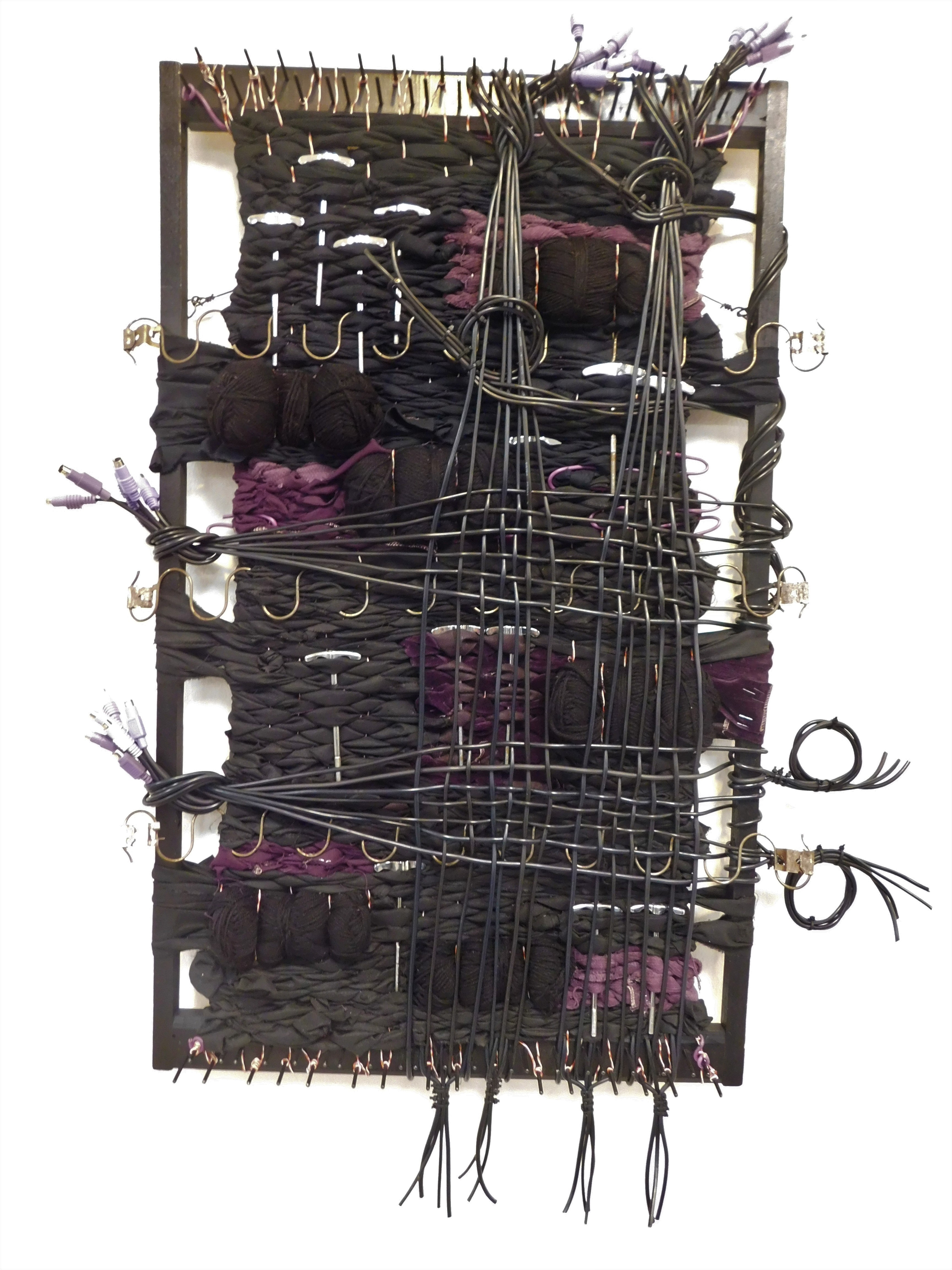
The Queen's Astronomer, by Jo Westfall

By Tom Wachunas 

   “Forget your ideas about art. Make a shopping list of everything you like about what you've done. Include qualities that you've seen in your life, in the world, and possibly in art that you like. Take this list and make a work that satisfies all of the things on your list without caring if it looks like art.”  — Joseph Kosuth

   “Art is an experience, not an object.” - Robert Motherwell

EXHIBIT: Joe and Jo – works by Joe Ostrowske and Jo Westfall / at Cyrus Art Gallery, 2645 Cleveland Avenue NW, Canton, Ohio / Meet the artists at “A Second Look”  party on January 20 at 6:30 p.m.– exhibit ends on JANUARY 30, 2023 / 330.452.9787 / Gallery Hours are Mon.-Fri. 10 a.m. to 6 p.m., Sat. 11 a.m. to 3 p.m.

    https://westfallrefinery.com/

   This provocative, intriguing and otherwise spectacular exhibit of paintings and assemblages has left me transfixed for weeks after first seeing it.  

   Joe Ostrowske has said of his highly expressionistic acrylic canvases that he is addressing “…the way that we all maneuver through the overlapping obstacles of life to find our way.”  Finding our way indeed.

    So what’s the destination? What specifically is being symbolized? That’s an open-ended proposition to be sure. If all else fails, slap your imagination in the face. Hard. Wake it up. Look long, and listen. Art expects nothing less. I’m willing to bet that if you ask 10 different people what any one of these pictures means or does exactly, you’ll get at least 20 different answers. Art can be like that.

   I read these paintings as a collective travelogue. They’re abstract extracts from a journey down the rabbit hole of a volatile nexus – a rough-hewn crossroads, where consciousness and subconsciousness (the artist’s and our own), along with unrestrained intuition coexist. The paintings are suffused with a dizzying diversity of stratified marks and scattered shapes amidst broad, amorphous bursts and rhytms of sizzling bright colors. There’s a palpable sensation of quick physical gestures, motion and transformation. An in-the-moment immediacy. Ostrowske’s style is a painterly stenography of sorts - shorthand explanations of the very actions and processes that brought the paintings into being.  Smudge, scratch and scribble; drip, doodle and delete; rub, rinse and repeat; expose, explore and erase; forget, flounder and find; initiate, improvise and illuminate; wail softly, whisper loudly and wonder always. Life can be like that.

   Meanwhile, versatile Jo Westfall has characterized her 2D and 3D works as “resource art.” Among her many fascinating entries in this exhibit are small, “portraits” of bruised, decaying fruit and vegetables, painted on grainy pieces of wood. In some ways they evoke the ancient aesthetic trope of memento mori – images made as warnings that life is short. Yet there’s nothing fearfully hideous about how these natural resources are depicted in their states of imperfection. Westfall’s exquisite technique imbues them not with the idea of death so much as a gentle savoring of their beautiful fragility.

    The caption accompanying the website (posted above) photo of Westfall describes her as “Designer of adornments, Delver of semi-conscious concepts, Explorer of seams.”  I would add, “Rescuer.” She’s a saver of found, castaway objects and various tactile materials. For her 3D pieces, she skillfully joins together seemingly unlikely candidates for the weaving process into elaborate assemblages that are a fascinating twist on conventional “fiber art.”  

    Read the list of ingredients for The Queen’s Astronomer: Repurposed fabrics and yarns, computer keyboard cables, drum tuners, piano parts, chair springs, zip ties, and phone cable. Or for Blow In It: Pneumatic hose, game controllers, phone cable, piano parts, coated wire clothes hangers, and AV cables. Here’s the sinewy meshing of ordinary computer guts, the common hardware innards of modern industry, or information and communication technology. But now, the original functionality of those components has morphed into a kind of metaphysical circuitry, transmitting a more purely aesthetic experience beyond the mundane and prosaic.

   So here’s to the warp and weft of 3D poetry.

Wednesday, January 4, 2023

Soulful Entrées


Soulful Entrées 


Requiescat in Pace, by Tom Wachunas

Naame (Reputation), by Chad Troyer

Coat of Sheer Empowerment, by Judi Krew

Seeing is Hearing, by Rodney Atwood

Birth of Matter, by Janis Salas

Fractured Light, by Emily Orsich

By Tom Wachunas 

“Art is a step from what is obvious and well-known toward what is arcane and concealed.”   - Kahlil Gibran

A work becomes a work of art when one re-evaluates the values of nature and adds one's own spirituality. — Emil Nolde

EXHIBIT: Annual Stark County Artists Exhibition / at Massillon Museum, THROUGH JANUARY 15, 2023 / 121 Lincoln Way East, downtown Massillon, OH / (330) 833-4061 /

www.massillonmuseum.org.

70 works of art by 49 artists (selected from 225 works submitted by 85 artists). More info, and participating artists, listed here:

 https://www.americantowns.com/event/stark-county-artists-exhibition-2022-12-23-massillon-oh.html

   While 2022 was for me - as for many of us, I suspect - an exceptionally daunting year in multiple areas of living, through all of it I have remained grateful for the ability to still make and look at art.  And in these fragile, conflicted times, some of the most moving works in this exhibit resonate on deeply spiritual planes with art that embraces and feeds the reality of the human soul. That said, I’m elated that my most recent artwork was accepted into this eclectic congregation of artists offering their responses to being alive. If you care to read more about my piece, click this link to my short blog post from July:

https://artwach.blogspot.com/2022/07/rest-in-piece.html  

   Meanwhile, here are a few entrées I found particularly savory.

  Fractured Light, an aptly-titled acrylic/ mixed media canvas by Emily Orsich, is a startling storm of scribbled marks and frenetic painterly gestures all aswirl in an exploding field of gritty textures. An apocalyptic encryption, it’s an epic war of opposites: light vs. darkness, good vs. evil. The world swallowed up and spit out.

   Far less ominous, the mixed media work on paper by Janis Salas, called Birth of Matter, is a mesmerizing sort of calligraphy. Look inside. Subtly nestled in the meticulous repetition of all those thin, black-white-grey curling lines, are wispy dots and dashes of other colors. Words, whispered across the waves, on the cusp of declaration, as in a divine command: Let there be… blue sky and fertile earth.

   Which brings up an intriguing question: Can we hear a painting? We’ve all at one time or another uttered that age-old response to a powerful image along the lines of, “Wow, that really speaks to me.” What, then, might we hear when looking at Seeing is Hearing, a large acrylic on canvas abstraction by Rodney Atwood?  What is this bold, teasing simplicity? An object lesson in synesthesia? The sound of one hand clapping? Maybe it’s a distressed pink dolphin, flapping noisily on a purple urban shoreline, bleating the words of Wassily Kandinsky, from his 1911 book, Concerning the Spiritual in Art: “Color directly influences the soul. Color is the keyboard, the eyes are the hammers, the soul is the piano with many strings. The artist is the hand that plays, touching one key or another purposively, to cause vibrations in the soul.”

   Judi Krew’s Coat of Sheer Empowerment is a sculptural figure of a standing woman bedecked in a delectable coat of translucent, ornate fabric remnants. The work is more than just a uniquely spectacular woman’s garment. Here’s a radiant celebration of impactful personhood, inscribed with the embroidered shapes of written words, such as Believe, Kind, Praise, Faith, Motivate, and Forgive. To read them, you need to walk around the figure and let your eyes trace the flow of the fabrics as they wrap their way up, down, and through the entire form. It’s not a matter of cursory glances at bits of pretty patterns so much as a process of discovering an empyreal wholeness. Like finding treasure.

   Speaking of reading and treasure, there’s Chad Troyer’s somewhat enigmatic tapestry and wood piece, strangely titled Naame (Reputation). A woven banner of burlap-like texture hangs in air, suspended from a wooden crossbar cut in the shape of a yoke. Questions abound. Is this a memorial to, or a symbolic portrait of, someone named Wally? Is/was Wally yoked to God? Look inside Wally’s name sewn (or could we say… sowed?) into the tapestry – his implanted soul, if you will - and see the tiny interwoven pieces of paper printed with Bible texts. The work reminded me of the words of Jesus recorded in Matthew 11:29-30: “… Take my yoke upon you and learn from me, for I am gentle and humble in heart, and you will find rest for your souls. For my yoke is easy and my burden is light.”   

   Making and looking at art is often a matter of probing the metaphysical, and just as often raises more questions than answers. So be it. Allow yourself this tired old conceit: It’s always about the journey, not the destination. So feast your eyes, feed your soul. Happy New Year and bon appétit!

Monday, December 12, 2022

Deck the Hall with Dickens


Deck the Hall with Dickens 


By Tom Wachunas

   “I will honour Christmas in my heart, and try to keep it all the year. I will live in the Past, the Present, and the Future. The Spirits of all Three shall strive within me. I will not shut out the lessons that they teach.”  Charles Dickens, A Christmas Carol

   THEATRE: A Christmas Carol, from The Players Guild Theatre, at Mary J. Timken Theatre in the Fine Arts Building of Kent State University at Stark, 6000 FRANK AVENUE NW, NORTH CANTON, OH/ Performances through December 18, 2022 / Box Office 330 – 244 – 3224 / Dates, tickets, and performance information at:

  https://playersguildtheatre.com/a-christmas-carol

   Background, and cast/crew information at: 

https://stagemag.broadwayworld.com/classic/A-CHRISTMAS-CAROL-2022-The-Players-Guild-Theatre-21706

    As a consumerist society in a mad world, what practices have we adopted to truly honor and savor the who and the why of Christmas? Conversely, how many of us have become souled-out and surrendered to the what of the ‘holidays’ - namely all the feckless commercialism and trivial superficialities we routinely heap upon them? For the moment, let’s forget jolly old elves, Rudolf, and Red Ryder Range 200-Shot BB guns. For the moment, let’s celebrate the efficacious conflation of classic literature and enthralling live theatre as one powerful device by which we can embrace the essence of Christmas.

   To that commendable end, The Players Guild Theatre is currently presenting, for the 41st year, Charles Dickens’ A Christmas Carol. This year’s exhilarating new production, in its new home, was adapted for the stage by  Beth Knox. The impressive scenic and authentic costume designs by Joshua Erichsen include meticulously rendered architectural facades and interior room sets that rotate scene-by-scene on an ingenious, large turntable. Beyond the luscious choral harmonies delivered by the Dickens Singers, the superb live music from the six-piece orchestra was arranged, composed and conducted by Steve Parsons, who also directed the amply talented cast.

  As the dark, sullen Ghost of Jacob Marley, Henrick Sawczak will sting you to your bones as he whips and cracks his heavy chains through the air and on the floor like bolts of lightning. Ashley Luli plays the Ghost of Christmas Past with charming, childlike innocence, imbued with a healthy dose of grown-up wisdom. Robert Trushel’s magnanimous Ghost of Christmas Present is all infectious ebullience until he leaves Scrooge on a very loud note of angry warning. As Fred, Scrooge’s nephew, Sam Marazita gives us a heartwarming picture of irrepressible optimism and willingness to love his unloveable uncle. Equally heartwarming are Matthew Heppe as Bob Cratchit, and Gabriel Amiot as his son, Tim, in their earnest and tender portrayals of high-spirited gratitude even in the face of cruel, humbling circumstance. All of the cast members – adults and children alike – perform with palpable, invigorating credibility.   

   Finally, then, Jim Graysmith’s presentation of Ebenezer Scrooge is an absolutely compelling embodiment of one man’s cathartic transformation from vitriolic misanthrope into lifelong disciple of selfless generosity and dispenser of joy. Even in the scenes when he’s not directly a part of the action, as he looks at the proceedings from a distance, we can still see clearly the sharpened, captivating expressions of genuine delight and wonder, or sorrow, or painful soul-searching on his face.

   In the 1843 introduction to his popular novella, Dickens wrote to his readers that he hoped his “Ghostly little book” would “haunt their houses pleasantly.” Did he have any idea of the urgency and relevance his story would still have nearly two centuries later? Talk about timeless storytelling.

    The Players Guild’s production isn’t about capturing the spirit of the tale only for the sake of feel-good entertainment. Call it a benevolent contagion, releasing that spirit into our active lives. The continued tradition of keeping this beautifully faceted, lustrous gem of a narrative shining is truly a necessary labor of love. Maybe all we should want for Christmas is to see more of us become redeemed Scrooges - instruments of hope, healing and light for those who desperately need it in an ever-darkening world.  

   Meanwhile, Thank You, Players Guild Theatre, for the blessing of your artful and inspiring agency in haunting our lives pleasantly.

Monday, December 5, 2022

With Eyes to See and Ears to Hear

With Eyes to See and Ears to Hear 


 …Do not conform any longer to the pattern of this world, but be transformed by the renewing of your mind. Then you will be able to test and approve what God’s will is – his good, pleasing and perfect will… – Romans:12:2 

    Holy Season’s Greetings to all of you! Here’s my annual “Christmas image.”

    At one point in painting it, I thought very deeply about what the writers (scribes, actually) of the Gospels must have experienced as they wrote God’s own words. I am certain that the faithful scribe pictured here was utterly transfixed and forever transformed, filled with an indescribable joy and an awesome hope beyond words. This image represents John, a most beloved disciple of Jesus, in the midst of delivering (in Greek) what we read today in Scripture as John 3:16: 

 For God so loved the world that he gave his one and only Son, that whoever believes in him shall not perish but have eternal life. 

Not a fantasy. Not a fiction. A fact. The perfect gift. The perfect peace and good will.

 Be BLESSED!

Saturday, December 3, 2022

Confabulations Extraordinaire


 Confabulations Extraordinaire


Sherri Hornbrook, (left) Honor, (right) Wings

Emily Vigil - Doing Dishes Together: Portrait of Us

Emily Vigil: Skipping Stones

Eleanor Dillon Kuder - Enduring Influence

Eleanor Dillon Kuder - Places She Called Home

Sherri Hornbrook -
 (clockwise from top left) Blossom, Departure, Nest, Pendulum

By Tom Wachunas 

  “Stop thinking about art works as objects and start thinking about them as triggers for experiences. What makes a work of art good for you is not something that is already inside it, but something that happens inside you.” ― Brian Eno

   “Nothing as drastic an innovation as abstract art could have come into existence, save as the consequence of a most profound, relentless, unquenchable need. The need is for felt experience - intense, immediate, direct, subtle, unified, warm, vivid, rhythmic.”   - Robert Motherwell

Painting is silent poetry, and poetry is painting that speaks. - Plutarch


EXHIBIT: CONVERSATIONS – paintings by Sherri Hornbrook, Eleanor Dillon Kuder, Emily Vigil / The Lemmon Visiting Artist Gallery, in the Fine Arts Building at Kent State University at Stark, 6000 FRANK AVENUE NW, NORTH CANTON, OH, THROUGH DECEMBER 9, 2022 / Gallery hours Monday – Friday, 11 a.m.-5 p.m.

   When it comes to paintings – whether making them, looking at them, or talking about them – I confess I’m an inveterate Romantic with an “unquenchable need.” Like many of us, I look for more than facile faithfulness to the familiar, or something more than skillfully rendered prosaic realism devoid of poetic spirit.

  The most compelling paintings aren’t just mute, decorative wall ornaments. They transcend static, generic images of mundane banalities. Rather, they’re events still forming, conversations still transpiring, or on the verge of commencing.

   Those conversations begin with the painters’ often intuitive methods for responding to their own mark-making - their storytelling, as it were. Such personal narratives are born out of a call-and-response process which evolves in real time across the picture plane.

    On one level, a “finished” painting is a private dialogue between marks and mark-maker. But the dialogue need not end when picture is mounted on wall. It can grow and expand when we viewers become third-party makers by virtue of our practiced, intentional looking. When we allow ourselves ample time to free our own intuitions, we can hear with our eyes. We can interpret messages or meanings as we see fit, or if not, find sublime contentment in savoring the potency of pure mystery. Either way, paintings can in fact speak in our real time if we imagine them first as inhaling our willful gaze, and then exhaling the “words” – indeed the life - of the painter. It is a powerful agency, stunningly present in this spectacular exhibit, bejeweled as it is with 56 works by three remarkable artists: Sherri Hornbrook, Eleanor Dillon Kuder, and Emily Vigil.

   Eleanor Dillon Kuder’s mesmerizing, mixed-media figural pieces are airy and mystical portraits of a kind, aglow with saturated, vibrant color. Recumbent or ascending women (perhaps self-portraits?) float, seemingly immersed in deep meditation, seeking or already embracing beauty at once electrifying and serene.

   There’s also an aura of meditation and spirituality in the soft chromatic translucency of Emily Vigil’s small-scale watercolors. In one series, her grid motifs of gently modulated colors are pixelated, in-the-moment flashes of personal encounters and memories. Additionally, there are equally elegant works from another series of compositions more directly representational in nature, called “Dishes Done.” These still-lifes from the kitchen are intriguing metaphors for intimate domesticity.

   Sherri Hornbrook’s canvases are dense, dazzling adventures. They breathe with both visceral and delicate painterly gestures amidst all manner of complex organic shapes and lines, rich color harmonies and dissonances that dance together, all enmeshed with intricate, pulsing patterns. Dichotomies united: finite with infinite, calm with conflict, light with shadow. The stuff of being alive.

   To Eleanor, Emily, and Sherri, thanks for talking with us. Your eloquence is enlivening.    

Friday, November 18, 2022

Psychscapes


Psychscapes 


Reach

Take Care of My Flowers

Will-o-the-Wisp

Metamorphosis

Leverage

Imitation

By Tom Wachunas

“There is no shape to the feeling that has gripped me, no name. Manifested in amorphous sensations and rippling currents – bringing one moment a tear, then a smile; there is no comprehending this wave. A hummingness courses through my mind.”

― Radhika Mukherjee, from “Broken Shadows”

“Abstract art is uniquely modern. It is a fundamentally romantic response to modern life - rebellious, individualistic, unconventional, sensitive, irritable.”  - Robert Motherwell


EXHIBIT: Emily Orsich – First Solo Exhibit, at John Strauss Studio, 236 Walnut Avenue NE, downtown Canton, THROUGH DECEMER 16, 2022 / viewing hours Monday-Friday 10 a.m to 5 p.m / Saturday 10 a.m. to 4 p.m.

   A recurring motif in Emily Orsich’s commanding paintings is a confluence of assertive boldness and delicate fragility, describing things simultaneously settled and tentative, solid and liquid. Her configurations are kinetic, intricate synchronies of opposites that nonetheless exist in an uneasy equilibrium.

   So what could these ‘things,’ these ‘opposites’ be? Maybe think of the painter as a cartographer, drawing in code, here mapping terrains of a kind, often inlaid with broad swaths of black and blood red - like rivers, deep-cut roads, or skid marks - juxtaposed with wandering crooked rivulets, amorphous translucent pools, and quiet, empty plains.

   Beyond sketchy, enigmatic connections to earthly geography, however, the expressive immediacy of these works also suggests metaphors for another type of terrain. Which is to say the artist’s state of mind and heart.  

   In this context, consider Orsich’s style of abstraction as a kind of writing. Think of her mark-making as a spontaneous cursive script, approaching a form of calligraphy both agitated and strangely elegant. 

   Could these paintings then indeed be narratives about Orsich, and by extension, all of us viewers willing to trust our own intuitions? Are these stories about navigating personal relationships? About resolving conflicts? Or finding joy amidst chaos? Or serenity in anxiety? Psychological balance? About growth, discovery, and catharsis?

   The answer’s in the looking. More power to ‘ya.

Monday, November 14, 2022

Compelling Drama, Mesmerizing Virtuosity


 Compelling Drama, Mesmerizing Virtuosity 


Pianist Michelle Cann

Gerhardt Zimmermann

By Tom Wachunas

…No, no, no, no, no, no, no /I'm overdue /I'm really in a stew/

No time to say goodbye, hello /I'm late, I'm late, I'm late

-      Lyrics from “I’m Late” from Disney film Alice in Wonderland

   Late indeed. With Thanksgiving nipping at our heels, I’m slowly returning to my writeful place here on ARTWACH, and very grateful for all the loving encouragement you readers sent my way following my previous post about my medical woes. So here’s a long overdue THANK YOU to the Canton Symphony Orchestra (CSO), now celebrating its 85the Anniversary, for yet another superb adventure into sheer musical excellence.  

    In writing about the CSO’s October 30 concert, Music Director and Conductor Gerhardt Zimmermann casually mentioned that a few of the selections were meant to “…help usher in Halloween the next day…” Fittingly, the intriguing thematic diversity of the program of four works certainly did include a few especially haunting journeys to the dark side.

   The evening commenced with César Franck’s 1883 macabre symphonic poem, Le Chasseur maudit (The Accursed Huntsman). The work was inspired by a ballad by German poet Gottfried August Bűrger, and tells the tale of The Count of Rhine who, on one fateful Sunday, decided to forego obligatory church devotions in favor of galloping into the woods to hunt, happily blowing his horn. The absolutely sumptuous sounds of the CSO strings and bright percussive chimes calling the faithful to worship on a sunny day soon enough gave way to the piercing clarity of the naughty horn calls. The hapless hunter proceeds to ride his way into the darkness wrought by his guilty conscience and subsequent pursuit by Satanic demons. For desecrating the Sabbath, the hunter became hunted by Hell itself. In telling the story, the orchestra quite effectively soared to chilling depths of aural scariness.

   And then, a mesmerizing respite from bittersweet morbidity transpired, thanks to the exquisite technical virtuosity of guest soloist Michelle Cann. Her dazzling piano wizardry was truly a wonder to behold as she brought to light and life the effulgent lyricism of Piano Concerto in One Movement, composed in 1934 by African -American composer Florence Price (1887-1953).

    Cann returned after intermission to further regale us with jaw-dropping panache in her rendering of Richard Strauss’s complex and rowdy Burleske for Piano and Orchestra. When the enthralled audience clamored for an encore, Cann eagerly obliged. With stern authority, she pounded the keyboard with the first three brooding chords of Rachmaninoff’s iconic Prelude in C sharp minor.  But then, not missing a beat (and no doubt in a Halloween spirit of clever mischief), Cann immediately unleashed a raucous and riveting mashup of Rachmaninoff’s motifs into a blindingly fast and seamless hybrid of jazzy- boogie-woogie - ragtime variations. At once brilliant and hilarious.          

   The evening concluded with yet another fierce trip into doom - Tchaikovsk’s magnificent 1876 Symphonic Fantasy, Fransesca da Rimini. For this narrative, Tchaikovsky sourced Dante Alighieri’s iconic 1321 allegory, The Divine Comedy, particularly its visit to the second circle of Hell, where sins of the flesh are punished, the sinners whipped mercilessly by roaring winds in eternal darkness. In a stunning interlude - slowly developed with achingly sweet melodies - Fransesca da Rimini and her lover Paolo are allowed to rise above the torture and tumult long enough to recall their carnal happiness in one of Tchaikovsky’s most heartrending love themes, only to be sent back to explosive torment. When the last frenetic cymbal crashes and violent drum rolls sounded the anguished finale of this work, please don’t think me too frivolous when I say I could practically hear a replay of the rattled lion’s chant in the Wizard of Oz movie, “I do believe in spooks, I do believe in spooks, I do I do I do I DO!”

   And so once again, when all was played and done, I too remained a believer. Certainly not in fictional ‘spooks’ as such, but far more importantly, in the Canton Symphony Orchestra as a palpable aesthetic force, haunting – and blessing – us with its always potent and inspiring embrace of pure, artful sublimity.

https://www.cantonsymphony.org/