Monday, October 25, 2021

Mindful Moments Well Met


Mindful Moments Well Met 


Gerhardt Zimmermann

Jenny Robinson

Margaret Brouwer


By Tom Wachunas 

   “…But as the sun rises above the horizon, a little breeze picks up and the boat begins to move more steadily…”  - Margaret Brouwer 

   Please forgive my extreme tardiness in posting these comments, but…drum roll, please. Live, from Umstaddt Hall in the Zimmermann Symphony Center, The Canton Symphony Orchestra (CSO), with Maestro Gerhardt Zimmermann conducting, commenced the 2021-2022 concert season on Sunday, October 10.

   https://www.cantonsymphony.org/the-season-overture/ 

  In lieu of a detailed piece-by-piece review of the concert, I simply want to share with you a few “moments” from that evening that filled me with especially deep gratitude as well as a renewed sense of anticipation.

   The October 10 concert opened with Northeast Ohio composer Margaret Brouwer’s The Art of Sailing at Dawn. Written during the pandemic, the optimistic and exhilarating work depicts a morning sail, through the tranquility of smooth water and the exuberance of crashing waves, the sails filling with brisk winds. Here are Brouwer’s program notes:

   “Imagine preparing to board a sailboat at dawn.  The water is completely calm.  There is hardly a sound except the occasional early morning birdcall and sound of a ripple breaking on the shore.   Leaving the dock, you are barely moving on the calm water. But as the sun rises above the horizon, a little breeze picks up and the boat begins to move more steadily.  As the day arrives, the breeze becomes a steady wind, and occasional big waves smash into the boat before everything is calm again.  The technical requirements and knowledge it takes to sail a big boat, are exhilarating, but are outweighed by the feeling of the peace and the emotional response to the beauty and power of the water and open space.  It reminds me of the popular 1974 book, Zen and the Art of Motorcycle Maintenance which demonstrates that rational expertise and Zen-like “being in the moment” can harmoniously coexist.” 

   In many ways, Brouwer’s words aren’t only a superbly concise description of her engaging and beautiful music, wondrously rendered here by the orchestra, but also a timely reminder of what could best be called the CSO’s promising dawn after a long night of pandemic-induced absence from our midst.

   And then there was an equally enticing performance of Jacques Ibert’s 1932-33 work, Flute Concerto, here featuring the electrifying solo debut of CSO Principal Flute, Jenny Robinson. Ibert’s work is a veritable romp through complex rhythm changes, aural colors and orchestral textures that pose dizzying technical challenges for the soloist. Robinson navigated all of them with flawless, truly robust virtuosity. She was wholly mesmerizing in the way she embraced the music’s constantly shifting energies between jaunty frivolity, tender lyricism, and poignant introspection.

   Altogether, the concert was a refreshing burst of light and an enlivening gust of fresh air – an inspired announcement of the CSO’s steady return to the space of our lives. And so in the aforementioned spirit of gratitude and anticipation, I’ll leave you with this link to info on the next CSO concert on November 14 at 7:30 p.m.. Consider it an invitation to experience the illuminating and healing power of live orchestral music for yourself.

https://www.cantonsymphony.org/prelude-for-strings/

Thursday, October 14, 2021

Metascores (rhymes with...)


                                                             Metascores (rhymes with…)  


Chorus: 34 Drag Chute

Chorus: Little Nova Rocker

Chorus: Singing Through a Hole

Chorus: Singing Through the Fence

Chorus: Singing on President's Day

Chorus: Gold Finch Song


By Tom Wachunas 

   “A painter… in his longing to express his inner life, cannot but envy the ease with which music, the most non-material of the arts today, achieves this end. He naturally seeks to apply the methods of music to his own art. And from this results that modern desire for rhythm in painting, for mathematical, abstract construction, for repeated notes of colour, for setting colour in motion.”

Wassily Kandinsky, from Concerning the Spiritual in Art

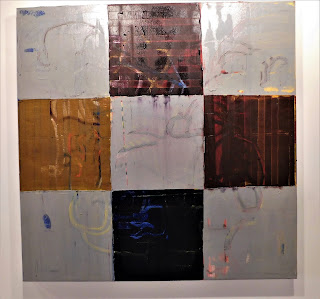
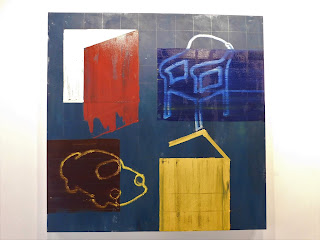
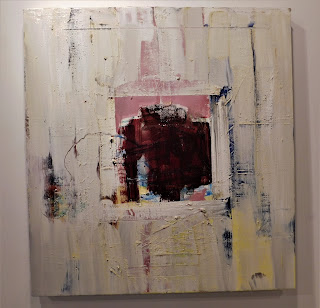
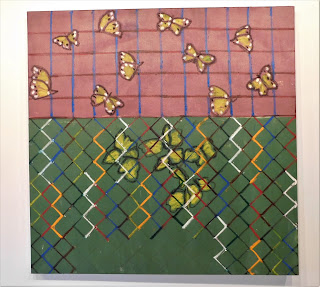
EXHIBIT: Chorus and Understudy, An Invitation to Look – 29 paintings by Earl Iselin / at The William J. and Pearl F. Lemmon Visiting Artist Gallery, located in the Fine Arts Building at Kent University at Stark / 6000 Frank Avenue NW, North Canton, OH / THROUGH OCTOBER 29, 2021 / Gallery Hours Monday – Friday, 11 a.m. – 5 p.m. (NOT OPEN on Friday, Oct. 15)

FOR MORE INFORMATION, CONTACT JACK MCWHORTER AT 330-244-3356 OR JMCWHORT@KENT.EDU.

Artist Reception and Gallery Talk – THURSDAY OCTOBER 21 - 5:30 – 7:30 p.m.

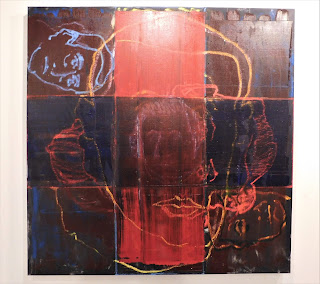
    In a recent statement about his work, Earl Iselin wrote about a seminal encounter from his days as an undergrad at Kent State University. While there, he often visited Robert Smithson’s land art installation, Partially Buried Woodshed, made on the University grounds in 1970. Sitting inside the entropic structure (i.e., designed by Smithson to disintegrate over time) induced a sensation of being buried alive. In that setting, Iselin’s view of the sky – a signifier of possibility for fully experiencing a present moment  – was obstructed.

   That memory resonates in his poetic philosophizing about painting. What he has called “skying the painting” speaks to the purpose of his pictures. “To be at home in painting means to defy the past,” he tells us, adding, “Every generation has to come to painting for itself. Every generation must go through the labor of off-loading in order to find what is appropriate for them, to unemcumber their work. We have to decide what we will take with us into the present, and what we will leave behind. Our inspiration must find lift.”

    Looking at these paintings brings to mind the phenomenon of synesthesia, from the Greek syn, meaning "together", and aisthesis, meaning "sensation." Synesthesia happens when one sensory or cognitive process is stimulated enough to cause a simultaneous perception or experience in another sense or cognitive pathway.

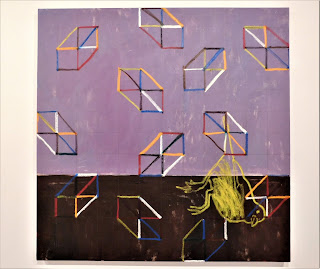
    A recurring pathway in Iselin’s paintings is the grid. It’s a motif apparent in much of modernist painting history, and one that can codify any number of contexts, including architectural constructions, urban landscapes, maps, measured units of time, or the very idea of repeated patterns found in nature.

    Iselin’s grids vary widely in terms of their rigidity and clarity. There are painterly, tactile actions – both representational and purely gestural or abstract – resting under, intertwined through, or placed directly on top of the grids. Faces, places, or objects – faded or fading, softly in the past, or loudly in the present. Balance and counterbalance. Seen and… heard?

   The titles of these paintings are intriguing. Most of them suggest a musicality, beginning with the word ‘Chorus’ followed by a reference to a specific subject. Voices singing and continuously interwoven. Iselin’s use of the grid as a delineated system for containing his marks and shapes is not so far removed from how a composer scores a musical work via a staff - the horizontal, 5-lined configuration for attaching or mapping the various signs and symbols that articulate melodies and harmonies, pace and rhythms, or durations in time.

   So here’s an invitation to not only look, but perhaps to listen as well. Iselin’s paintings are, on one fascinating level, scores written for the instrument of his imagination and yours. To look at this impressive collection is to join a choir and…find lift.

Friday, October 1, 2021

Unto Dust?


Unto Dust? 


Homecoming (2018)

Precedent (detail)

detail

detail

Precedent (2021)

By Tom Wachunas 

   “…for he knows how we are formed, he remembers that we are dust.”  - Psalm 103:14

   “…We know that the whole creation has been groaning as in the pains of childbirth right up to the present time.”  - Romans 8:22

   “Be anxious for nothing, but in everything, by prayer and petition, with thanksgiving, present your requests to God. And the peace of God, which surpasses all understanding, will guard your hearts and your minds in Christ Jesus. Finally, brothers, whatever is true, whatever is honorable, whatever is right, whatever is pure, whatever is lovely, whatever is admirable—if anything is excellent or praiseworthy—think on these things.…”  Phillipians 4:6-8

   “I have told you these things, so that in me you may have peace. In this world you will have trouble. But take heart! I have overcome the world.”  - John 16:33

   The inveterate Word nerd strikes again. On one level, this most recent work of mine - titled “Precedent” – began in a spirit of disdain. Actually, hate would be more accurate. I’ve come to hate the attachment of the word unprecedented to just about every report and opinion on this protracted pandemic season of ours. As it is now, too much of humanity is floundering in a merciless vortex of anxiety and anger, confusion and conflict, medical mayhem and moral malaise. And no measure of political poppycock and prattle can alleviate our pain.

   But,…unprecedented? A rarely mentioned, much less researched, COVID side-effect is its power to turn us into blithering amnesiacs when it comes to remembering our plagued history as a species on earth. Call it an Anthropocene nightmare. Britannica.com defines the Anthropocene epoch as the “… unofficial interval of geologic time, making up the third worldwide division of the Quaternary Period (2.6 million years ago to the present), characterized as the time in which the collective activities of human beings (Homo sapiens) began to substantially alter Earth’s surface, atmosphere, oceans, and systems of nutrient cycling ...”  

   These days, I’m thinking that the Anthropocene should be renamed the Entropocene, as in entropy – our collective, ongoing decline into profound disorder in virtually every aspect of existence. There is indeed a precedent for my newest painting. I think of it as a topography of a tautology. I / we have been here before, again. And so I repainted a work from nearly four years ago. I wrote about that painting (shown here above) in a post from early 2018, titled, ironically enough, “Can the past have a future in the present?”

http://artwach.blogspot.com/2018/01/can-past-have-future-in-present_89.html  

   The old painting exists now only as a digital image, a memory. Meanwhile, traces of it are still present in the new work. It isn’t an alteration so much as an altaration – a performative, sacrificial prayer to reach for the promised peace of God while living in a troubled world. I fully believe that it is that peace alone which will overturn our entropy.

Wednesday, September 22, 2021

Sublime Symbiosis


Sublime Symbiosis 


Old Delhi - Jama Masjd

Others in their World

A Synnoetic System (detail)

A Synnoetic System

Synnoetic Systems - 7

Synnoetic Systems - 6

By Tom Wachunas 

   “In creating these works I combine our most advanced digital tools and processes with ancient traditions of making. This series represents a world within our world; an unseen world at the edge of our perception, at the edge of what our most advanced tools are able to measure…The driving force behind the work for me is always to make the work as beautiful, sensual, felt, and sometimes whimsical as possible, regardless of media.”  - Gregory Little

EXHIBIT: Parallel Worlds – Mixed Reality Artwork by Gregory Little / at The William J. and Pearl F. Lemmon Visiting Artist Gallery, located in the Fine Arts Building at Kent University at Stark / 6000 Frank Avenue NW, North Canton, OH / THROUGH SEPTEMBER 30, 2021 / Gallery Hours Monday – Friday, 11 a.m. – 5 p.m.

FOR MORE INFORMATION, CONTACT JACK MCWHORTER AT 330-244-3356 OR JMCWHORT@KENT.EDU.

Reception and Gallery Talk – THURSDAY September 23 - 5:30 p.m.

From Merriam-Webster/  Symbiosis (sim-bē-ˈō-səs- )  = the living together in more or less intimate association or close union of two dissimilar organisms; a cooperative relationship

   I am agape. Agog. Amazed and awestruck. Flabbergasted and gobsmacked. Did I mention impressed?

   So this is when an art gallery can be more than a typical art gallery. Right now, The William J. and Pearl F. Lemmon Visiting Artist Gallery at KSU Stark is a spectacular junction. A magnificent experiential crossroads. A compelling  nexus of the micro and macro, the mystical and mundane.

   The 32 works in this exhibit - ranging in scale from hand-sized, to pieces more than 5’ tall (as in the Synnoetic Systems series) or the 7’-wide A Synnoetic System - consist of mixed media paintings, collages, and archival digital prints.  They combine hand-ground pigments with digital elements and processes. Also included is a non-looping digital animation of endless evolving DNA splices, and a 12-minute animation set to a composition by the renowned composer Jeffrey Mumford.

    Not long after he was hired to teach painting at Kent Stark in 1989/90, Gregory Little, who currently teaches digital art at Lorain Community College, embarked  on a path to learn everything necessary to make virtual reality artworks.  “I stopped painting and devoted myself to this task for eight years,” he explains, “and succeeded in learning about all aspects of VR (virtual reality) to make and exhibit my own virtual worlds.  Now I have returned painting to my toolkit, but also use all that I have learned to produce a variety of digital assets that I use and reuse across a range of mediums.”

   Little’s works certainly aren’t conventional scenes or pictures of objective, familiar realities. To fully look at them is to be willing to engage a state of mind and be drawn into contemplations of indeterminate depth. It is to enter evocations.

   The striking Synnoetic Systems pieces, for example, are named after a term coined in 1961 by computer scientist Louis Fein to describe what he had called the “…symbiosis of people, mechanisms, plant or animal organisms, and automata into a system that results in a mental power (power of knowing) greater than that of its individual components.”

   Little has translated this concept into breathtaking, multidimensional panoramas. They’re blissfully dense with infinitesimal details. Otherwordly indeed. The stratified minutiae of organic particles and shapes, whether clustered in groups or individually floating within supernal networks of fibers and filaments, all seem to oscillate and glow, as if shot through with bursts of colored light from many distant suns.

    The art of Gregory Little is a wondrous navigation of the longitudes and latitudes of visual perception itself, and an otherwise astonishing spiritual adventure. Might this be what Nirvana looks like?

Saturday, September 11, 2021

In Memoriam: 911


In Memoriam: 911


By Tom Wachunas 

   Ten years ago I was blessed with the opportunity to be included in a group show at downtown Canton’s Anderson Creative (later named Translations Art Gallery), guest-curated by Dr. Fredlee Votaw. Some of you readers may remember the exhibit. It was called “The Persistence of Memory” – commemorating the 10th Anniversary of 911. Here’s a link to my comments on the exhibit from back then:

http://artwach.blogspot.com/2011/09/mournings-after.html

   So here we are once more immersed - thanks largely due to the towering medium of television - in our recollections of 911, twenty years later.

   And here I am likewise immersed. Not only in remembrance of an overwhelmingly tragic event, but also in recollections of making my contribution to that 10th Anniversary exhibit - a sculpture, nearly 5’ tall, called Window on the World. The process was a long one, evolving through about 10 weeks during the summer of 2011, and one I continue to think of as a series of daily meditations and a season of protracted prayer.

   It started with purchasing, then gutting (removing the heavy picture tube) a big, used Magnavox television from a Salvation Army store. An eery serendipity, this finding a Magnavox TV. Magna vox, Latin for “great voice”.  Next, building a wood pedestal. Then faux-painting those forms to suggest the marble or granite finish of an elaborate gravestone - a funereal totem.

   The protracted prayer element commenced when I began to handwrite a litany - the names of 2,977 people - on to 41 sheets of white paper, on each page three columns of names. As I scrolled down the online list I found of all those who perished, one name at a time, I touched the desktop screen, offering aloud each name to God as I wrote it onto paper. I made photocopy reductions of those 41 pages, finally cutting them into thin vertical strips that I glued to the inside walls of the hollow TV shell, arranged to perhaps suggest the metropolitan skyline of NYC.  

   Even as I type this now, in this moment at my computer desk, I can hear my TV in the living room, broadcasting the reverential ceremonies transpiring at the 911 Memorial in lower Manhattan.

   Television. Tell a vision. In this moment, I am praying yet again. Looking through this window on the world. Here, but for the grace of God…

Wednesday, September 8, 2021

3D Menuscripts


3D Menuscripts 


Cozy Coupe (oil on canvas)

Hoover Concept II (oil on canvas)

Running Late

Jamie's Hand

Our House Cafe

Glass Rack 1 & 2

By Tom Wachunas


“Art should be literally made of the ordinary world; its space should be our space; its time our time; its objects our ordinary objects; the reality of art will replace reality.” – Claes Oldenburg


EXHIBIT: 86’d – work by Daniel McLaughlin, at VITAL ARTS GALLERY /

324 Cleveland Ave NW , in downtown Canton, Ohio / Gallery Hours: Wednesday 4-8pm, Thu-Sat 6-10pm / THROUGH OCTOBER 16, 2021

   From the posted exhibition statement: “86’d is a series of contemporary works created by Canton artist Daniel McLaughlin. The collection is inspired by his career in restaurants spanning 20 years, and the often overlooked objects and materials in the service industry…Large scale, non-traditional canvas structures with emphasis on three-dimensional elements…Painting and sculpture combine various plywood, paints, and finishes to create these minimally representational and playful works of art.”

   So, Pop Art meets Minimalism? Here’s a truly fresh and fascinating salad, if you will, of big, wall-mounted mixed-media sculptures, along with three oil paintings. But first, there’s the terse yet conceptually loaded title of the show, 86’d. 

   While the precise origins of the term are unclear, the most frequently cited history of the expression relates to the restaurant industry of the early 20th century. By the 1930s, many restaurants in the U.S. were using ‘86’ as a shorthand code for “not available,” or “we’re out of this item.” Other anecdotal tales mention Chumley’s, a legendary bar in New York City located at 86 Bedford Street, where rowdy patrons were routinely thrown out the door, and where they no doubt took notice of the large 86 overhead as they were carted away by the cops. This came to be called “being 86’d.”  Other associations are military in nature, such as Article 86 of the Uniform Code of Military Justice, handling soldiers who have gone AWOL. The code was also used in reference to enemy planes shot down during the Korean War by F-86 fighter jets.

   McLaughlin recently shared this observation with me: “…I wasn't sure how well known the term is to people that haven't worked in the industry.  But 1986 is the year I was born so I felt that was a good fit being that a lot of the work is self representative.  And on certain days and times I feel out of myself (depleted) in a way, as do others across, I think, any industry.  But in contrast to that, doing this work was really motivating and energy- giving.”

    In some ways, McLaughlin’s intriguing works here can be regarded as 3D pages from a personal journal, or a surrogate self-portrait. Some of the pieces include flattened accumulations of seemingly countless handwritten guest checks and meal orders sealed into the surface of the plywood forms. These are gathered records of his and fellow workers’ time on the job - menu mementos, customers’ appetites recalled… the prosaic graffiti of restaurant stewardship.

   Considering the well-publicized negative impact of COVID trauma on the restaurant industry, it is just a little ironic that this show doesn’t really feel so much like a sad 86-ing as it does an honest, even optimistic affirmation of a livelihood built on the materialities of culinary service.  

   Call it metaphoric food for thought, and energy-giving at that.  

Friday, August 27, 2021

Krew Couture


Krew Couture 


We Burned

What color is your COVID?

Dress for Sex-cess: Truth or Dare

Good and Hot (left) / The Peacock Gown

COVID Coat #2 and the Hydration Dress


By Tom Wachunas 

“…Fashion is instant language.”  Miuccia Prada 

EXHIBIT: Judi Krew: Hoard Couture, Where Art Meets Fashion / Through October 6, 2021, at Massillon Museum STUDIO M / 121 Lincoln Way East in downtown Massillon, Ohio / 330.833.4061

https://www.massillonmuseum.org/

From Judi Krew’s exhibition statement: “…I embrace the mantra of reuse, repurpose, reconsider, and reimagine to guide the overall concept of each piece. What began nine years ago as a small scale sculptural dress serves to explore the idea of why we feel the need to hold onto “things”, this project has grown into an exploration rooted in problem solving…The original intent of Hoard Couture, to reduce an accumulation of things, has evolved over time into a series that sometimes looks back at our past and perhaps also forward to our future…”

   Here’s an eye-popping parade of femiquinns bedecked in a bodacious array of unconventional materials. In this context, we can rightly regard Judi Krew’s works as not just “fashion design”, but also as remarkable mixed-media sculptures.

   On a purely formal level, she consistently achieves an elegant balance of volume and mass animated with electrifying patterns and textures, and all harmonized by an intoxicating color sensibility.  

   On a conceptual plane, I think there’s a kind of probity to many of these pieces that brings new meaning to the idiomatic trope of wearing one’s heart on one’s sleeve. In all of their astonishing intricacy of constructed details, these exquisitely crafted assemblages are more than merely decorative. They’re declarative. I’m confident that you would be well served to read the text placards accompanying each piece, wherein Krew speaks about the history of her materials and their ideological symbolism, as well as processing and resolving the technical challenges in making a given piece actually wearable.

  Fashion statements indeed. Here’s just a few examples.

   Dress for Sex-cess: Truth or Dare is a stark white denim dress covered with handwritten names or victim numbers of 358 women who filed sexual harassment claims against Bill Cosby, Harvey Weinstein, Roy Moore, Bill Clinton, and Dr. Larry Nasser. It’s a literally gripping document and, as Krew tells us, “…a walking, wearable record of history to spark conversation and awareness.”

    What color is your COVID is a cape comprised of neckties with varying configurations of circles, spots and dots, and attached toetags with numbers written on them. Krew counted every single one of those circles, spots and dots, totaling 44,935. But that number is just a starting point for grasping the symbolism of this ingenious work. Once again, here’s where reading the placard can be especially vital in appreciating the meticulous way Krew breaks down that tally further into a sort of algorithm signifying the staggering and still growing number of COVID victims in the U.S.

   We Burned is a beautiful and haunting remembrance of the deadly 2018 California Wildfire season. That billowy bodice is a cluster of 2,000 hand-cut “leaves”, each one burned or charred, and made from such things as greeting cards, photos, wrappers and cartons – stuff easily lost to fire. Krew adds this poetic note: “…Sometimes a leaf will fall off and float away, another lost soul returning to nature.”

   In all, the excellent physical installation of this collection exudes an inspiring theatricality. You might easily imagine being backstage at a fashion show, or standing in the wings while gazing at the line of “models” poised to strut and swirl their fantastic finery onto the runway. A palpable sense of imminence. Suddenly those static sculptures seem positioned to become kinetic entities in space - a thrilling and provocative work of performance art.

   MEET THE ARTIST at the STUDIO M reception on Saturday, Aug. 28, from 5:00 to 7:00 p.m.

ALSO, MassMu will post a podcast interview with Judi Krew on Tuesday, September 21, at noon.