Tuesday, September 10, 2013

An Artful Fostering of Hope


An Artful Fostering of Hope

By Tom Wachunas 

    “It’s not just about a ‘good production’ anymore. It can’t be.” So wrote Jonathan Tisevich back in 2010, when he directed Annie at the Canton Players Guild Theatre. His program notes at the time expressed his hope that the production would somehow move theatre goers toward making a difference in the lives of marginalized children in the real world.

    Tisevich is back in the director’s seat for this current run, and once again shares that same hope, demonstrating a remarkable giftedness in eliciting palpable sincerity, believability, and generally unflagging energy from his cast. While consistently sustaining the story’s spunky child-appeal, his directing lets the story rise above the platitudes of a musical comic strip. This Annie exudes a very adult moral urgency. Yes, the mood often waxes sentimental, but strongly dosed throughout with bittersweet relevance.

    That mood is established from the outset by Annie, played by Brianna Swinford, and her 16 orphan cohorts. Swinford’s rendering of Maybe (a duet with Bella Gambone as the orphan Molly), wherein she imagines what her parents might be doing and prays for them to return, is achingly wistful. Throughout the evening, her impressive singing is infused with tonal purity and warmth. Her performance of the iconic Tomorrow is charming, mellow and airy rather than show-biz brassy. Additionally, she brings to her character a wholly disarming blend of tomboyish pragmatism and indefatigable optimism.

    And it’s a similarly infectious, sizzling gusto that informs all the orphans’ performances, starting with their fierce, electrifying communal romp through Hard Knock Life. The adorable second-grader, Bella Gambone, is practically a show unto herself, particularly when as she apes the booze-gulping orphanage supervisor, Miss Hannigan, played by Trisha Joy Fites.

    Fites’ portrait of Hannigan is a fairly riveting study of blatant self-absorption - at once a darkly humorous caricature of inebriated swagger and a sociopathic reality. Her malevolence is especially chilling in her brooding performance of Little Girls.

    Meanwhile, Jason Green is outright hilarious, in a scary sort of way, as Miss Hannigan’s con artist/ jailbird brother, Rooster. And Taylor Scott is deliciously animated in her role of Lily, Rooster’s ditzy girlfriend, imbuing the character with vaudevillian verve.

    As Oliver “Daddy” Warbucks, Jay Sigler projects an endearing awkwardness in his early time with Annie, which progressively blossoms into real affection. His singing seems tentative and lacks the relatively soaring technical finesse that Heidi Swinford brings to her lovely portrayal of Grace, Warbuck’s assistant. That said, Sigler nonetheless embodies the convincing authenticity of a man anxiously courting new possibilities, a man embracing both self-awareness and selflessness. He tenderly communicates as much during the second act when he sings Something Was Missing.

    One example of effectively nuanced direction here comes at the end of Act I, after Warbucks has announced his intention to locate Annie’s parents at any cost, thus sacrificing his desire to adopt her. While the ensemble singing throughout most of the evening is certainly zestful enough, the energy in You Won’t Be an Orphan for Long is distinctly understated. Even as the words of the song ostensibly express joyous optimism, the mood is an ironically solemn, subdued conveyance of sorrow at the possibility of Annie’s departure.

     And once again, the Players Guild employs the tried and true pairing of vivacious choreography by Michael Lawrence Akers with the jazzy ebullience of the live orchestra directed by Steve Parsons. It’s a winning combination that thrusts the nostalgic musical spirit of the 1930s into fresh, sparkling relief.  

    In the end, I was reminded that Warbucks’ real wealth isn’t to be found in his bank balance. It is rather in the overflow of his genuinely caring heart - a willingness to answer a child’s hope.

    Seen in that light, and in these times so saturated with intractable cynicism and despair, maybe the most efficacious take-away from this  uplifting work of musical theatre is the hope that life could indeed imitate art.

    Annie, at the Players Guild Theatre, 1001 Market Avenue North, Canton. Performances THROUGH SEPTEMBER 29, at 8 p.m. Fridays, 2 p.m. Saturdays and Sundays. Tickets $25 adults, $23 seniors, $19 for 17 and younger. To order, visit www.playersguildtheatre.com or call 330-453-7617.
    PHOTOS by Michael Lawrence Akers, from top: Brianna Swinford as Annie; The orphans; Trisha Joy Fites as Miss Hannigan; (left to right) Jay Sigler as Oliver Warbucks, Brianna Swinford as Annie, Heidi Swinford as Grace

    For other commentaries by Tom Wachunas on the performing and visual arts in the greater Canton area, visit ARTWACH at www.artwach.blogspot.com

Monday, September 2, 2013

Celebrating Interconnectivity


        Celebrating Interconnectivity
        by Tom Wachunas

        “The painting has a life of its own. I try to let it come through.”
         -Jackson Pollock

        EXHIBIT: Out of Impulse, work by Betsy Cavalier, at The Little Art Gallery THROUGH SEPTEMBER 29, located in the North Canton Public Library, 185 N. Main Street, North Canton
 
      My first encounter with the work of Betsy Cavalier was in April of this year during the Impossible Gardens group show at Translations Art Gallery. On that occasion, I wrote of her installation, “… Betsy Cavalier’s delightfully sprawling concoction of clustered bulbous forms - made from stuffed panty hose, weather balloon latex, insulating foam and found objects – is an appreciation of the garden as a multiplicity of interconnected organic systems.”

     This time around, her 3D installation piece, Out of Impulse, displays the same spirit of ‘delightfully sprawling concoction’ along with a similarly wild inventory of material ingredients (including my personal favorite, “…Random Dusty Handmade Fuzz balls…”). Central to Cavalier’s aesthetic is the consideration of a concept in science called interconnectivity. In her statement for this show, she summarizes the concept as describing the individual components of a given system being dependent upon and interacting with each other.

    Generously spilling out from walls and ceiling into the gallery space, Out of Impulse is an intensely tactile assemblage of variably scaled protuberances. Some are sensuous and rotund, often suggesting birthing more of their kind. Others are bundles of smaller spheroids, trussed up into tight groups, and still others are hung in rows, contained in transparent “skins” distended into long connecting strings. Viewing the installation is an altogether immersive experience, not unlike walking through a massive 3D schematic of internal anatomies or cellular/ molecular structures – micro gone macro.

    The same spirit of mapping out complex organic and/or mechanical networks coming together and pulling apart is very much at work in Cavalier’s equally tactile paintings. Her visual language is much more effectively articulated on her ambitious large canvases than with the eight small paintings in the gallery’s glass showcase. Those are, while pleasantly decorative  (maybe studies for the larger projects?), far less compelling by comparison. In this particular mode of painting, more is more and bigger is better.

    It is indeed the scale of the large abstract paintings that allows Cavalier to generate truly magnetic micro/macrocosms. I was drawn inexorably into their layered thrall. Combining oil paint, latex or acrylic paints and ink, along with enamel and spray, the paintings seethe with visual tensions and textures both visceral and atmospheric. Here are fluid, improvisatory syntheses of painted shapes and marks, large and small, which are poured or flung with abandon, as well as drawn with purpose. They simultaneously explode outward, as if exhaling an underlying force, and congeal, progressively inhaling my attentions to the more detailed embellishments that lay deeper inside the picture plane.

    Cavalier’s visual systems or networks of richly varied (and at times colliding) motifs on the same plane read nonetheless as fertile, symbiotic and otherwise unified entities. One network gives rise to, or hosts another. While her conceptual motivation might well have spawned heady encounters with murky gravitas, it is her unabashedly neon palette that thrusts her paintings into an electrifying conviviality and even pure joy as they celebrate fecundity itself.

    PHOTOS, courtesy Little Art Gallery curator Elizabeth Blakemore, from top: Out of Impulse; Interconnectivity II; The Spreading of Something; My Experiment       

Sunday, August 25, 2013

Trails and Thresholds


Trails and Thresholds

By Tom Wachunas
 

    “The mountains were his master. They rimmed in life. They were the cup of reality, beyond growth, beyond struggle and death. They were his absolute unity in the midst of eternal change.” –Thomas Wolfe, from Look Homeward, Angel

    “Do not go where the path may lead, go instead where there is no path and leave a trail.” –Ralph Waldo Emerson


    EXHIBIT: Courage: An Attempted Explanation/Understanding, installation by Debra DeGregorio, THROUGH OCTOBER 1, at Malone University Fountain Gallery, located in the Johnson Center, 2600 Cleveland Avenue NW, Canton


    Among the more intriguing aspects of this highly engaging exhibit by Debra DeGregorio are the disarmingly simple physical materials she uses in delineating what can fairly be called a daunting contemplation - the dichotomy of explaining a thing (or idea) and understanding it. In this case, as the title of the installation tells us, she attempts to explain and understand courage.

     “WELL ThIS IS what hAppeneD TO Me” is a subtitle in block letters adhered to the wall just below a horizontal sprawl of four ‘mountains’ made of painted cloth mâché distributed between six sumi ink drawings on paper. These elements are loosely connected by arcing lines of tiny orange flags on straight pins, a scattering of rounded paper forms painted to suggest blue lakes, and meandering squiggles of wire.

    In her statement for the show, DeGregorio calls her formal arrangements “approachable micro-worlds.” Herein she addresses “…the mammoth and courageous task of living every day in the vast interior and exterior arena of history, memory, emotions, interactions and futures.” Whew. Talk about the rarefied air of mountaintops.

   DeGregorio labels her mountains as an “explanation.” These are fairly literal representations, presented from an aerial perspective, of apparent volume, mass and texture either already traveled and known (as indicated by dotted lines of “footprints,” marker flags and miniscule coils of climbing rope) or, perhaps, yet to be traversed.  

    Her drawings, on the other hand, represent “understanding.” These are  relatively more abstract configurations executed in sumi ink, a highly prized medium originated centuries ago by Japanese masters of ink wash painting. Such masters often rendered landscapes from memory, and their elegant images were intended to prompt reflection on the numinous essence of the subject matter. DeGregorio’s fluid and visceral ink drawings tap into that tradition, exuding a similarly intuitive, meditative air.

    I see the combined visual elements of this installation as representing the gestalt of knowledge (“explanation”) and wisdom (“understanding”). One might embrace the work as a codified map, or a collective symbol of the challenging questions and breakthroughs that dot the landscape of life itself. Or call it the artist’s personal journal of encountered thresholds -  “Well this is what happened to me.”

    At the risk of further assigning too lofty an interpretation of the work at hand, I leave you with this thought: The vagaries of living are such that whether negotiating capricious, wandering trails, or purposefully forging paths to new terrains, all of them require courage if we are to ultimately discern the true meaning of the journey.


    P.S. If you visit the Fountain Gallery to see this installation, and haven’t viewed the Malone Adjunct Faculty exhibit in the McFadden Gallery (reviewed here at       http://artwach.blogspot.com/2013/07/different-strokes.html ), please note that that show has been apparently extended until Sept. 23.


    PHOTOS: Installation full view and details of Courage: An Attempted Explanation/Understanding by Debra DeGregorio  

Monday, August 19, 2013

Lyrical Improvisations


Lyrical Improvisations

By Tom Wachunas
 

    “Of all the arts, abstract painting is the most difficult. It demands that you know how to draw well, that you have a heightened sensitivity for composition and for colors, and that you be a true poet. This last is essential. ”

- Vassily Kandinsky


    EXHIBIT: Fractured Structures – Paintings in Oils and Mixed Media by Christopher Triner, at Second April Galerie THROUGH AUGUST 30 / 324 Cleveland Avenue NW, downtown Canton / www.secondapril.org


     I realize that for some, perhaps many, the requirement “to draw well” in the making of an abstract painting (as mentioned in the Kandinsky quotation above) might seem to be counterintuitive if not outright puzzling.  Conventional thinking usually associates the term ‘drawing’ with faithful representations of reality. In that context, to positively acknowledge artists for their drawing abilities is to praise their skill in rendering convincing, objective imitations – as well as idealizations - of the recognizable world.

    Kandinsky was among the first artists in the early years of the 20th century to arrive at a non-objective visual language which we could rightly call “fully abstract.” In so doing, he and his fellow pioneers challenged viewers to embrace an expanded idea of drawing to mean the spontaneous and intuitive configuration (i.e., arrangement or organization) of various elements on the picture plane, thus freeing painting from its centuries-old burden of recapitulating the familiar. Call it mark-making with abandon. But this is certainly not to equate abstraction with abandonment of all traditional design principles which could make abstract paintings compelling or edifying.

    That said, Christopher Triner draws well. The more recent (2013) abstract works here (there are also older pieces on view) are highly intriguing compositions of linear and shape elements that are drawn into as well as floating on top of brushy, amorphous fields of variably saturated color. In particular, three of his oil paintings on canvas – Parapet, Cantilever, and Modern Pilaster – are loosely architectural in nature (as indicated by the titles).


    Back in 2010, I commented in a review of Triner’s work (http://artwach.blogspot.com/2010/10/slash-and-learn-painters-brush-with.html ) that his strongest painting evoked a musicality reminiscent of Romantic-era symphonies. And in this show, I still sense a palpable lyricism in the aforementioned paintings, though not so much of the symphonic sort. Interestingly enough, while the title of the exhibit would seem to imply a kind of deconstruction or “fracturing,” I find these newer works more akin to structures (or musical compositions, if you will) in the process of coming together in a spirit of frenetic joy.

    These pieces conjure for me the instrumental improvisations characteristic of Bebop or Free jazz. Get playful. Think of Triner’s defined linear structures as percussive rhythms simultaneously supporting and releasing his gestural shapes and splashes of bright color like so many staccato accents or brassy solo passages. All of the energetic configurations in these paintings (the “drawings”) unfold not so much against the blended, undulating color harmonies in the “background” as they emerge from it, establishing a distinctly optimistic, upbeat mood.

    Here, Kandinsky’s call for poetry in abstract painting is well met.  


    PHOTOS: top -  Modern Pilaster; bottom-  Parapet (left); Cantilever (right)

Saturday, August 10, 2013

Ardent Totems


Ardent Totems

By Tom Wachunas
 

    “My ideas are based on goals of healing, educating and problem-solving. I translate these goals into interactive art, where visitors play an active role in the life cycle of the work.” – artist Melissa Daubert, from her web site: www.melissadaubert.com


    EXHIBIT: Devoted: New Work by Melissa Daubert, at Translations Art Gallery, 331 Cleveland Avenue NW, downtown Canton, THROUGH AUGUST 31  www.translationsart.com  View works at  www.translationsart.com/gallery/devoted


    After looking at this exhibit for about 20 minutes on my first fly-by, the initial observation that I scrawled on my note pad was simply ‘this time it’s really personal.’ To the artist, no question. But I needed to remind myself to stay focused on just how remarkably resonant Melissa Daubert’s site-specific (sight-specific?) installation is with my own sensibilities as an artist who loves God deeply.

    This is not to say that the exhibit comprehensively embraces or espouses any specific religion. What the show does evoke is a sense of religiosity – indeed, a compelling spirituality – as implied in the idea of ‘devotion.’ So yes, there are some overtly theological references. Devoted to Krishna: 108 Gopis, for example, is a brightly colored collection of 108 Gopi figurines (“cow-herd” girls) made of painted cow dung.

    In general, though, the exhibit is an immersive, interactive presentation (some of the pieces have moving parts which viewers can activate) of various human proclivities which on one level might seem like mundane routines. But by placing them in the “devoted to…” context, Daubert lets us reconsider the actions and tasks she illustrates – such as caring for a beloved pet, cleaning the house, farming or mowing the lawn, to name only some - as paths toward a more elevated attitude about  “ordinary” societal engagements.   

    Daubert’s forms of people and animals are pared down to an archetypal kind of simplicity. Her raw materials are a modest means to an edifying end. Coconut hair, wood, and wire are assembled with a loving exactitude that conveys a domestic charm and humility while at the same time exuding a primal, ritualistic air.

    Particularly effective in delivering the ethos of devotions acknowledged in this show is Devoted To Our Pets: Bhuda. A lanky cat (with jiggling tail) stands in the center of a circle of bricks on the floor strewn with used insulin needles – 1,717 of them. Dauber explains in her accompanying comments that Budha, her cat of 18 years, was diabetic and needed insulin twice daily. The needles are from 3,434 injections over a span of 4.7 years.

    The piece reminds me that our purest and most rewarding devotions are  expressions of our unflinching loyalties and unconditional love. And as with other pieces in the exhibit, I’m also reminded of Brother Lawrence, a 17th century lay brother who for more than 50 years served as a cook and sandal repairer at a Carmelite monastery in Paris. His book, The Practice of the Presence of God, was published in 1692, and today remains a potent document of devotion’s power to impart joy amid even the most menial labors.

 In the end, Daubert’s intriguing sculptural vignettes are intimate, totemic embodiments – narratives, actually – of servanthood.


    PHOTOS (from top):Devoted To Our Pets: Budha / Devotion Through Posture: Kneeling / Devoted To Clean: The Mopper  

Thursday, August 1, 2013

Divertissement Duets


Divertissement Duets

By Tom Wachunas
 

    “Wit is educated insolence.” –Aristotle


    “From there to here, from here to there, funny things are everywhere!” –Dr. Seuss


    EXHIBIT: “Match Play”: Huggett Serves, Krew Returns, at The Little Art Gallery, located in the North Canton Public Library, 185 North Main Street, North Canton, THROUGH AUGUST 17  www.northcantonlibrary.org


    In her statement for this show, Judi Krew explains that she and Rick Huggett have been considering a collaborative exhibit since she first encountered Huggett’s work a few years ago. They wanted to have a “title battle,” as she puts it, or “…a game of visual and verbal volleyball…”

    As painters, each has honed a signature (what one might call ‘trademark’) visual language of painting. While their techniques and methods are distinctly different, the overall sensibility of their respective bodies of work has been one immersed in quirky humor. Formally, their works are representational and show a clear kinship with cartooning, though their “styles” are, again, clearly separate.

    For example, Huggett’s hand- painted shapes and characters (silkscreen ink and gesso on canvas), delineated in jittery black contours - call it a refined awkwardness - and filled in with flat, solid colors against uncomplicated, sometimes empty grounds, have all the smooth surface quality of screen prints, which is a remarkable technical feat in itself. On the other hand, Krew’s acrylic paintings on canvas are, well,…painterly. The visceral presence of a confident, facile brush is consistently evident. And unlike the sparse feel of Huggett’s “scenes,” Krew’s have always been filled out with specific background settings, often elaborately so.

    That said, for this show, in an effort to better “match” Huggett’s aesthetic, Krew intended to distill and otherwise limit certain elements of her normative approach in responding/reacting to the images Huggett selected, or served to her, if you will. In that, she’s been successful in offering relatively pared-down pictorial designs while still retaining the essential character of her style. There are two instances, displayed in the gallery’s glass showcases, wherein the relationship between server and served is reversed. Here, two of Krew’s Hoard Couture dress sculptures (hilarious, hefty consumerist haute) are the inspiration for the found-object sculptures by Huggett.  In any event, the net result (pun intended) of their gamesmanship is a giggly gambol, a rollicking romp, a frisky frolic through visual/verbal histrionics.

     Seen independently of each other, Huggett’s images are appealing in their sleek, childlike simplicity, while Krew’s are more overtly complex and satirical in their witty jabs at adult behavior. Together they complement one another in a way that lets Huggett’s somewhat minimalist purity acquire a more accessible narrative context. Not that it ever needed one in any conventional sense. Still, read Krew’s titles and you’ll sense that she’s completing the tale begun by Huggett. The entertaining heart of this particular collaboration is to be found in the tried and true tradition of storytelling.

    And funny stories at that. But the scenarios presented here aren’t just for kids. It seems to me that these are funny in the same way that vintage Looney Tunes cartoons were, with their subtly subversive, topical undertones, puns and inside jokes, intended as much (if not more) to tease grown-ups’ brains as elicit gleeful laughter from children.

   So go ahead and make a game of it for yourself. See, for example, how many times Huggett’s original New Mexican Cactus Toad makes his appearance as an Illegal Mexican Cactus Toad in Krew’s images. While you’re at it, don’t be afraid to pull back the black curtain that covers much of her …caution, this one might spark some controversy! That work is paired with Huggett’s stark but elegant Another Shocking Image, itself signaling a new direction in his work.

    Who, then, is the winner of this delightfully clever match-up? In this world ever in need of comic relief from the ugly tragedies that assail it, the victor is…us.  


    PHOTOS (from top down): left – Careful what you wish for (Krew), right – Geez, I hope they water their plants with Cheese Whiz (Huggett)

    left – Another Shocking Image (Huggett), right - …caution, this one might spark some controversy (Krew)

    left – The tumbling Trampolini Brothers (Huggett), right- …And their trampy sister, Tumbalina (Krew)

    left – Making Hay (Huggett), right – Hey! Watcha Make’n? (Krew)  

Sunday, July 28, 2013

Different Strokes


Different Strokes

By Tom Wachunas
 

    “Time is but the stream I go a-fishing in.” –Henry David Thoreau


    “The only reason for time is so that everything doesn’t happen at once.” –Albert Einstein
 

EXHIBIT: Adjunct Faculty at Malone University, McFadden Gallery, located in the Johnson Center for Worship and the Fine Arts, 2600 Cleveland Avenue NW, Canton. Open for viewing during regular business hours Monday through Friday. Works by Liz DeBellis, Todd Biss, Heather Bryson, Laura Donnelly, Li Hertzi, Richard Hugget, Susan McClelland, Michele Waalkes, Sarah Winther Shumaker, THROUGH AUGUST 9
 

    Some of you faithful readers may have noticed that of late I’ve not been my usual prolific ARTWACH self. Never before has so much time passed (nearly three weeks!) between posts. The previous one doesn’t really count as it’s not my own writing. No, I’ve not been “on vacation” –  I’ve forgotten what that means anymore. That’s certainly not a complaint, mind you.

    I’m remembering that sobering scene in Dances With Wolves when a trail guide, peering down at a human skeleton that Kevin Costner discovered in the sun-drenched prairie grass, smirks and comments, “Somebody back East is sayin’, ‘Why don’t he write?’” I’ve simply been very committed to other projects which, as life would have it, tend to occasionally collide and greedily feast on my time.

    One casualty of my critiquing hiatus was the most recent group show at Translations Gallery, Those Who Can. While I greatly enjoyed the viewing experience – a thoroughly engaging range of work – I was unable to record here any thoughts. I think that’s been the only show I’ve missed writing about from that important gallery since its inception, and I really do apologize. Tempus fugit.

    Speaking of thoroughly eclectic content, though, there’s still a little time (Monday to Friday during business hours) to take in the excellent Adjunct Faculty Exhibit at Malone University’s McFadden Gallery. I saw the show shortly after it was installed in May, and I mention here just a few of the fine works that have persistently clamored for comment before the show ends on August 9.

    In the past, I found some of Sarah Winther Shumaker’s earlier mixed media explorations, in varying degrees, to be somewhat formally awkward and unresolved. But here, in her sleek stoneware and encaustic wall piece Amalgamation, there’s no such shortcoming. All the variations in texture, pattern motifs, and color work together toward an elegant geometric harmony. It’s a beautifully designed, tactile gem of gleaming symmetry that is at once pristine and earthy.

    Growth, by Liz DeBellis, is a gently crinkled, printed “curtain” of sheer fabric that is more a conjuring of fleeting sensations than it is a solid object. Both veiled and revelatory, its gossamer texture evokes a duality - the cycles of life in bloom and decay.

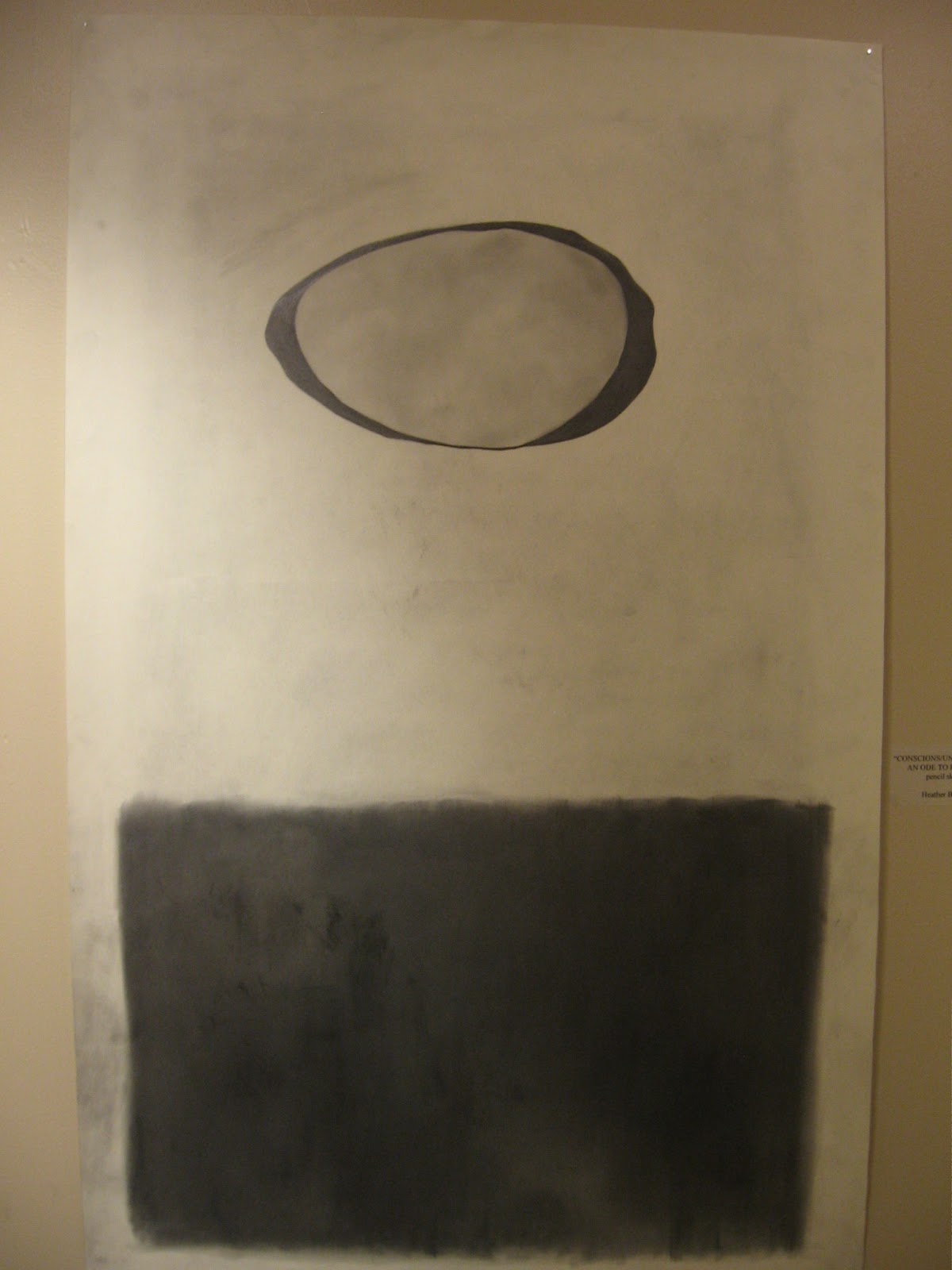
   Most intriguing about Heather Bryson’s Conscious/Unconscious- An Ode to Mark Rothko is how it manages to embody the serene, often somber ethereality of Rothko’s large oil canvases in such an unlikely, counterintuitive fashion. While Rothko immersed us in visual mysticism via fields of subtly undulating color, this intimately scaled homage by Bryson is in pencil – a studied meditation in moody dark grays and soft, misty mid-tones. Mysticism indeed, it’s a haunting picture of the unpicturable.

    On a lighter (though not insignificant) note are the three acrylic ink on canvas entries by Richard Hugget - the refined freneticism of a highly playful imagination. You’ll be reading more about his work in my next entry, I assure you. And I won’t be letting three weeks pass before posting it.


PHOTOS, from top: Amalgamation by Sarah Winther Shumaker; Growth by Liz DeBellis; Dish Rags by Laura Donnelly; Conscious/Unconscious- An Ode to Mark Rothko, by Heather Bryson