Monday, September 19, 2016

Outside the Lines


Outside the Lines

By Tom Wachunas

“Drawing makes you see things clearer, and clearer, and clearer still. The image is passing through you in a physiological way, into your brain, into your memory - where it stays - it's transmitted by your hands.”
― Martin Gayford, A Bigger Message: Conversations with David Hockney ―

“We who draw do so not only to make something visible to others, but also to accompany something invisible to its incalculable destination.” ― John Berger, Bento's Sketchbook


EXHIBIT: Drawing Invitational – works by Noelle Allen, Jean Alexander Frater, Joseph Karlovec, Anderson Turner, Josh Welker, and Patricia Zinsmeister Parker / At Main Hall Art Gallery on the Kent State University at Stark campus / 6000 Frank Avenue NW, North Canton, Ohio / THROUGH SEPTEMBER 30 / For more information, contact Jack McWhorter at 330.244.3356 or jmcwhort@kent.edu

   Many viewers of this exhibit might be challenged to wonder how some of the pieces - in a show clearly listed as drawing – are even “drawings” at all. The term itself can bring to mind all sorts of traditional (which is to say culturally conditioned) preconceptions, assumptions, and expectations concerning “draftsmanship,” media, or the nature of representational art. 

   But the works presented here constitute an expansion of the parameters of the term – a gestalt, if you will - such that we could rightly consider “drawing” as an ideation greater than the sum of its obvious parts. Think of drawing as essentially configuration. That is, the manipulation, organization, or  structuring of many possible elements which need not be identified with, or limited to, a specific medium, material, technique, or for that matter, even two-dimensionality. From this perspective, drawing can be rightly appreciated as a conceptual and practical foundation for making any work of visual art, so that one could consider, say, a full-color abstract painting on canvas, a free-standing sculpture, a ceramic vessel, or a work of architecture, as “a drawing.” 

   With crayon, graphite, or watercolor on unusual surfaces such as resin or Mlyar sheets, Chicago-based Noelle Allen renders membranous “pictures” that suggest organic cross sections, microcosms, or the workings of morphological structures. These fascinating, ghostly images are teeming with myriad tiny marks and shapes that sometimes appear to be suspended in pools of viscous liquid.

   The pieces by Jean Alexander Frater, also based in Chicago, are deconstructions and reformulations of stretched or framed raw canvas. The uniform 2D surface that we normally associate with supporting paint becomes a sculpted entity in various states of disruption. Call it a 3D meditation on the intrinsic components (malleable textures and patterns) of materiality itself.

   Joseph Karlovec is currently an Exhibit Technician at the Akron Museum of Art. His “A Simpler Time” looks a bit like a storyboard sketch for a scene from Jurassic Park. The work combines two mark-making methods which might be metaphors for two epochs of life on our planet. There’s an interesting tension between the carefully contoured style of the delicate floral arrangement at the top of the scene – like you’d find in a coloring book - and the more visceral, double-lined (accomplished by holding two pencils at once) rendering of the crocodile (?) in the low foreground. Meanwhile, the photo-transfer of greenery around a pavilion-like structure nestled in the middle ground could be a commentary on the encroachments of “civilized” living - human kind’s managed and manicured landscapes vs. the primordial wild.  

   There’s a coloring book simplicity, too, in the sketchbook illustrations by versatile artist, curator, and writer (including art reviews for the Akron Beacon Journal), Anderson Turner. While some are framed and under glass as “finished” pieces, most are tacked to the wall with a notes-to-myself sort of randomness. See them all as steps in a process -  selected  ideas related to a larger, ongoing “fantasy” narrative about an underwater culture populated by “Mermen.” Anderson’s  images – sure-handed, quick and somewhat whimsical - often have a dimensionality that suggests they could be designs for future sculptures.

   Fortress” is a very large black and white work on okawara (a Japanese printmaking-grade paper) made with graphite and ink, by Josh Welker, currently based in Upland, Indiana. The piece is indeed a formidable and altogether mesmerizing series of maze-like layers comprised of ornate, repeated shapes, patterns, and visual textures. For all of its sheer linear density, the work is nonetheless strangely airy, with an intriguing sense of spatial depth. There are many intricate passages in this vast matrix that harken to the complex geometry of “carpet” pages in illuminated manuscripts, or the 3D filigree and intarsia techniques from the Middle Ages.

   And “matrix” might be a good way to get a handle on “You Could Hear a Pin Drop,” a gloss enamel and collage work on paper by Patricia Zinsmeister Parker. For many years, Parker has been one our region’s most eminently accomplished painters, having honed a unique, expressionistic language often characterized by aggressive color dynamics and mark-making that can be at once startling, bold, and enigmatic.

   Here, her drawing is a painterly field (you could call it a system, matrix, or implied grid) comprised of discrete units, each supporting some variant of unabashedly shiny, broad, and very blue gestures and marks. It’s a progression that seems dictated not so much by a pre-planned logic per se, but rather Parker’s immersion in the moment of making and seeing one mark, then intuitively responding to it with the next. 

       This eye-popping progression, this continuous declaration of primal marks, looks like it could go on forever.  And interestingly, it also feels like an affirmation of the history of drawing itself, even back to those prehistoric communal gatherings of individuals who put pigment on cave walls. As if to say, I am here, I have seen, I am seeing.

   PHOTOS, from top: Ghosted, by Noelle Allen; Canvas Fall From Rectangle, by Jean Alexander Frater ; A Simpler Time, by Joseph Karlovec ; Assorted Sketchbook Works, by Anderson Turner ; Fortress, by Joseph Welker ; You Could Hear a Pin Drop, by Patricia Zinsmeister Parker

Friday, September 9, 2016

A Bargain-Basement Hyperhodgepodge


A Bargain-Basement Hyperhodgepodge 

By Tom Wachunas


   ”I have nothing to say/ and I am saying it/ and that is poetry/ as I need it.”  - John Cage, from "Lecture on Nothing" (1949)

    EXHIBIT: THEATRE OF THE MIND – work by John Bruce Alexander and Robert Gallik / at Little Art Gallery, located in North Canton Public Library / THROUGH OCT. 2, 2016 / 185 N. Main St., North Canton, OH /330.499.4712 Ex. 312


    A goofy gallimauphry? A silly salmagundi? A pithy pastiche? This gathering of works by John Bruce Alexander and Robert Gallik is a curious mélange of objects and images offered at surprisingly affordable prices (ranging from $10 to $175). Many of the pieces do seem to have a casual, almost throw-away sensibility, making the gallery feel a bit like a flea market, or the artists’ inventory clearance sale.

   In his bio/statement, Gallik tells us, “The subject matter for my work has been form: shapes, color, balance, tension or texture structured in space…” Clear enough, keeping in mind that those elements are embraced by all sculptors to one degree or another regardless of “subject matter.” But then Gallik adds this: “…What they mean or symbolize, I don’t know. Maybe they’re only props on this stage we call life.” 

   So discerning the artist’s deeper motivations and conceptual intentions is left to us, the viewers. We are in effect invited to write the script, as it were, wherein Gallik’s “props” are more like animated characters that cavort about in a narrative of whimsical or surreal riddles. “Sometimes it surprises me,” Gallick writes, “what bubbles up from the subconscious…”

   There’s certainly a raw, child-like spontaneity - and even an art brut spirit - to the way Gallik has constructed his array of common or found materials, giving them the aura of cartoonish folk art. Yet they’re also sophisticated in an odd sort of way, often bringing to mind, in 3D form, the delightfully quirky stylizations of Saul Steinberg (1914-1999), who once described himself as “a writer who draws.” In 1978, the eminent critic, Harold Rosenberg, wrote this of Steinberg’s art in an essay for the Whitney Museum of American Art, though I think the observation is apropos enough to Gallik’s aesthetic elements as well: “…a parade of fictitious personages, geometric shapes, items of household equipment, personified furniture, each staged in a fiction of what is – or in a dream of being something else.”

    In his lengthy bio/statement, John Bruce Alexander goes a step further (or would “backward” be more accurate?) than Gallik’s when addressing the nature of his art. “I am not sure what art is or is supposed to be,” he writes, adding, “I may be doing it by accident or maybe not. Your view of what I have done is exactly what it is. All that I make are a form of self-portrait.”  Yikes. Are we to read this disarming if not ironic admission as sincere self-deprecation, or that Alexander doesn’t know what he’s doing? Or is it to imply that what he has made might be something other than “art”? Maybe I’m making more of his words than they merit. In any case, I’ll stick with that cute old bit of abductive (abducktive?) reasoning and note that if it quacks like a duck, swims like a duck… You get the picture.

   Alexander’s pictures, then, essentially take three forms here. Arguably the least successful are his reverse- color images on clear acrylic sheets (i.e., images made by applying material – mostly paint, I think - to the back of the clear sheet). It’s a technique that diminishes the tactile sense of the artist’s hand so that the pieces all have the same glossy poster look. That in itself isn’t as problematic as Alexander’s inconsistent design sensibilities. They aren’t dynamic compositions as such, but rather simplistic juxtapositions of non-descript shapes and marks, as well as representational images, floated on ambiguous planes of color. With the exception of the few that are mounted away from the wall to allow for some interesting shadow play, such as “Banshee,” there’s something a little lifeless about this formulaic methodology.

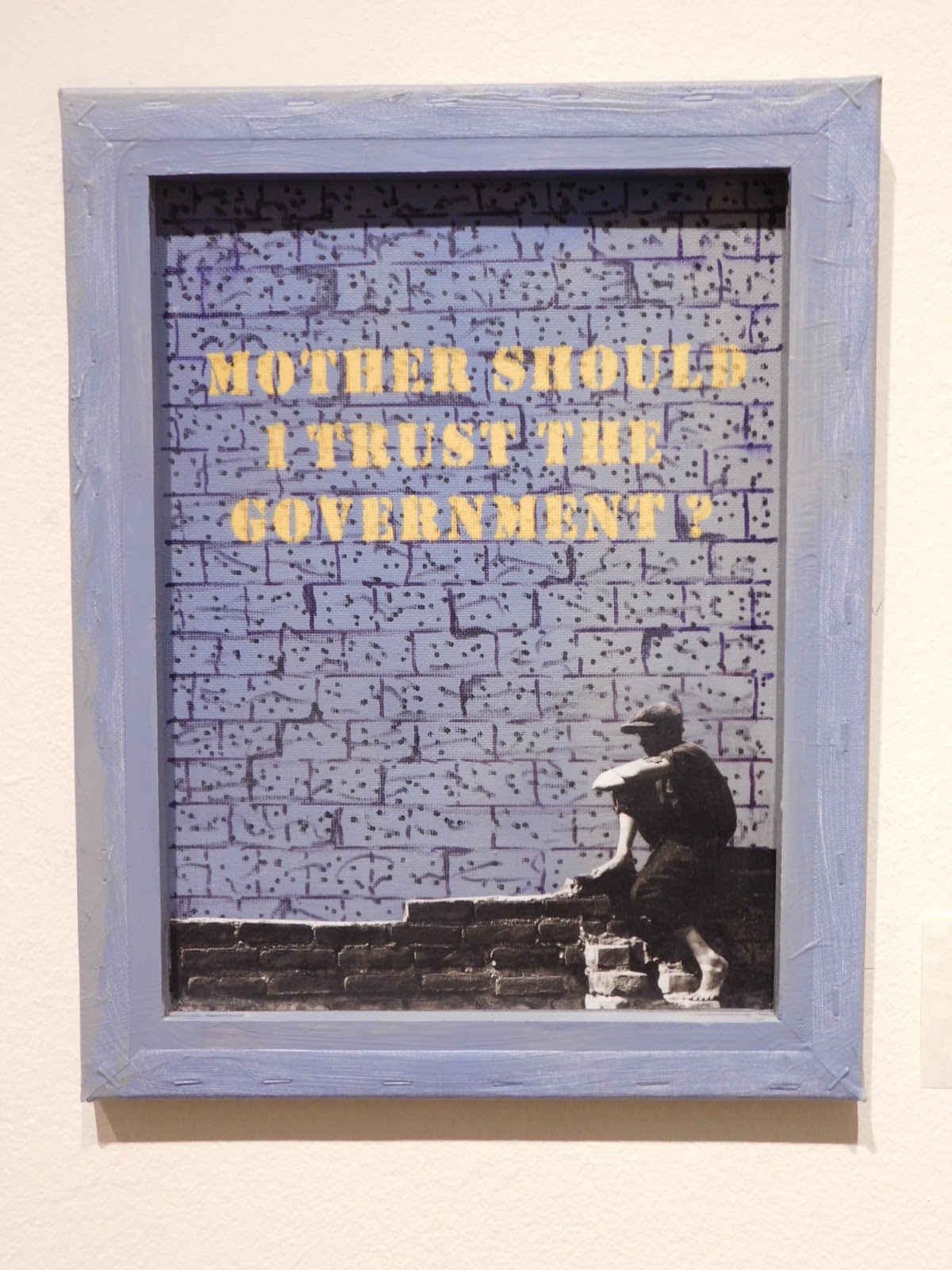
   Another series of small black–and-white works on canvas are considerably more engaging. Most of these have a vaguely photo-documentary feel, depicting a kind of street theatre with a sociopolitical agenda, and include  figures against brick walls with block-letter graffiti messages such as “Mother Should I Trust The Government?” 

   Alexander’s most visually exciting pieces – even to the point of dizzying -  are his color collage panels. These are stunning if only from the perspective of considering the insanely laborious exactitude needed to cut out and paste myriad tiny images and texts. At first blush these pieces might seem like random senselessness. But a decidedly smart move was the inclusion of the magnifying glasses mounted in various spots on the gallery walls to assure ease of closer scrutiny. Thus engaged, you can better identify the thematic/conceptual threads that hold them together. 

   So take your time exploring these shiny surfaces, like so many vibrant  lakes, teeming with…life. Enjoy the swim. Quack quack.

   PHOTOS, from top: Installation view, with Robert Gallik’s Button-eye Jack with Bird Nest in Beard in left foreground /  Fowl Play on the Banks of the Tuscarawas River, by Robert Gallik / The Happy Prince or A Child’s Worst Nightmare, by Robert Gallik / Banshee, by John Bruce Alexander / Mother Government, by John Bruce Alexander / Left and Right Brain Sections, by John Bruce Alexander      

Monday, September 5, 2016

Hail to the Grief


Hail to the Grief

By Tom Wachunas

   I am he as you are he as you are me / And we are all together / See how they run like pigs from a gun / See how they fly /  I’m crying – from “I Am the Walrus” by John Lennon and Paul McCartney

   The etymology of the English word assassin is a fascinating one, derived from the Arabic hashishiyyn, meaning “hashish users.” During the time of the Crusades, a fanatical Muslim sect was notorious for killing enemy leaders after working themselves into a frenzy brought on by ingesting hashish.

   And so it is that the one-act musical, Assassins, currently playing at Canton’s Players Guild Theatre, with music and lyrics by Stephen Sondheim, probes the intentions and motivations of nine disillusioned and deluded individuals who either attempted or succeeded in killing a U.S President. One might say that their frenzy-inducing drug of choice wasn’t hashish, but rather their dangerously festering resentments after their desires for societal inclusion, attention, or celebrity had been denied. Sound familiar? As one of the show’s songs puts it, "There's another national anthem, folks, for those who never win... We're the other national anthem, folks, the ones who can't get in..." It’s a thin line indeed between the American Dream and American Scream, between “All Lives Matter” and “All Lives Shattered.”

    The narrative is a time warp that plucks these individuals (some more infamous than others) from history and places them all together in a surrealistic carnival setting, complete with a grimy shooting gallery (scenic design by Joshua Erichsen), adorned with targets bearing a President’s face. Director Jonathan Tisevich clearly has an uncanny gift for unpacking and fleshing out the characters’ challenging and complex strata of emotional and psychological nuance. And in turn, it’s the astonishingly gifted cast members, both as singers and actors, who altogether transform what could have been merely absurd or toxic cartoons into authentic and impactful human presences. Their visceral, in-your-face energy is all the more augmented by the black-box surrounds of the Guild’s arena theater.

   Micah Harvey brings sinister relish to his role of the carnival proprietor - a Mephistophelean huckster who provides guns and temptations to his customers. Joe Halladey III doubles as the “Balladeer” and, late in the proceedings, the John F. Kennedy assassin, Lee Harvey Oswald. As the former, he’s a crooning narrator who articulates Sondheim’s lyrical verbosity with practically magical ease, often mocking the deviant thoughts and actions of the other characters. As Oswald, he’s an arresting figure, flummoxed and haunted by the pleas of the other assassins to join their “family.”

   Vincent Sisley plays Guiseppe Zangara, who attempted to kill FDR in 1933. Jacob Sustersic plays Leon Czolgosz, who killed William McKinley in 1901. Both performers invest their performances with palpable gravitas, delivering their rants and grievances with convincing accents (Italian and Polish, respectively).

   Craig Joseph deftly paints an edgy portrait of optimistic clownishness with a brooding underside in his colorful role of Charles Guiteau, who shot James Garfield in 1881. As John Wilkes Booth, Jimmy Ferko is a particularly magnetic presence, and for all of his character’s arrogance, oddly likeable. Corey Paulus is truly scary as Samuel Byck, who intended to kill Richard Nixon in 1974. Clad in a tattered Santa costume, he’s at first utterly hilarious in a dark sort of way, bellowing all manner of foul-mothed (and full-mouthed) insults and complaints which relentlessly escalate into unfettered rage. 

   Speaking of dark hilarity, Julie Connair’s portrayal of Sara Jane Moore, who tried to kill Gerald Ford in 1975, borders on comic genius. One of the most memorable passages of the evening transpires when she shares a scene with Taylor Marie Scott, playing “Squeaky” Fromme, another would-be Ford assassin who was obsessed with Charles Manson. Scott’s performance is a chilling look at insane idol worship. Russell Jones is similarly commanding in his role of John Hinkley Jr., who wanted to impress his imagined lover (Jody Foster) by shooting Ronald Reagan in 1981. 

   Through it all, the excellent off-stage orchestra conducted by Steve Parsons plays, often very softly, an intriguing, almost ghostly montage of period-style tunes reminiscent of ragtime, old-timey folk songs, or circus marches.
   
   Here then is a challenging tragicomedy, a startling parade – at once bleak, vulgar, and uncomfortably funny - of wounded or hopelessly corrupted psyches. And with no intermission, it seemed to me at one point an agonizingly long parade. But on further reflection, an intermission might well have broken the intensity necessary to let these disturbing characters and their twisted stories resonate beyond their own times and thus evoke something much more urgent and timely.

   So I don’t think this work is just about the horrific consequences of the moral/psychological aberrations that triggered a handful of murderous individuals from America’s past. What makes it still stand as an electrifying  work of theatre art is in how it becomes a compelling indictment of the terrible spiritual poverty of not only our current American culture, but of the global human condition as well.

   We have met the enemy… With a broken moral compass, when we’re not  running about in aimless panic, we’re flying upside down. Meanwhile the walrus, as it were, sits in our living rooms. We’re crying. Goo–goo-g’joob.

    Assassins, at Canton Players Guild’s William G. Fry Theatre, 1001 Market Avenue N., Canton, Ohio / Shows THROUGH SEPTEMBER 18 – Friday and Saturday at 8 p.m., Sunday at 2 p.m. / TICKETS $27 for adults, $19 for ages 17 and under, $24 for seniors / Order at  www.playersguildtheatre.com  or call 330.453.7617 

   PHOTOS: Top photo of cast by Scott Heckel, Canton Repository / other photos for Players Guild by Mike Akers

Sunday, August 28, 2016

Canton Arts District Weather Report: CLOUDY


Canton Arts District Weather Report: CLOUDY

By Tom Wachunas

   “Snarky Art and Journey Studios have some news to share….We are moving to the cloud! After years at both Second April Galerie and 431 4th St NW, Snarky Art and Journey Studios announce they are moving! We have tried using our beautiful corner space as an art gallery with a classroom and yoga studio, as working studio spaces, and as a fashion boutique with unique wearables. We've shown you beautiful art and one-of-a-kind fashions. We've thrown parties, offered classes, organized community projects and held lovely art exhibitions and fundraisers. But in the end, we find our walls and racks full... but our pockets...not so much. "  - from Su Nimon, Journey Studios

   I was originally going to title this entry “Journey’s End,” but thought it a bit too pessimistic. The recent buzz in the arts community about Su Nimon (Journey Studios) and Judi Krew (Snarky Art) closing up shop at the end of September does indeed mean the cessation of business in their location for nearly the past three years - a particularly elegant physical space within the “Canton Arts District” at the corner of 4th Street and McKinley Avenue NW.  But it also signals a forward look, a beginning of their respective endeavors to continue making their art accessible to the public online, and hopefully profitable enough to sustain their creative practices in the long term. And after all, what seriously active artist doesn’t want to find a consistently dependable venue where worthy work can be properly presented, viewed, and yes, purchased?

   I’ll sorely miss Journey Studios and Snarky Art. Sue Nimon and Judi  Krew have been an important and unique entity in our midst, and I wish for both women better days ahead as they artfully weave their web presence. 
 
   That said, Canton and “thriving art gallery scene” are far from synonymous. A number of factors – some arguably insurmountable for the foreseeable future – work against making the downtown corridor a viable location for establishing real art galleries. High on the list is the sobering fact that too few people venture into the heart of downtown specifically to view, much less buy, fine art on a regular basis. (As it stands now, there’s actually only one space that could be rightly called an art gallery in the truest sense of the word – Ikon Images on 5th Street NW – though I’ve no idea how well the gallery is doing these days.) Those who do explore the “Canton Arts District” will encounter, for the most part, bazaar or boutique-style offerings heavy on crafts, some interesting collectibles, and utilitarian tchotchkes -  fancy snack bars, so to speak, but not much in the way of a gourmet feasts. And frankly, I’m still not convinced that the demographic and geographic potential for developing sustainable art galleries even exists in Canton’s cultural DNA. Someone please prove me wrong! 

   If there’s an overarching local perspective on the idea of sustainable “retail art” establishments in the Canton Arts District, perhaps it has been best indicated in a recent Repository article by Dan Kane, reporting on ArtsinStark’s management of the former Second April Galerie, now called Avenue Arts. Here’s an excerpt  (click here for the full article -    http://www.cantonrep.com/entertainmentlife/20160821/artsinstark-transforms-downtown-canton-gallery-into-avenue-arts  ):
  
        Almost all of the artists have stayed," said Tricia Ostertag, ArtsinStark's First Friday and Canton Arts District coordinator who now also is running Avenue Arts. "We have 14 resident artists who pay rent, and 20 additional commission artists." Three artist studios, which rent for $175 to $225 a month, are available.
    Ostertag made clear her desire to shift Avenue Arts from a fine-arts gallery to an arts marketplace. "We're moving from $600 paintings on the wall to more of a place for gifts and functional items. "We want to be a place where you'd buy a scarf or a T-shirt or a piece of pottery or jewelry," she said. Boutiques on the second floor are devoted to handmade soaps and crocheted hats, scarves and bags.

    At the end of the day, it seems that more and more artists, for better or worse, are necessarily embracing the reality of web marketing to keep their art “out there.” Will brick-and-mortar galleries ultimately give way to online viewing and shopping?  Meanwhile I wait, looking forward to my first sighting of an Amazon drone-drop of a pesky $600 painting or sculpture. Thanks to “the cloud,” someday soon it could be raining fine art on a front yard near you.

   TOP PHOTO: Su Nimon (left) and Judi Krew