Sunday, August 25, 2013

Trails and Thresholds


Trails and Thresholds

By Tom Wachunas
 

    “The mountains were his master. They rimmed in life. They were the cup of reality, beyond growth, beyond struggle and death. They were his absolute unity in the midst of eternal change.” –Thomas Wolfe, from Look Homeward, Angel

    “Do not go where the path may lead, go instead where there is no path and leave a trail.” –Ralph Waldo Emerson


    EXHIBIT: Courage: An Attempted Explanation/Understanding, installation by Debra DeGregorio, THROUGH OCTOBER 1, at Malone University Fountain Gallery, located in the Johnson Center, 2600 Cleveland Avenue NW, Canton


    Among the more intriguing aspects of this highly engaging exhibit by Debra DeGregorio are the disarmingly simple physical materials she uses in delineating what can fairly be called a daunting contemplation - the dichotomy of explaining a thing (or idea) and understanding it. In this case, as the title of the installation tells us, she attempts to explain and understand courage.

     “WELL ThIS IS what hAppeneD TO Me” is a subtitle in block letters adhered to the wall just below a horizontal sprawl of four ‘mountains’ made of painted cloth mâché distributed between six sumi ink drawings on paper. These elements are loosely connected by arcing lines of tiny orange flags on straight pins, a scattering of rounded paper forms painted to suggest blue lakes, and meandering squiggles of wire.

    In her statement for the show, DeGregorio calls her formal arrangements “approachable micro-worlds.” Herein she addresses “…the mammoth and courageous task of living every day in the vast interior and exterior arena of history, memory, emotions, interactions and futures.” Whew. Talk about the rarefied air of mountaintops.

   DeGregorio labels her mountains as an “explanation.” These are fairly literal representations, presented from an aerial perspective, of apparent volume, mass and texture either already traveled and known (as indicated by dotted lines of “footprints,” marker flags and miniscule coils of climbing rope) or, perhaps, yet to be traversed.  

    Her drawings, on the other hand, represent “understanding.” These are  relatively more abstract configurations executed in sumi ink, a highly prized medium originated centuries ago by Japanese masters of ink wash painting. Such masters often rendered landscapes from memory, and their elegant images were intended to prompt reflection on the numinous essence of the subject matter. DeGregorio’s fluid and visceral ink drawings tap into that tradition, exuding a similarly intuitive, meditative air.

    I see the combined visual elements of this installation as representing the gestalt of knowledge (“explanation”) and wisdom (“understanding”). One might embrace the work as a codified map, or a collective symbol of the challenging questions and breakthroughs that dot the landscape of life itself. Or call it the artist’s personal journal of encountered thresholds -  “Well this is what happened to me.”

    At the risk of further assigning too lofty an interpretation of the work at hand, I leave you with this thought: The vagaries of living are such that whether negotiating capricious, wandering trails, or purposefully forging paths to new terrains, all of them require courage if we are to ultimately discern the true meaning of the journey.


    P.S. If you visit the Fountain Gallery to see this installation, and haven’t viewed the Malone Adjunct Faculty exhibit in the McFadden Gallery (reviewed here at       http://artwach.blogspot.com/2013/07/different-strokes.html ), please note that that show has been apparently extended until Sept. 23.


    PHOTOS: Installation full view and details of Courage: An Attempted Explanation/Understanding by Debra DeGregorio  

Monday, August 19, 2013

Lyrical Improvisations


Lyrical Improvisations

By Tom Wachunas
 

    “Of all the arts, abstract painting is the most difficult. It demands that you know how to draw well, that you have a heightened sensitivity for composition and for colors, and that you be a true poet. This last is essential. ”

- Vassily Kandinsky


    EXHIBIT: Fractured Structures – Paintings in Oils and Mixed Media by Christopher Triner, at Second April Galerie THROUGH AUGUST 30 / 324 Cleveland Avenue NW, downtown Canton / www.secondapril.org


     I realize that for some, perhaps many, the requirement “to draw well” in the making of an abstract painting (as mentioned in the Kandinsky quotation above) might seem to be counterintuitive if not outright puzzling.  Conventional thinking usually associates the term ‘drawing’ with faithful representations of reality. In that context, to positively acknowledge artists for their drawing abilities is to praise their skill in rendering convincing, objective imitations – as well as idealizations - of the recognizable world.

    Kandinsky was among the first artists in the early years of the 20th century to arrive at a non-objective visual language which we could rightly call “fully abstract.” In so doing, he and his fellow pioneers challenged viewers to embrace an expanded idea of drawing to mean the spontaneous and intuitive configuration (i.e., arrangement or organization) of various elements on the picture plane, thus freeing painting from its centuries-old burden of recapitulating the familiar. Call it mark-making with abandon. But this is certainly not to equate abstraction with abandonment of all traditional design principles which could make abstract paintings compelling or edifying.

    That said, Christopher Triner draws well. The more recent (2013) abstract works here (there are also older pieces on view) are highly intriguing compositions of linear and shape elements that are drawn into as well as floating on top of brushy, amorphous fields of variably saturated color. In particular, three of his oil paintings on canvas – Parapet, Cantilever, and Modern Pilaster – are loosely architectural in nature (as indicated by the titles).


    Back in 2010, I commented in a review of Triner’s work (http://artwach.blogspot.com/2010/10/slash-and-learn-painters-brush-with.html ) that his strongest painting evoked a musicality reminiscent of Romantic-era symphonies. And in this show, I still sense a palpable lyricism in the aforementioned paintings, though not so much of the symphonic sort. Interestingly enough, while the title of the exhibit would seem to imply a kind of deconstruction or “fracturing,” I find these newer works more akin to structures (or musical compositions, if you will) in the process of coming together in a spirit of frenetic joy.

    These pieces conjure for me the instrumental improvisations characteristic of Bebop or Free jazz. Get playful. Think of Triner’s defined linear structures as percussive rhythms simultaneously supporting and releasing his gestural shapes and splashes of bright color like so many staccato accents or brassy solo passages. All of the energetic configurations in these paintings (the “drawings”) unfold not so much against the blended, undulating color harmonies in the “background” as they emerge from it, establishing a distinctly optimistic, upbeat mood.

    Here, Kandinsky’s call for poetry in abstract painting is well met.  


    PHOTOS: top -  Modern Pilaster; bottom-  Parapet (left); Cantilever (right)

Saturday, August 10, 2013

Ardent Totems


Ardent Totems

By Tom Wachunas
 

    “My ideas are based on goals of healing, educating and problem-solving. I translate these goals into interactive art, where visitors play an active role in the life cycle of the work.” – artist Melissa Daubert, from her web site: www.melissadaubert.com


    EXHIBIT: Devoted: New Work by Melissa Daubert, at Translations Art Gallery, 331 Cleveland Avenue NW, downtown Canton, THROUGH AUGUST 31  www.translationsart.com  View works at  www.translationsart.com/gallery/devoted


    After looking at this exhibit for about 20 minutes on my first fly-by, the initial observation that I scrawled on my note pad was simply ‘this time it’s really personal.’ To the artist, no question. But I needed to remind myself to stay focused on just how remarkably resonant Melissa Daubert’s site-specific (sight-specific?) installation is with my own sensibilities as an artist who loves God deeply.

    This is not to say that the exhibit comprehensively embraces or espouses any specific religion. What the show does evoke is a sense of religiosity – indeed, a compelling spirituality – as implied in the idea of ‘devotion.’ So yes, there are some overtly theological references. Devoted to Krishna: 108 Gopis, for example, is a brightly colored collection of 108 Gopi figurines (“cow-herd” girls) made of painted cow dung.

    In general, though, the exhibit is an immersive, interactive presentation (some of the pieces have moving parts which viewers can activate) of various human proclivities which on one level might seem like mundane routines. But by placing them in the “devoted to…” context, Daubert lets us reconsider the actions and tasks she illustrates – such as caring for a beloved pet, cleaning the house, farming or mowing the lawn, to name only some - as paths toward a more elevated attitude about  “ordinary” societal engagements.   

    Daubert’s forms of people and animals are pared down to an archetypal kind of simplicity. Her raw materials are a modest means to an edifying end. Coconut hair, wood, and wire are assembled with a loving exactitude that conveys a domestic charm and humility while at the same time exuding a primal, ritualistic air.

    Particularly effective in delivering the ethos of devotions acknowledged in this show is Devoted To Our Pets: Bhuda. A lanky cat (with jiggling tail) stands in the center of a circle of bricks on the floor strewn with used insulin needles – 1,717 of them. Dauber explains in her accompanying comments that Budha, her cat of 18 years, was diabetic and needed insulin twice daily. The needles are from 3,434 injections over a span of 4.7 years.

    The piece reminds me that our purest and most rewarding devotions are  expressions of our unflinching loyalties and unconditional love. And as with other pieces in the exhibit, I’m also reminded of Brother Lawrence, a 17th century lay brother who for more than 50 years served as a cook and sandal repairer at a Carmelite monastery in Paris. His book, The Practice of the Presence of God, was published in 1692, and today remains a potent document of devotion’s power to impart joy amid even the most menial labors.

 In the end, Daubert’s intriguing sculptural vignettes are intimate, totemic embodiments – narratives, actually – of servanthood.


    PHOTOS (from top):Devoted To Our Pets: Budha / Devotion Through Posture: Kneeling / Devoted To Clean: The Mopper  

Thursday, August 1, 2013

Divertissement Duets


Divertissement Duets

By Tom Wachunas
 

    “Wit is educated insolence.” –Aristotle


    “From there to here, from here to there, funny things are everywhere!” –Dr. Seuss


    EXHIBIT: “Match Play”: Huggett Serves, Krew Returns, at The Little Art Gallery, located in the North Canton Public Library, 185 North Main Street, North Canton, THROUGH AUGUST 17  www.northcantonlibrary.org


    In her statement for this show, Judi Krew explains that she and Rick Huggett have been considering a collaborative exhibit since she first encountered Huggett’s work a few years ago. They wanted to have a “title battle,” as she puts it, or “…a game of visual and verbal volleyball…”

    As painters, each has honed a signature (what one might call ‘trademark’) visual language of painting. While their techniques and methods are distinctly different, the overall sensibility of their respective bodies of work has been one immersed in quirky humor. Formally, their works are representational and show a clear kinship with cartooning, though their “styles” are, again, clearly separate.

    For example, Huggett’s hand- painted shapes and characters (silkscreen ink and gesso on canvas), delineated in jittery black contours - call it a refined awkwardness - and filled in with flat, solid colors against uncomplicated, sometimes empty grounds, have all the smooth surface quality of screen prints, which is a remarkable technical feat in itself. On the other hand, Krew’s acrylic paintings on canvas are, well,…painterly. The visceral presence of a confident, facile brush is consistently evident. And unlike the sparse feel of Huggett’s “scenes,” Krew’s have always been filled out with specific background settings, often elaborately so.

    That said, for this show, in an effort to better “match” Huggett’s aesthetic, Krew intended to distill and otherwise limit certain elements of her normative approach in responding/reacting to the images Huggett selected, or served to her, if you will. In that, she’s been successful in offering relatively pared-down pictorial designs while still retaining the essential character of her style. There are two instances, displayed in the gallery’s glass showcases, wherein the relationship between server and served is reversed. Here, two of Krew’s Hoard Couture dress sculptures (hilarious, hefty consumerist haute) are the inspiration for the found-object sculptures by Huggett.  In any event, the net result (pun intended) of their gamesmanship is a giggly gambol, a rollicking romp, a frisky frolic through visual/verbal histrionics.

     Seen independently of each other, Huggett’s images are appealing in their sleek, childlike simplicity, while Krew’s are more overtly complex and satirical in their witty jabs at adult behavior. Together they complement one another in a way that lets Huggett’s somewhat minimalist purity acquire a more accessible narrative context. Not that it ever needed one in any conventional sense. Still, read Krew’s titles and you’ll sense that she’s completing the tale begun by Huggett. The entertaining heart of this particular collaboration is to be found in the tried and true tradition of storytelling.

    And funny stories at that. But the scenarios presented here aren’t just for kids. It seems to me that these are funny in the same way that vintage Looney Tunes cartoons were, with their subtly subversive, topical undertones, puns and inside jokes, intended as much (if not more) to tease grown-ups’ brains as elicit gleeful laughter from children.

   So go ahead and make a game of it for yourself. See, for example, how many times Huggett’s original New Mexican Cactus Toad makes his appearance as an Illegal Mexican Cactus Toad in Krew’s images. While you’re at it, don’t be afraid to pull back the black curtain that covers much of her …caution, this one might spark some controversy! That work is paired with Huggett’s stark but elegant Another Shocking Image, itself signaling a new direction in his work.

    Who, then, is the winner of this delightfully clever match-up? In this world ever in need of comic relief from the ugly tragedies that assail it, the victor is…us.  


    PHOTOS (from top down): left – Careful what you wish for (Krew), right – Geez, I hope they water their plants with Cheese Whiz (Huggett)

    left – Another Shocking Image (Huggett), right - …caution, this one might spark some controversy (Krew)

    left – The tumbling Trampolini Brothers (Huggett), right- …And their trampy sister, Tumbalina (Krew)

    left – Making Hay (Huggett), right – Hey! Watcha Make’n? (Krew)  

Sunday, July 28, 2013

Different Strokes


Different Strokes

By Tom Wachunas
 

    “Time is but the stream I go a-fishing in.” –Henry David Thoreau


    “The only reason for time is so that everything doesn’t happen at once.” –Albert Einstein
 

EXHIBIT: Adjunct Faculty at Malone University, McFadden Gallery, located in the Johnson Center for Worship and the Fine Arts, 2600 Cleveland Avenue NW, Canton. Open for viewing during regular business hours Monday through Friday. Works by Liz DeBellis, Todd Biss, Heather Bryson, Laura Donnelly, Li Hertzi, Richard Hugget, Susan McClelland, Michele Waalkes, Sarah Winther Shumaker, THROUGH AUGUST 9
 

    Some of you faithful readers may have noticed that of late I’ve not been my usual prolific ARTWACH self. Never before has so much time passed (nearly three weeks!) between posts. The previous one doesn’t really count as it’s not my own writing. No, I’ve not been “on vacation” –  I’ve forgotten what that means anymore. That’s certainly not a complaint, mind you.

    I’m remembering that sobering scene in Dances With Wolves when a trail guide, peering down at a human skeleton that Kevin Costner discovered in the sun-drenched prairie grass, smirks and comments, “Somebody back East is sayin’, ‘Why don’t he write?’” I’ve simply been very committed to other projects which, as life would have it, tend to occasionally collide and greedily feast on my time.

    One casualty of my critiquing hiatus was the most recent group show at Translations Gallery, Those Who Can. While I greatly enjoyed the viewing experience – a thoroughly engaging range of work – I was unable to record here any thoughts. I think that’s been the only show I’ve missed writing about from that important gallery since its inception, and I really do apologize. Tempus fugit.

    Speaking of thoroughly eclectic content, though, there’s still a little time (Monday to Friday during business hours) to take in the excellent Adjunct Faculty Exhibit at Malone University’s McFadden Gallery. I saw the show shortly after it was installed in May, and I mention here just a few of the fine works that have persistently clamored for comment before the show ends on August 9.

    In the past, I found some of Sarah Winther Shumaker’s earlier mixed media explorations, in varying degrees, to be somewhat formally awkward and unresolved. But here, in her sleek stoneware and encaustic wall piece Amalgamation, there’s no such shortcoming. All the variations in texture, pattern motifs, and color work together toward an elegant geometric harmony. It’s a beautifully designed, tactile gem of gleaming symmetry that is at once pristine and earthy.

    Growth, by Liz DeBellis, is a gently crinkled, printed “curtain” of sheer fabric that is more a conjuring of fleeting sensations than it is a solid object. Both veiled and revelatory, its gossamer texture evokes a duality - the cycles of life in bloom and decay.

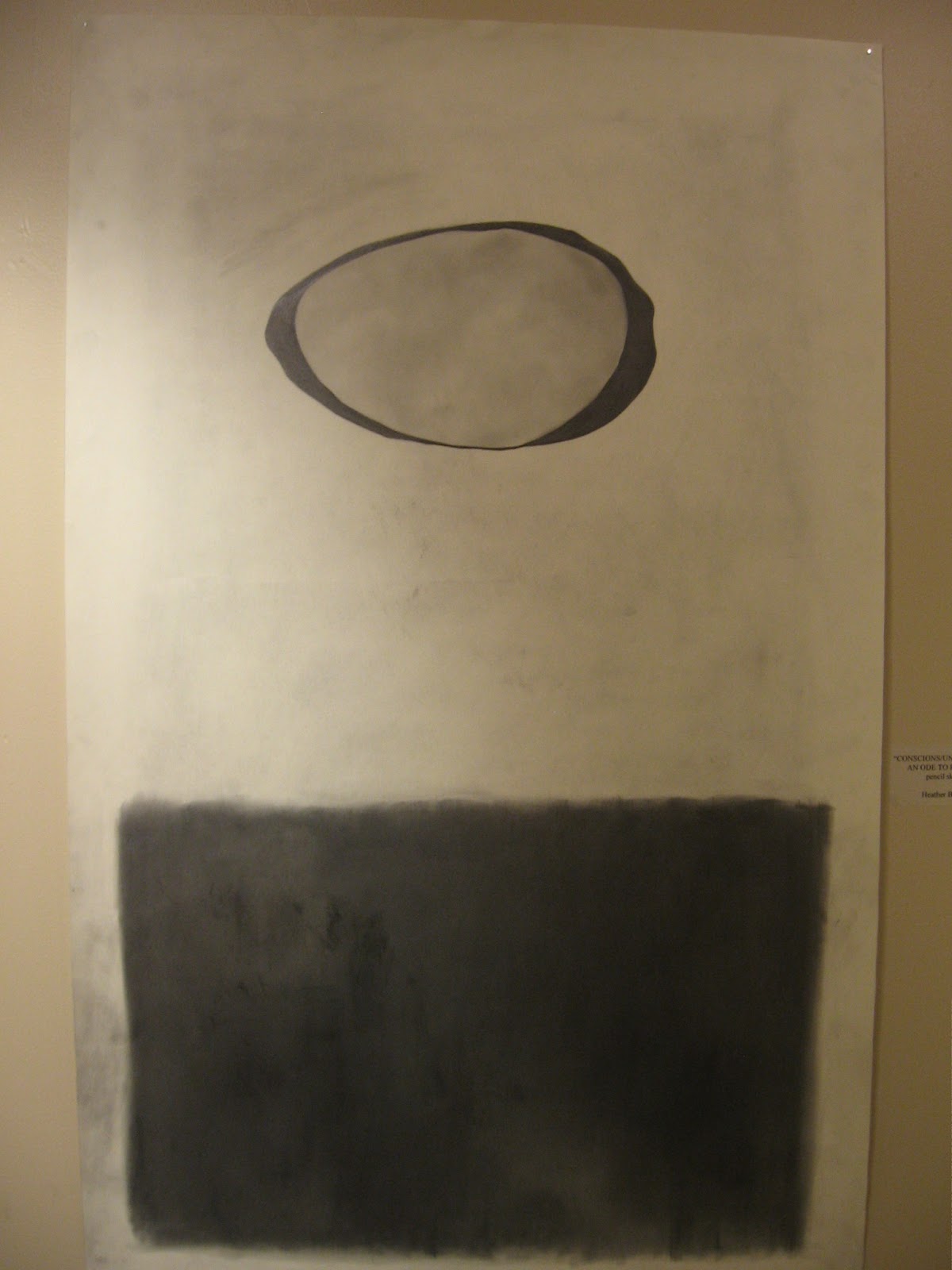
   Most intriguing about Heather Bryson’s Conscious/Unconscious- An Ode to Mark Rothko is how it manages to embody the serene, often somber ethereality of Rothko’s large oil canvases in such an unlikely, counterintuitive fashion. While Rothko immersed us in visual mysticism via fields of subtly undulating color, this intimately scaled homage by Bryson is in pencil – a studied meditation in moody dark grays and soft, misty mid-tones. Mysticism indeed, it’s a haunting picture of the unpicturable.

    On a lighter (though not insignificant) note are the three acrylic ink on canvas entries by Richard Hugget - the refined freneticism of a highly playful imagination. You’ll be reading more about his work in my next entry, I assure you. And I won’t be letting three weeks pass before posting it.


PHOTOS, from top: Amalgamation by Sarah Winther Shumaker; Growth by Liz DeBellis; Dish Rags by Laura Donnelly; Conscious/Unconscious- An Ode to Mark Rothko, by Heather Bryson    

Friday, July 26, 2013

Something New


    I just received this from Craig Joseph, curator of Translations Art Gallery and co-founder of The Parallax Ensemble. I’m passing it on as received. Thanks to all for your attention.
Hello, Friends

    As you may know, this past year was Year One for a theatre group I'm a part of called The Parallax Ensemble.

    We introduced ourselves to the public with the Ohio premiere of a new play by LA-based writer, Anna Carini, called SWEET CONFINEMENT.

    We entertained audiences and raised lots of money for anti-bullying initiatives with a production of the Broadway hit, GOD OF CARNAGE.

    For the past few months, we've been producing live performances of original radio dramas - complete with sound effects and music - for First Friday crowds; this initiative is called THE SOCIAL ANXIETY HOUR.

    We're tackling our most ambitious project yet. A totally new piece, developed by our ensemble, modeled on Thornton Wilder's OUR TOWN and based on interviews we've collected with people around Canton, Ohio

    We'd love if you could help us out in two ways.  Check out all the details at the link below and if you feel so moved, please contribute.  ANY amount helps.  Then, if you'd be so kind, tweet and post on Facebook and share the link wherever you can to let the community know that we're developing a piece all about them.


   And THANKS so much!  Feel free to contact me with questions


   caj

   Craig Joseph, Curator

   Translations Art Gallery

   331 Cleveland Ave NW

   Canton, OH, 44702

Wednesday, July 10, 2013

Natura Reformati


Natura Reformati

By Tom Wachunas


    “The artist and the photographer seek the mysteries and adventure of experience in nature.” –Ansel Adams

  “Art not only imitates nature, but also completes its deficiencies.” –Aristotle

   “I am at two with nature.” –Woody Allen

   EXHIBIT: Lux Botanica: The Photography of Doug McLarty, at the Canton Museum of Art, THROUGH JULY 21, 1001 Market Avenue North, Canton

   www.cantonart.org  330.453.7666             www.signaturefocus.com


    Part whimsy, part high drama, the botanical imagery of photographer Doug McLarty is wholly enthralling. The wondrous theatricality of his configurations brings to mind this observation from Guillarme Apollinaire: “Without poets, without artists, men would soon weary of nature’s monotony.”

    There’s certainly nothing monotonous about McLarty’s delightfully unique take on plants, flowers, seeds and the like. His compositions, set against solid black grounds, often appear to be intricately sculpted entities, exuding an otherworldly aura.

    The heightened dimensionality and focus of detail, astonishingly crisp and vibrant hues, and sharp illumination of the forms are all the result of a working technique which the artist calls Scanography. His explanation of the technique is posted with the exhibit, described in part as a process “…of capturing digitized images of objects for the purpose of creating printable art using a flatbed “photo” scanner with a CCD (charge-coupled device) array-catching device.” Sheesh. Such technospeak is so far beyond my understanding that it might as well be alchemy.

    And indeed, the net effect of McLarty’s wizardly method is nothing short of magical. Several of his images are mesmerizing in a way somewhat reminiscent of the playfully surreal works by Giuseppe Arcimboldo, the 16th century Italian painter who made portrait heads comprised of fruits, flowers and vegetables.  

    One resonant function of art derived from nature has been not so much to merely imitate it as much as shape and sharpen our attentions to its power of evocation, its power to make us sense things beyond the obvious, or monotonous. It’s not about improving on nature per se (a fool’s errand if ever there was one), but improving our ability to see in the fullest sense of the word. In McLarty’s photographs, marvelously presented forms seem to vibrate as if to music, or recite wordless poetry.

    After seeing them, I’ve acquired a renewed, celebratory appreciation for the wild gathering of textures and myriad shapes that are currently dancing together in my vegetable garden.


    PHOTOS (from top): Toucan Island; Scheherazade; Supremes