Thursday, May 27, 2021

A Healing Return to the Stage


A Healing Return to the Stage from the Canton Symphony Orchestra 

By Tom Wachunas 

“Wisps of cloud and mist, are lit from above, breeze in the foliage and wind in the reeds, and all is scattered.”  - from first part of Faust, the lyric poem by Johan Wolfgang von Goethe, and the inspiration for the third movement of Felix Mendelssohn’s Octet for Strings 

     Reasons to be cheerful: They’re back! The May 23 concert by the Canton Symphony Orchestra (CSO) marked the first time in more than a year that the ensemble has performed live at Umstaddt Performing Arts Hall. This occasion was certainly an important step on the road back to cultural “normalcy” as we recover from the dreadful pandemic shutdown.

   For a May 21 article by Ed Balint in The Repository (Canton’s daily newspaper), CSO president and CEO Michelle Charles said of the concert, “That's what we do, that's what we love and that's why we exist, to perform music live. You do take for granted how readily available (classical music) is until it's not. So I think it's going to be very emotional."  Noting that the concert was especially significant to Gerhardt Zimmermann, CSO music director and conductor since 1980, she added, "It's been so long, and Canton has held a special place in his heart for many, many years. I think it's going to be more emotional for him than anyone." The emotional factor becomes even more resonant when considering Zimmermann’s own battle with coronavirus which led to weeks of hospitalization and rehabilitation in 2020. He’s still not at optimal strength, and consequently conducted the program while seated on a raised platform.

   This short concert (with no intermission) was an altogether unique sensory experience, and not a CSO business-as-usual affair. Zimmermann chose just two works to be on the program: Felix Mendelssohn’s Octet for Strings, and Wolfgang Amadeus Mozart’s Symphony No. 29. Covid protocols were in place. Umstattdt Hall, a 1,400- seat venue, felt eerily empty as the audience was limited to a total of 300 attendees, most seated in socially distanced manner, and all required to wear masks, as were the musicians spaced widely across the stage.

   From the very start of Mendelssohn’s grand Octet, the palpable esprit de corps between Maestro Zimmermann and the ensemble (four violins, two violas, two cellos) was a pleasure to behold - inspired and inspiring. At once fiery and flamboyant, delicate and precise, the vigorous sound emanating from this small group during the first movement (and for that matter the entire work) was a warm embrace of the inventive composer’s youthful panache, and his instructions that the work “…be played by all the instruments in a symphonic orchestral style. Pianos and fortes must be strictly observed…”  Mendelssohn’s Octet is a masterpiece calling for virtuosity from all the players to varying degrees, but none more so than from the first violin. Here, the vibrant playing by Emily Cornelius was exquisite. Her arpeggios often soared to ravishing heights above the intricate syncopations and lovely harmonies being crisply articulated beneath.

   Pausing after the long first movement, Zimmermann turned briefly to the audience and with a broad smile said, “How sweet it is.” Then it was on to the gentle textures and beautiful phrasing of the lyrical Andante movement, followed by the bewitching Scherzo, seemingly transporting us to a magical forest wherein nocturnal spirits scurry about. And finally, the robust fourth movement Presto. Here was a dazzling, ebullient romp, truly symphonic in scope, first announced by the cellos, then quickly rippling through the whole ensemble at a furious tempo with an explosive, infectious energy.

   That same spirit of infectious energy was present in a rousing performance of what is widely considered to be Mozart’s first symphonic masterpiece, his Symphony No. 29. Though originally scored for a smaller-scaled orchestra (here there were 29 instruments including strings, a pair of oboes and a pair of French horns), the CSO dispatched all of Mozart’s vigor and lyricism, his melodic grace and frolicsome wit, with impressive clarity and robust sonority, all of it bringing a very grateful audience to its feet.     

   In his brilliant virtual pre-concert lecture, Professor MJ Albacete noted that both works on this program were written when the composers were astonishingly young -  Mendelssohn was 17 years old, Mozart was 18 - and were of major importance in their respective aesthetic evolutions. Further, he offered this moving personal observation about what he called a subliminal connection between the works and their symbolic meaning for our current time and circumstances: “Both begin in joy, descend into a period of serenity – you might even say melancholy – but revive with hope and expectation and conclude with a sense of triumph and rejoicing, returning to the way things were not so very long ago. Great music can also be a remedy for the spirit and the soul. So may it be for all of us in the days and weeks to follow.”

   How sweet it is indeed. 

Friday, May 7, 2021

Familiar Fare


 Familiar Fare


Gold Self Portrait, by Heather Bullach

In A World Gone Crazy..., by Judi Krew

We're not in Kansas Anymore, Toto. by Sally Lytle

Circle of Life, by Wanda Montgomery

Boston Bricks I, by Diane Belfiglio

Bourbon and Cigar, by Todd Bergert

Boole, by Dave Kuntzman

By Tom Wachunas 

   EXHIBIT: 78th Annual May Show, at The Little Art Gallery, located in North Canton Public Library, 185 N Main St, North Canton, Ohio,  through May 29, 2021. Viewing hours: Monday – Friday: 10 a.m to 6 p.m. / Saturday: 10 a.m. to 2 p.m.

Best in Show - Heather Bullach, Gold Self Portrait, Oil / Second Place -  Sally Lytle, We’re not in Kansas Anymore, Toto, Oil /Third Place -  Wanda Montgomery,  Circle of Life, Mixed Media / Honorable Mention - Scott Coleman, Diamond Beach, Media: Photography / Honorable Mention - Nancy Darrah, Stepping Out, Watercolor /Honorable Mention -  David L. Dingwell,  Colfax Blues, Photography

   This year’s competition was juried by Dennis Kleidon and Rose Kleidon. Here are their catalogued comments: “This year’s May Show is a dramatic, mood-setting experience. Many of the strongest pieces contain an atmosphere within their messages, expressing fear, anxiety, serenity, and contemplation. Almost all of the submissions were technically competent. We saw many beautiful examples in pencil, watercolor, oil, acrylic and mixed-medium, and we commend all participants for this. The submissions that stand out also had something more to say—a message, a mood or a story that the artist tried to bring to the surface. These pieces make a statement beyond technical competency. These underlying messages give the show its personality.”

   There might be an implied promise in the juror’s comments, setting up an expectation of a satisfying, maybe great gallery experience. But in the end, we’re in largely subjective territory here. Expectations are fragile things; easily ballooned and easily deflated. In that regard, this exhibit is a little disappointing in its depth and variety of iconographic content.

    For starters, in numbers alone, this year’s show, with just 28 works from 26 artists, is substantially smaller than any May Show I’ve seen in the past 12 years or so. The physical space of the gallery itself feels somewhat empty. Incomplete. Even the show’s one and only free-standing 3D piece has been pushed seemingly out of the way, placed too close to a brick wall, like some sort of unobtrusive sentinel. Still, it’s a marvelously crafted and intricate patchwork garment embroidered with many evocative words by Judi Krew, called “In A World Gone Crazy We Hide Behind Our Labels And Share Words Of ____!”   

   There’s an unfortunate scarcity of purely abstract works. In that category, Dave Kuntzman’s acrylic painting called “Boole” is a thoroughly captivating vision of precisely delineated, interlocking luminous grids. A wondrous feat of spatial playfulness.

   Diane Belfiglio’s oil pastel “Boston Bricks” is a hypnotic blend of both representational (i.e., identifiable) and abstract elements. The illusory brick surface, itself a grid, bristles with chromatic textures bathed in sunlight and intersected by striking, translucent shadows shooting across the picture plane at contrasting angles.   

   Otherwise, the exhibit does indeed heavily favor conventionally framed 2D works of a representational or illusory nature (landscape, still life, floral, portraiture, figural, etc.). Most of these works, as the jurors noted, are “technically competent.” And nowhere in this exhibit is technical acuity more elegantly evident than in the oil painting by Heather Bullach, “Gold Self Portrait.”  The piece should have been displayed on an actual gallery wall where it can more freely breathe its classical grace and dignity. Instead, it’s tucked away like a curio in one of the gallery’s glass showcases.

   What most of the works in this exhibit share, to varying degrees, is a nostalgic preciousness and an intimacy that creates an aura of celebrating the familiar, the pretty and pristine.  And though it’s true that I missed seeing the kind of art that doesn’t need to appropriate so much of literal reality to be beautiful, I do respect the stylistic finesse and sincerity present in the works of many of the artists here. To all of them I say thanks for the memories.

Wednesday, April 14, 2021

Navigating Interior and Exterior Forces


Navigating Interior and Exterior Forces


Undergirded, by Michelle Mulligan

Turn, Turn, Turn, by Priscilla Roggenkamp

Strong as Nails, by Clare Murray Adams

Agree to Disagree, by Sarah McMahon

Breaking Out, by Judith Sterling

Perseverance, by Heather Bullach

Creativity Killers,  by Gail Trunik

Sekhmet, by Laura Kolinski-Schultz

By Tom Wachunas 

   “Freeing yourself was one thing, claiming ownership of that freed self was another."  - Toni Morrison

   "There is no gate, no lock, no bolt that you can set upon the freedom of my mind."  - Virginia Woolf

   “A woman is human. She is not better, wiser, stronger, more intelligent, more creative, or more responsible than a man. Likewise, she is never less. Equality is a given. A woman is human.”         -  ----- Vera Nazarian, The Perpetual Calendar of Inspiration

   EXHIBIT: Women of Resilience / an invitational exhibition featuring 25 women artists, curated by Priscilla Roggenkamp, Judith Sterling, and Patricia O’Neill Sacha / at Massillon Museum, 121 Lincoln Way East, downtown Massillon, Ohio / Through May 23, 2021 - Exhibiting artists include: Clare Murray Adams, Ruthie Akuchie, Kathleen Browne, Heather Bullach, Sarah Curry, Annette Yoho Feltes, J. Leigh Garcia, Laura Kolinski-Schultz, Charmaine Lurch, Sarah McMahon, Erin Mulligan, Michelle Mulligan, Patricia O’Neill Sacha, Mary Kaye O’Neill, Cynthia Petry, Priscilla Roggenkamp, Judith Sterling, Sylvia Treisel, Gail Trunick, Michele Waalkes, Gwen Waight, Jo Westfall, Gail Wetherell Sack, Laurel Winters and Kiana Zigler.

https://massillonmuseum.org/  

 From the exhibit statement: “...Twenty-five artists have explored a variety of topics in traditional and non-traditional media.  These topics include: personal empowerment, overcoming barriers, the capacity to recover, acts of strength and resistance, and healing the world and ourselves… the need to assert one’s place at the table and in the world continues…this exhibition reminds us that art remains an important vehicle for activism.

   Though the impetus for this exhibit was to celebrate the centennial of women’s suffrage, the formal and conceptual scope of the exhibit is substantially broader and more complex than simply a woman’s right to vote in national elections per se. You could call this remarkably diverse exhibit a communal incantation, or invocation of sorts. Here is a calling forth of past and present circumstances, attitudes, evolutions. It’s a symbolic journey through our culture still so fraught with vexing challenges to women having and holding a viable place at the table of human living. Women seeking an equi-table, if you will.  

   Sekhmet is an exquisite, lavishly glazed and painted stoneware statue by Laura Kolinski-Schultz. The piece is named for the powerful ancient Egyptian deity traditionally represented as a lion-headed woman. She was worshipped both as a ferocious warrior wreaking punishment on her enemies, and a generous healer – a kind of patron saint of doctors. In this context, consider her not as a mythological divinity, but as an earthbound force - a strong-willed woman.

    With one eye swollen shut and the other meeting ours in a piercing stare, Creativity Killers, by Gail Trunick, is a clay figure of a tormented woman. An anguished soul. Her flesh is incised with words, cut like so many stab wounds. Vicious imperatives and judgements. Keep Quiet. You’re Too Old! You’ll never amount to anything. You’re not talented enough…  Words meant to silence a voice. Words uttered to obliterate dreams. Words too often heard in the patriarchal meritocracy of our time. Yet words she hears with one eye open.

   In Perseverance, a stunning self-portrait oil painting by Heather Bullach, both of her eyes are wide open in a look of unflinching determination. The canvas is infused with red, as if illuminated by a fire close by. A crisis? Unscathed, she appears to be running, but not in a state of panic so much as with palpable confidence, out from the confines of the picture plane, toward us and a new destination.

    A similar sense of undaunted tenacity is evident in Judith Sterling’s fused glass and ceramic work, Breaking Out. It’s an episodic rendering of an escape. A woman is in the process of literally shattering the ceiling of the glass box that had imprisoned her - the box of societal biases, assumptions and expectations that can stifle a woman in fully realizing her identity and potential.

   With her intriguing textile piece (handwoven on a computerized jacquard loom), Agree to Disagree, Sarah McMahon also presents a boxed-in woman, though not in escape mode. Interestingly, when you stand within inches of the work, it appears as a vast plane of pixelated patterns. An abstraction. With more physical viewing distance from the cotton surface, the woman’s form fully materializes. McMahon’s statement articulates it brilliantly: “…The computer and body relationship is in fact very meaningful…digital and analog working together, standing in and overlapping for the psychological and physical. The imagery here comes down to defining interior and exterior forces, and how we navigate existence and space as minds inside a body (a concept that becomes more elusive the more it is pondered: fragile, squishy bags carrying around an awareness of being fragile, squishy bags).

   I don’t take from this that women are by definition any more fragile or squishy than men. That’s just one arguable condition of humanity in general. Other conditions can be constituted of sterner stuff. Consider Clare Murray Adams’ homage to the history of strong, influential women in her mixed media work, Strong as Nails. In the chest cavity of a fabric-sculpted torso is a window – a soul – through which we see a pile of rusted nails – memories of real work. On the wall next to this object are image transfers, hung from rusted washers, showing the faces of 36 accomplished women who collectively have affected human existence for the better.

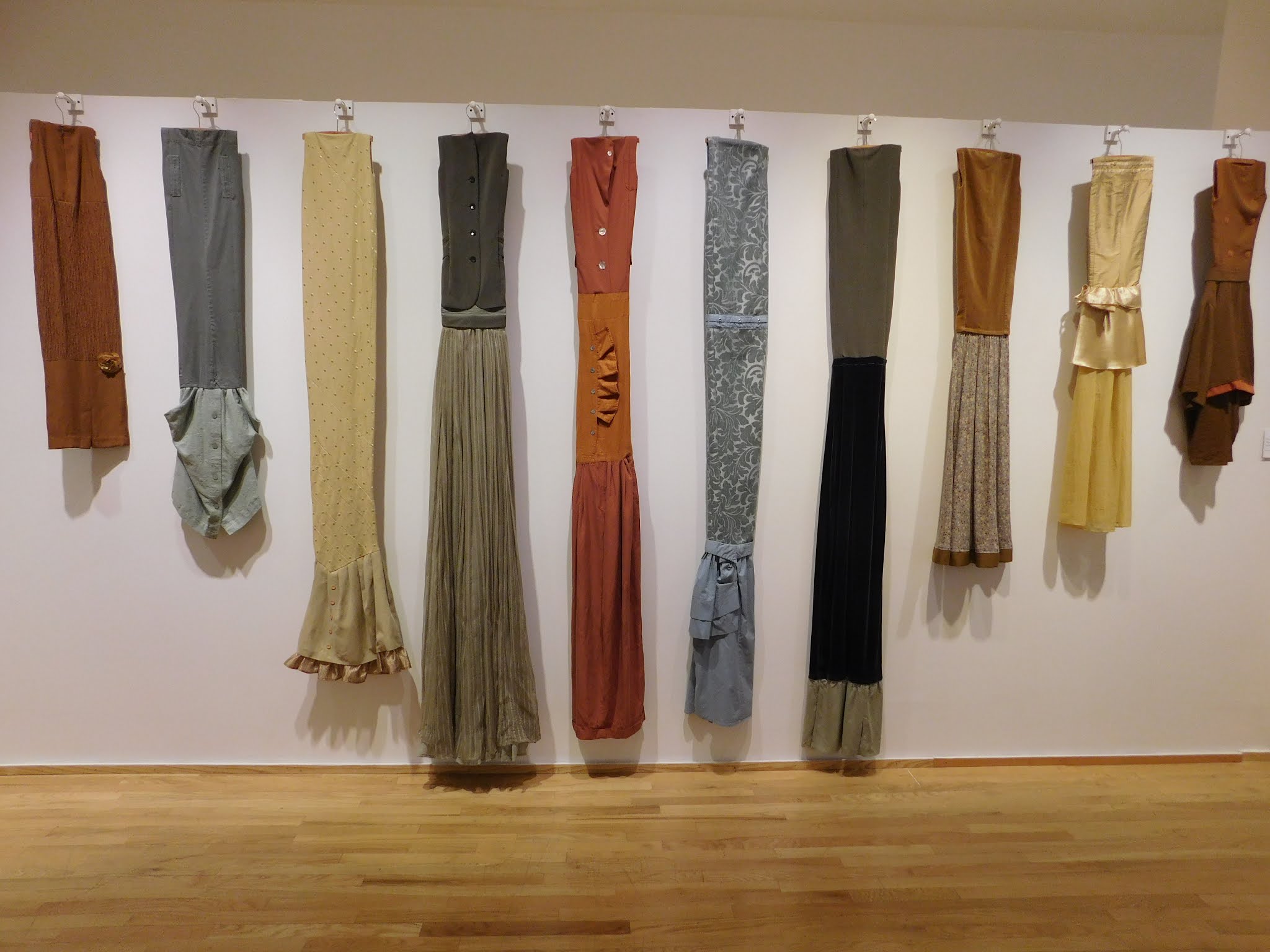
   The title of Priscilla Roggenkamp’s impressive fabric and repurposed clothing work – Turn, Turn, Turn – is a reference to a phrase in the biblical book of Ecclesiastes (and the Pete Seeger song): “To every things there is a season, a time to every purpose under heaven.”  The 10 dress styles are based essentially on a single form, though with subtle variations. It’s an evolved sameness that nevertheless speaks to a woman’s adaptability in roles, duties, and identities amid the the constancy of change, whether consciously chosen or simply inevitable.

   The placement of Michelle Mulligan’s mixed media Undergirded, on a low pedestal and directly to the left of Roggenkamp’s much larger work, is particularly fascinating. A time to every purpose under heaven indeed.

   Mulligan’s piece is a small upright book, it’s thick pages exposed just enough so we can read her hand-printed meditations, along with an anatomical image of a human heart. The book’s cover is intricately sewn with ornamental doilies and pieces of colored fabric.  This intimate, charming tome seems to be at once a mother’s diary and prayer book, containing innermost reflections from the heart of a woman of faith, a lover of God and family.

   Turn, turn, turn. I’ve mentioned only some of the many impactful works in this exhibit. There’s much that I continue to process on emotional and psychological planes. These artists’ timely visions, articulated with compelling skill, have left me alternately humbled, dismayed, exhilarated, alarmed, thrilled, mesmerized. And forever…grateful.

Saturday, April 3, 2021

Bounteous Bowie


Bounteous Bowie

By Tom Wachunas


“…I watch the ripples change their size

But never leave the stream

Of warm impermanence

And so the days float through my eyes

But still the days seem the same

And these children that you spit on

As they try to change their worlds 

Are immune to your consultations

They're quite aware of what they're goin' through…”  - some lyrics from the song “Changes” by David Bowie


Turn and Face the Strange, paper mosaic by Tim Carmany

Eyes of Blue, oil,  by Todd Bergert

Ziggy Stardust, oil and pyrograph, by Erin Mulligan

Electric Bowie, polymer, epoxy resin, by Erika Katherine

Teeth of Grass, acrylic on wood, by Alex Strader

TMWFTE - 76, by Billy Ludwig

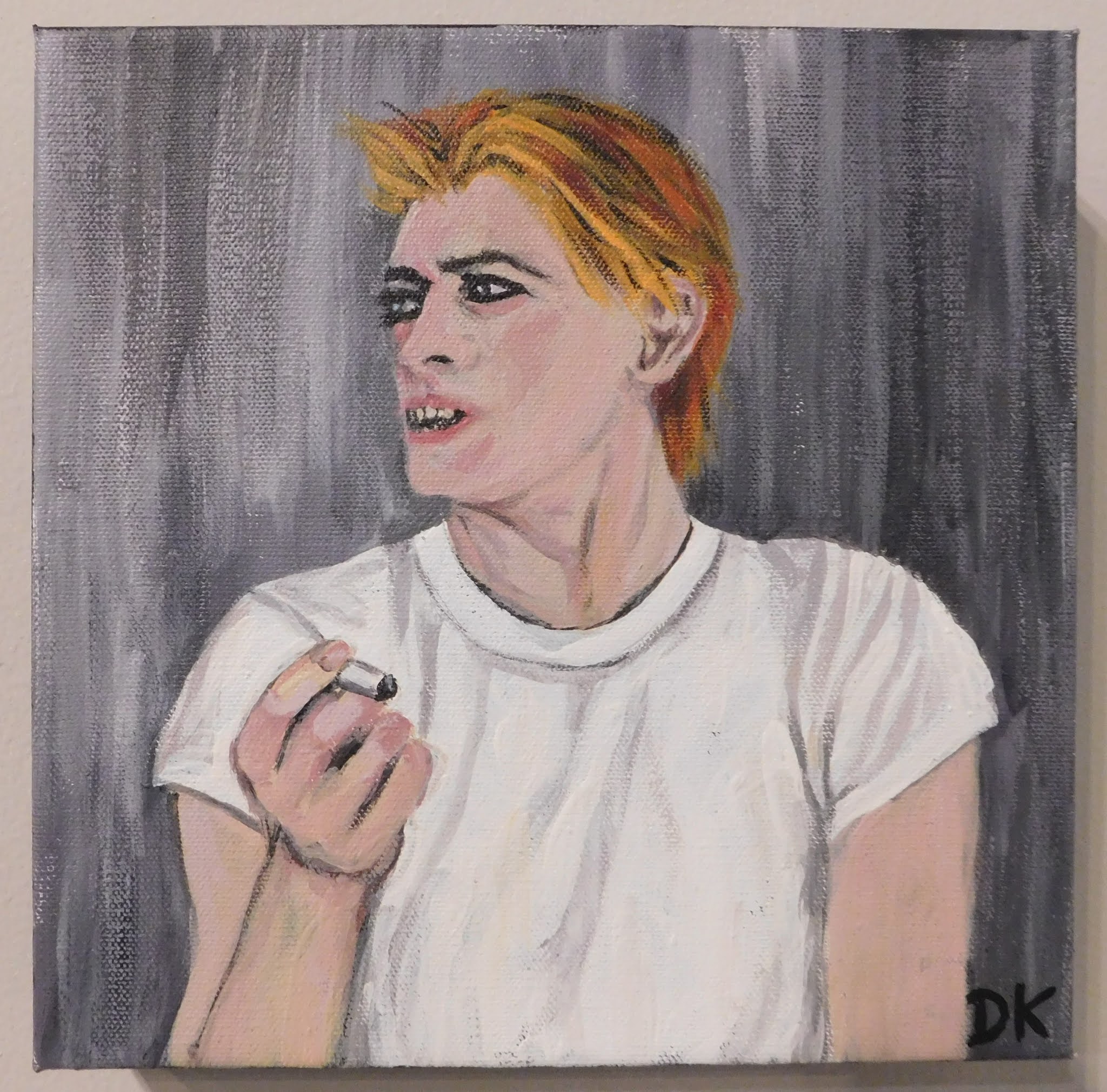
Smoke and Mirrors, acrylic, by Dan Kane

I'm Not Going to Talk About Judy, acrylic on wood, by Scot Phillips

The Life and Times of David Robert Jones, Hoard Couture jacket, by Judi Krew


Exhibit: Turn and Face the Strange – A Visual Celebration of David Bowie / at The Hub Art Factory / 336 6th St NW, downtown Canton, Ohio / curated by Dan Kane /

https://www.facebook.com/TheHubArtFactory/

Exhibiting artists: Steve Ehret, Kat Francis, Erin Mulligan, Tim Carmany, Heather Bullach, Marti Jones Dixon, David Sherrill, Judi Krew, Billy Ludwig, Tim Eakin, Erika Katherine, Jessica Bennett, Todd Bergert, Jake Mensinger, Rochelle Edwards Haas, Holly Buffy Atkinson, Scot Phillips, Alex Minturn, Alex Strader, Cody J. Martin, Dan Kane


    I offer my sincerest THANKS to Dan Kane for his passion and dedication in selecting the 21 area artists for this superb exhibit; to The Hub Art Factory for presenting it; and of course to the participating artists themselves. Collectively, they have succeeded in providing an adventurous remembrance of a profoundly important, complex and influential artist – David Bowie (b. Jan 8,1947 – d. Jan. 10, 2016).

   For those of you who missed the exciting opening on Friday night, April 3, there’ s another opportunity to see the show on Tuesday evening (April 6) from 7p.m. to 9p.m. (face coverings required). Or you can inquire about arranging another time to view the exhibit by e-mailing the gallery: thehubcanton@gmail.com

   Through a marvelous diversity of media, the artists in this show  transported me in an uncanny way, letting me feel again the electrifying pulse of Bowie’s artistry that shaped an era.

   Additionally, I leave you with the powerful words of New York Times music critic, Jon Pareles, excerpted here from his memorial article published the day after Bowie’s death. What an articulate assessment of a musical force!!!

“David Bowie, the infinitely changeable, fiercely forward-looking songwriter who taught generations of musicians about the power of drama, images and personas…”

“…Mr. Bowie wrote songs, above all, about being an outsider: an alien, a misfit, a sexual adventurer, a faraway astronaut. His music was always a mutable blend — rock, cabaret, jazz and what he called “plastic soul” — but it was suffused with genuine soul...”

“…Angst and apocalypse, media and paranoia, distance and yearning were among Mr. Bowie’s lifelong themes. So was a penchant for transgression coupled with a determination to push cult tastes toward the mainstream…”

“…Mr. Bowie was his generation’s standard-bearer for rock as theater: something constructed and inflated yet sincere in its artifice, saying more than naturalism could. With a voice that dipped down to baritone and leapt into falsetto, he was complexly androgynous, an explorer of human impulses that could not be quantified.”

   Here’s a link to the entire article:

https://www.nytimes.com/2016/01/12/arts/music/david-bowie-dies-at-69.html       

Wednesday, March 24, 2021

Rites of Renewal


Rites of Renewal 


By Tom Wachunas


“Man reading should be man intensely alive. The book should be a ball of light in one’s hand.” – Ezra Pound

“The unread story is not a story; it is little black marks on wood pulp. The reader, reading it, makes it live: a live thing, a story. —Ursula K. Le Guin

“The greatest part of a writer’s time is spent in reading, in order to write; a man will turn over half a library to make one book.”—Samuel Johnson

“You can make anything by writing.”  -C.S. Lewis  


   A curious phenomenon – this consciousness of inspiration in making art. Inspiration. An indwelling idea, an implanting of…what? A force? A truth? A spirit? A person? Inspiration for me is all of that.

    Most of my art of the past 20 years has been a response to Divine prompting - my response to a presence that pursues, reveals, counsels. That presence becomes all the more real when I read the Bible. The words therein are indeed a voice – his voice, the Creator’s voice - that holds me in its thrall just as a steady wind would fan the pulsing glow of embers from a fire. Inspiration.

   So from inspiration to realization. The making of something. An arrival. My most recent arrival is called Rites of Renewal, a mixed-media painting/drawing on a wood panel, 16” (h) x 12” (w).

   The piece is a convergence of multiple recollections and reflections. Among those is my memory of a homework assignment from my Catholic school days, requiring me to copy, in my very best penmanship, on unlined white paper, the complete biblical text of 1 Corinthians, chapter 13 (which the good Sister and her cohorts always called “The Love Chapter”). I can still recall having an uncanny sensation, though I didn’t then know exactly what to call it. Looking back, I know it was a key moment when reading and writing had joined to become for me a singular action, a potent rite of discovery and spiritual renewal. The words printed in my Bible, those “little black marks on wood pulp,” became a living form, and not just on paper. My very being had been imprinted.

   Further, I was fascinated to read that Pope Francis recently held an inter-religious prayer service near the the ancient Ziggurat at Ur, in Iraq. This sacred structure is a towering, stepped pyramid (though not a tomb; think of the biblical Tower of Babel story) dating back to the ancient Sumerian civilization (c. 2100 BCE), which was the first to evolve a writing system, pre-dating Egyptian hieroglyphs, called cuneiform. Not an alphabet per se, cuneiform is comprised of pictograms - symbolic drawings - of observable realities. Hence my inclusion of brown cuneiform marks – my homage to the beginnings of writing itself. They appear to mingle with my green handwriting of a passage from The Love Chapter (1 Corinthians 13:8-13). To read my imperfect scrawl, you would need to hold the painting up to a mirror. In lieu of that action, I offer it to you here:  

 …Love never fails. But where there are prophecies, they will cease; where there are tongues, they will be stilled; where there is knowledge, it will pass away.  For we know in part and we prophesy in part, but when perfection comes, the imperfect disappears.  When I was a child, I talked like a child, I thought like a child, I reasoned like a child. When I became a man, I put childish ways behind me.  Now we see but a poor reflection as in a mirror; then we shall see face to face. Now I know in part; then I shall know fully, even as I am fully known.  And now these three remain: faith, hope and love. But the greatest of these is love.

Wednesday, March 17, 2021

At the Corner of Hither and Yon


At the Corner of Hither and Yon 


Somewhere near Do Not Be Afraid

Somewhere on a Walk with Addie and Jon

Somewhere, Sunshine

Somewhere, after SOS

Somewhere Turning Twenty-Three

Somewhere I Almost Remember

By Tom Wachunas 

“You need to bring your awakening into city life. Bring it into fast-paced complexity where it thrives.”  - John de Ruiter

“The city is a fact in nature, like a cave, a run of mackerel or an ant-heap. But it is also a conscious work of art, and it holds within its communal framework many simpler and more personal forms of art. Mind takes form in the city; and in turn, urban forms condition mind.”  - Lewis Mumford

matrix (noun) - ˈmā-triks :  something within or from which something else originates, develops, or takes form.

EXHIBIT: Somewhere - paintings by Lizzi Aronhalt / curated by Alaska Thompson, at Vital Arts Gallery, 324 Cleveland Ave NW, downtown Canton, Ohio / Through April 24, 2021 – gallery hours are Thursday-Saturday, 6:00 p.m. – 10:00 p.m.  

From Vital Arts web page at https://www.facebook.com/VitalArtsGallery/  :

"As much as we feel we know a place, time passes, places change, and we as people do as well. Eventually those places are held in memories: sometimes with fading sweetness and sometimes with feelings of regret."

Lizzi Aronhalt's recent series of paintings "Somewhere," created during the covid-19 pandemic, explores the physical locations she has inhabited, whether for a few moments, many months or only in her imagination…

___________________________________________________________

   Lizzi Aronhalt’s acrylic cityscapes are bright and bold, luminous and loud.  Just as cities can be regarded as matrixes in flux, her painterly scenes are themselves matrixes - intriguing urban simulacra, both literal and abstract. These somewheres, if you will, are intersections of the tangible and the ephemeral, announcing themselves like so many neon signs flashing in the light of day.

   Made during this vexing time of scattered closures, lockdowns and “social distancing,” it’s interesting to notice what’s missing in these depictions of the urban milieu: people. For the most part, there’s a real scarcity of shoppers strolling by storefronts, or pedestrians crossing streets, or folks leaning out of apartment windows, or neighbors chatting on sidewalks and front stoops. So where are the essential social components of this matrix we call citizens?

   Here’s a thought: We have met the citizens, and they are us. Art viewers. In looking at these paintings, we become residents of the matrix. Aronhalt’s visions – whether memories of places she inhabited, visited, or simply imagined – aren’t about distancing or diminishment so much as they are immediate, in-your-face realities. These places aren’t disintegrating or fading away. With all their electrifying color dynamics, their exuberant rhythms of lines, marks and generously brushed shapes, they become our dwelling space, at least for the time we make to really see them.

   Stretch of your imagination a bit and try thinking of these pictures as having the heartbeat of a medicine woman, a healer. Or think of the artist as shaman and celebrant, practicing sympathetic magic. “If I paint where I dwell in this manner,” the healer thinks, “that place can remain alive.” And so can we.   

Thursday, March 4, 2021

Metamorphs


Metamorphs


Backwoods Escapade, by Justin Brennan

Untitled, by Andy Thomas

Untitled, by Andy Thomas

Untitled, by Andy Thomas

Untitled, by Andy Thomas

Pale in Comparison, by Justin Brennan

Misplaced Trust, by Justin Brennan

100 Miles per Hour, by Justin Brennan

By Tom Wachunas 

“All painting is an accident. But it's also not an accident, because one must select what part of the accident one chooses to preserve.” - Francis Bacon

“Clay is a very interesting and fundamental material: it's earth, it's water, and - with fire - it takes on form and life.”  - Rithy Panh 

EXHIBIT:  Figural Allusions - BY JUSTIN BRENNAN (PAINTINGS) AND ANDY THOMAS (CERAMICS) / at The Malone Art Gallery, located inside the east entrance of Malone University’s Johnson Center, 2600 Cleveland Ave, N.W., in Canton, Ohio /  THROUGH MARCH 30, 2021 / Gallery hours are Monday – Friday, 11 a.m. to 4 p.m., or by appointment.  The gallery is free and open to the public.  Face masks, social distancing, and limited occupancy (18-person maximum) are required.

https://www.malone.edu/gallery-and-exhibits/the-gallery/

   An intriguing tension permeates this gathering of abstract works by Cleveland-based painter Justin Brennan. There seems to be a deliberate bait-and-switch dynamic at work here. You might well imagine the painter initially setting out to make a portrait – a painting of, and/or about, a person. An expectation. But then, somewhere in the process, changes happen. A different narrative inserts itself, desired or not. Unexpected memories surface. Unplanned events or random circumstances alter the painter’s state of mind or heart. Pesky serendipity. Making a painting can often be a chance operation. Slowly, abruptly, or both, the painter arrives at a painting about… painting. Questions abound.

    These paintings are certainly departures from the conventional niceties of portraiture. They’re frenetic, ambiguous glimpses - interrupted moments of careful rendering. The disciplined act of making illusory likenesses of an actual person’s face has given way to unleashing all manner of tactile painterly marks and gestures. Brushed, piled, poured, slashed, scraped, or sprayed, the paint insists on telling its own story. Does this image depict a face emerging from behind a veil, or being erased? Does that one show a person coming into being, or fading away in rushes of smeared, dripping colors? A spirit of the unpredictable, the spontaneous and even the accidental prevails. It’s a dichotomous spirit, fraught with opposing energies. Yet here they are, coexistent in a fascinating if not quirky equipoise. Casual, playful, glib, disquieting, disarming. All at once. And lifelike after all.

   Technically, the untitled objects by Andy Thomas in this exhibit are clay vessels (i.e., hollow containers) that appear to be made of stone. Yet when considering how they subtly suggest the contoured form of the human body, we can also regard them as sculptures in-the-round. These vessels transcend a strictly utilitarian function of decorative receptacles.

   The fact of their hollowness is not to say that they’re empty. There’s a preternatural sense of something active inside them, as in a body. Something contained, yes, but also pushing forward, animating the tight, stony skins of the outer surfaces with elegant undulations and the nuanced look of muscles flexed or breathing.

    Whether intended by Andy Thomas or not, there’s an aura of the primeval about these ceramic abstractions, evoking an ancient narrative - the Genesis account of creation. You know… the story of the first human, made from the stuff of earth. Clay given a pulse.